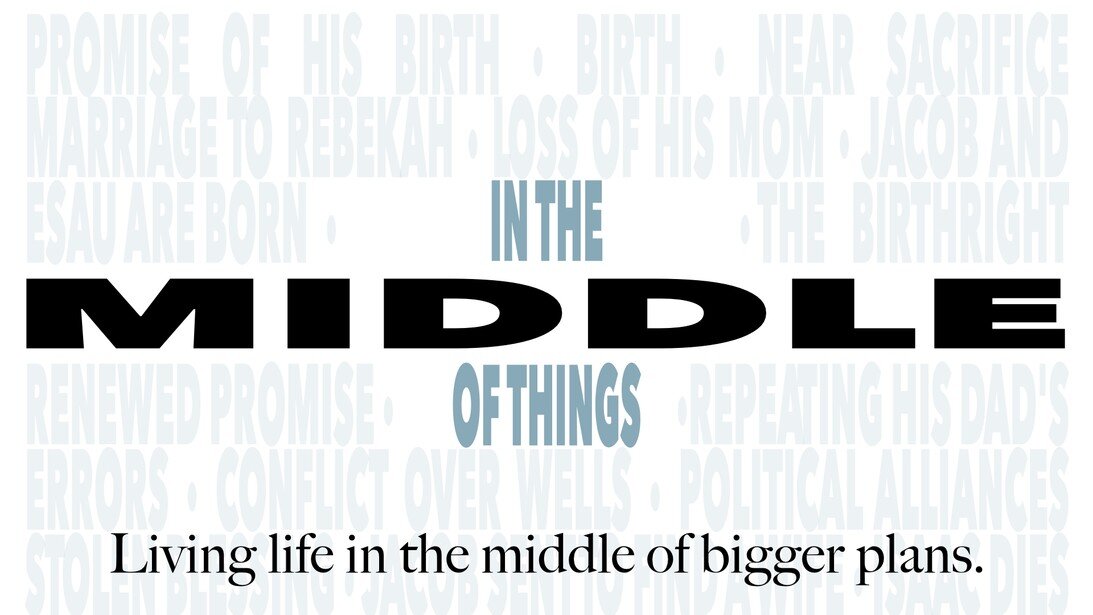
We instinctively read our circumstances as a verdict on where we stand with God—ease means favor, famine means failure. In Genesis 26, Isaac is stranded in exactly that famine, holding a promise that the land and its people seem to be disproving, and God’s answer to him isn’t immediate relief but something harder to trust.
The following study questions are AI generated and may contain errors.
The sermon argues that “circumstances don’t disprove God’s promise.” When have you been tempted to interpret your circumstances as a sign that you’re out of God’s favor—and what helped (or would help) you see that situation differently?
Isaac is told to stay in the famine rather than go to Egypt where food is available. What are the “Egypts” we’re tempted to run to when facing discomfort, and how do we discern between running away from God’s calling and wisely solving a real problem?
Jesus says to “take up your cross and follow me”—a call to be willing to die. How does that radical call challenge the way you normally think about what success or blessing looks like in your Christian life?
The preacher mentions that we should examine ourselves both when things are going well and when they’re going poorly. Why is it so much harder to examine ourselves when circumstances seem favorable?
What does it mean practically to “keep your eye on the city with foundations” rather than the city you can move into right now? How does that vision shape decisions you’re facing today?
This transcript has been automatically generated and may contain errors.
Well, it looks like people need some correction.” And so there was a pastor a few years ago, he went to his congregation, he felt like they needed to be encouraged to move closer to where God’s plan was, and he got pretty fiery about it. I mean, he got passionate about it. I watched a video of it, and he’s like right down, it was bigger than our space, so it’s a little bit more notable. I’m right, you know, we’re all right together as it is, but you know, he’s right in front of people, basically yelling at them, trying to correct them. I don’t think you’re ever going to see that here; that’s not our style. But I mean, passionate, passionate about it, right?
And you might say, well, it’s good to know that a pastor is so passionate about the well-being of his flock that he’s that emotional about it. Yes, yeah, he was really, really upset because he told them he wanted a designer watch, and they hadn’t bought it for him after a year and a half, and he felt he needed to correct them on that.
Now he outlined two things about this. First, that it didn’t speak well of how they viewed him, because he told them he wanted this designer watch. I didn’t recognize the brand, but in any case, it was an expensive, very nice watch. He told them, and they didn’t buy it for him, so they didn’t respect him, and also then he connected that by saying, “This is why you don’t have enough money, because you don’t have faith. You don’t have enough faith to give up your stuff from cheaper food to more expensive places to dine out. You’re not willing to give up that money to buy me this watch, and that’s why all of you are just poor losers, essentially.”
Well, as you can imagine, this didn’t go over very well. It went viral on the internet. He had to ultimately do a video apology. He claimed, if you understood the context, it wasn’t really the way it looked, but they thought about that while he was more overt. He was really just tapping something that we fall into over and over again, which is there should be some worldly success that points to the fact that I’m on the right track.
He saw that for the people, if they do what he thought they should do, well, then they would have success. If they were all having success, he should be wearing designer things. He should have a designer watch, because that meant they were successful. The spiritual health of the congregation was being manifested by the fact that he had this really expensive watch on.
As absurd as that sounds, we do the same thing. We may not go and berate people, hey, you didn’t buy me a designer watch, but we do look at our worldly status, our worldly success, and we say, how am I doing before God? Well, let’s see. Sometimes it’s the really bad times that bring that out, not when someone fails to buy us a designer watch, perhaps, but when things are just going terribly wrong, and we say, well, it must mean that I’m not in the right place with God.
And it is true that at times God does withhold blessing when He wants to correct us. He’s not going to necessarily encourage us into a path that isn’t where He wants us to be, but it’s not that mechanical. And the problem is, when we look at troubles and toils as a sign of our spiritual health, of our place in the middle of God’s plan, a lot of times we miss out, and we come in with the wrong attitude, and we get further and further off course until maybe one day we’re like that pastor where he’s gotten so far off because now understanding how God is working is tied to wearing some designer item rather than how close he is to God and how close the people in his church are drawing to God.
How do we understand when things are going wrong? How do we understand when things are going right? These are important questions to ask, but sometimes, sometimes when it’s going right, we just kind of move forward. We don’t think a whole lot about it, or we just say, oh, yeah, God likes me. It’s when it’s going wrong that we really have to see where our faith is. Am I able to hold on? Am I able to stay focused when things don’t look how I thought they should?
In this next part of Genesis, returning to Genesis 26 tonight, Isaac is in the middle of a famine. If you think about it, we’ve been talking about different situations Isaac’s going through. Now Isaac is going to find himself in a famine, and recall, so the promise was given to Abraham. Isaac has seen it working out kind of, sort of, although some things are a little disturbing, but now he, as the one who bears the promise, not only has to wonder, well, why don’t my sons get along? Why is it taking so long for God to bring about the promise that He has made for us?
Now he has to say, and God is now going to let us all die if we stay here in this land He brought us to. Is there something I need to do, or do I need to go find a different solution? It’s one thing to feel misdirected like we looked at last week, where it just seems like everything isn’t quite nice and neat like how we had hoped, but it’s a whole other thing when it’s outright bad. When it would seem like the things we might look for to indicate we’re on the right track are actually breaking apart.
And if you’ve been promised land, if you’ve been promised a people, and that land doesn’t produce food, and therefore the people that are going to be your descendants, they’re going to carry forth that promise, are going to die if something doesn’t change, it’s really easy to start to think, maybe I’m not really in the middle of God’s plan at all. But what we see time and time again in Scripture is that’s not how God works. Circumstances, the superficial circumstances of life, are not the key indicator of spiritual health. Circumstances don’t disprove God’s promise, and that’s what Isaac has to wrestle with.
Take a look at verses 1 and 2 of Genesis 26. It says,
“Now there was a famine in the land beside the former famine that was in the days of Abraham. And Isaac went to Gerar to Abimelech king of the Philistines. And the Lord appeared to him and said, ‘Do not go down to Egypt; dwell in the land of which I shall tell you.’”
That’s a hard call. God doesn’t say He’s going to take away the famine immediately; He just says not to go to Egypt. And Egypt represents a place where he could go and find food. And as we struggle in those places that something is missing, something is going wrong, and we think we see a promise, but we’re also pretty sure God’s calling us somewhere else, that’s where we’re really called to keep our eyes on Jesus and to walk in faith.
Let’s pray tonight that He would help us to do that in the situations of our lives. Let’s pray.
Father, as we seek to be faithful to You, it is hard. We’d like it to be so simple that material blessing and ease appears if we’re doing Your will and not if we’re not. And yet You tell us often that the path that You call us to is a hard path, calls to keep our eyes somewhere else. Yet the world values the things that our hearts want to value, and in that we find ourselves muddled and confused. Lord, would You redirect us, would You guide us that we might do what You’ve called us to do? To be faithful in the ways that You’ve called us to be faithful. We pray in Jesus’ name. Amen.
So circumstances don’t disprove God’s promise. That’s a tough one, because it would really, really be nice if circumstances could, if it were as simple as, oh, I have all the material blessing I could possibly want, I’m in God’s favor. Oh, things aren’t going right, I just need to correct, and then I’ll have God’s favor. But if God doesn’t do that for the patriarchs, He doesn’t do it for His people throughout Scripture. Yes, there are times He blesses them, but if that’s not the indicator of walking faithfully, then we shouldn’t expect it to be the way that we understand that we’re walking faithfully now.
And yet, while that pastor I mentioned was an extreme example, he isn’t the only example. How often do we hear Christians talking that way? “I’ve been being faithful and now God’s blessed me with a new job.” “I didn’t get the job, I wonder what I’ve done wrong, why is God angry at me, what do I need to correct?” Now it’s good to be circumspect, we should be looking into where is it that I might not be in accord with God’s will, but we should be doing that both when things are going really well and things are not going well, not one or the other.
Circumstances don’t disprove God’s plan, and that’s something I would imagine Isaac had to wrestle with here, because he knows that there’s this promise of land, this promise of descendants, and a famine represents everything that could take that away.
But how does God work over and over and over again in Scripture? Matthew 16, verse 24,
Isn’t it funny when you really think about it? I mean, there are so many Christians today, so many Christian teachers that have gathered large followings that say, if you just follow Jesus enough, things are going to go really easily, and what does Jesus say as he’s recruiting people, as he’s training people to follow him? He says, “Hey, why don’t you take up your execution device and follow me?”
You’ve turned taking up a cross into a cliché. “Oh, I gave up breakfast so I could show up at the Bible study. I’m taking up my cross and following Jesus.” But Jesus is saying, be willing to die to follow me. It’s not the most appealing recruiting effort, but it’s what Jesus says.
And I think, while it might not make a nice postcard or a viral TikTok, it does speak to the heart of God. The things of the world, including our own lives, are not what determines where we are and how we’re doing. That’s not what God is using to speak to us. God is speaking to us through His word; that’s where we look. When we’re trying to determine whether we’re in His will or not, we shouldn’t say, “Well, if this is working, I must be in His will; if it isn’t working, I’m not in His will.” We should be saying, does it fit with God’s promises, His plan that He’s said to us? Because that’s what determines how He’s working.
A lot of times, when we start looking for other measures to understand God’s plan, it’s just a great way to exit out of God’s plan and start chasing after other things. Because even if we say, “Well, I only want to see if there’s material blessings coming in because then I know that I’m doing the spiritual things that are good,” do you see what we’re doing? We’re taking our eyes off of Jesus and taking them onto the things that we think might be indicators from Jesus, but we know our hearts, those become the things. Jesus doesn’t want that; He calls us to focus on Him.
R.T. France quipped on this passage, “It’s not a mild asceticism.” What does he mean by that? I like that phrase, “not a mild asceticism,” because we’re pretty good at that. We’re pretty good at, “Oh, I’ll give up this meal and go do a Bible study; I’ll stay up late, talk to a friend,” and those might be good things to do, but when we do that, we’re not taking up our cross and following Him yet. It might be a step in that.
The road to Christian faithfulness isn’t built on only super dramatic, incredible moments where we’re standing up and saying, “Kill me for Jesus” or something. I mean, that’s not what it looks like, but what we should do is get to the point where if Jesus says, “I’m going to require even your life,” we say, “Yes, that’s what I want to do. I want to follow Jesus.” What He’s saying is, be so wholly committed to me that nothing else matters, that we are those with complete integrity in following Him, and in this life we’re not going to reach that, but that’s the goal.
And the problem when we’re looking for these other indicators, like that pastor was, well, I don’t know where he is today, heart-wise, I don’t know if generally speaking he’s been a very faithful follower of Christ and went way off the rails for a moment. I’m not trying to determine that; I’m specifically not mentioning his name because I don’t know his heart, but I can say in that moment I’m pretty certain he was more focused on how impressed people would be if he was wearing that designer watch than he was on if Jesus was pleased with what he was doing.
And it’s easy to point fingers at him, but how often am I doing that? Might not be a designer watch, but how often am I pleased when, say, I look on our social media channels and I see our views are up, and oh, God’s blessing us. I think that’s not a bad thing in and of itself. We want to reach more people. If no one’s actually hearing what we’re doing here, if the message isn’t getting out, that’s not good, but on the other hand, that’s not it either.
We just need to focus on Jesus, be faithful to Jesus. There might be success, but there are also people who have been incredibly faithful over time and have very little to show for it. God knows what He’s doing. Maybe that person influenced one person or two people. Maybe you have. You don’t even know it. It doesn’t always show up in big, grand ways.
Are we willing to give up our lives because we understand that we’re chasing something better?
I was reading about a man, a very wealthy man, who paid an exorbitant amount of money to go on a journey. Paid $200 million. How’s that sound to everybody? Anyone never paid $200 million to go anywhere? No. I can conclusively say, I don’t have to check my bank statement, I know I’ve never paid $200 million to go someplace. I’m pretty certain unless inflation gets totally out of control, I never will.
He paid 10% of his wealth. He has about $2 billion. He has a lot of money, but he paid about 10% of his wealth to go on a flight. The flight that he took didn’t serve all kinds of nice food. It didn’t take him to a beautiful tropical island or even majestic Alaskan glaciers. No Ozark glaciers. We have a problem if we have those.
It didn’t take him someplace grand and wonderful in those sorts of ways, comfortable and relaxing. It took him into a place that was incredibly hostile and in which he might have died. He paid $200 million for that.
Well, if you’ve been following the news this week, maybe you’re starting to piece together what I’m talking about. Jarek Isaacman, a founder of a technology company, paid $200 million so that SpaceX would send him and three other people he selected up into space. In fact, they went so far into space, they went further than any human being has since the end of the Apollo program. And then they did something else really amazing.
As a ship that was crewed purely by civilians, they had a spacewalk, the first ever civilian spacewalk. And two of the four people, including Isaacman, got out of the capsule and walked in space.
Now, walking in space isn’t like walking on a beach someplace. I mean, it’s not beautiful in that regard, and yet it’s awe-inspiring but incredibly dangerous. If something malfunctions, you die. If you go fly to Hawaii and you’re walking on the beach, you’re not going to die. But if you go and walk in space and anything goes wrong, you die.
So, why would you do it? It doesn’t seem like an indicator that his $200 million got him anyplace good, right? And yet it did. It did all kinds of amazing things. We can’t even imagine, any of us here, what it would be like to walk in space.
But more than just merely walking in space, he got to play a part in the step forward in exploring space by being the first civilian to ever step out of a spaceship and walk in space. It’s a step towards further space exploration.
And so, for him, I believe, from what I’ve read, it wasn’t merely, “Oh, wow, this is amazing, I get to play a part in getting to someplace better.” And I think that’s a really, really important thing that we lose sight of. It wasn’t merely the thing itself, because the thing itself, I can think of a lot of places people could go that would be a lot more comfortable, much more relaxing, and cost way less money. If you think it takes $200 million to get someplace really nice, you can donate it to Little Hills and Little Range Travel. No, you don’t need to do it, right?
And in the moment, it might seem like indications of success are really, really low because you’re in a hostile environment that might kill you. And he got to do it for a total of 10 minutes.
And yet, what was accomplished?
Incidentally, they landed safely this morning. And it’s just so awe-inspiring when you think about it.
But it takes being able to say, “Okay, I’m not looking for immediate comfort. I’m not looking for immediate success.” He didn’t get to fly to some faraway alien planet and see some civilization like in Star Trek. He got to walk out in space and not die.
And yet, he was keeping his eye on something better.
That’s a challenge for Isaac. Because in a way, he was kind of doing the same thing. Going into an alien land where the people around you would probably rather kill you, and now you’re in a famine that might kill you, and your kids can’t get along, and if they fight too much, that might kill you. Because God has said, I’m taking you someplace great.
It’s like stepping out of that capsule and saying, “Okay, God, I know you’ve said there’s something better. I can’t see it yet. I can’t feel it. I can’t experience it. I’m going to follow it.”
And that’s the challenge that each of us faces to greater or lesser degrees every single day as we choose whether we’re going to walk with Him.
We can’t do it on our own. That’s why, for example, when we have confession, we come before the Lord and ask for the Holy Spirit to give us strength. Because I do know about you. I do know about me. I know us as human beings. We can’t do it on our own. We fall short. But God doesn’t.
Hebrews 11:10 speaks of Isaac and his journey, and it says,
“For he was looking forward to the city that has foundations, whose designer and builder is God.”
Isaac isn’t looking at this land he’s in at the moment and saying, “Oh, this is risking dying and never having success and never feeling like my life amounted to anything. It’s totally worth it to live in this hostile land that wants to kill me.”
Now, what is Isaac doing? Isaac’s looking to the promise of God and what God has said He’s going to do ultimately and chasing after that.
And the key thing to do that, the key thing to live faithfully, is to understand that the Christian life isn’t about ease. We’re not chasing after the city that’s available right now. We’re chasing after the city that will be.
Not next year when some developer comes and develops a new plot of land, unless Jesus returns next year. I guess we could call Him a real estate developer ultimately, right? He’s going to rebuild the heavens and the earth. We’re going to talk more about that in Sunday school. God is going to redevelop. God is going to be the ultimate urban planner, you might say, but we’re chasing after Him and what He’s going to do and how He’s going to make things right.
Not after something we can experience right now. The world says, well, why not chase after something right now because it would be a whole lot more comfortable. Why not chase after what’s easy? Why not chase after what will make people just think the world of you? Why not chase after what makes everyone get along in the moment?
God says, step into the discomfort. Step into the uncertainty. Step into the fact that much of the world is going to hate you just as it hates Me. There’s something better coming.
Verse 3 of Genesis 26: God goes on and says to Isaac,
“Sojourn in this land, and I will be with you and will bless you. For to you and to your offspring I will give all these lands, and I will establish the oath that I swore to Abraham your father. I will multiply your offspring as the stars of heaven and will give to your offspring all these lands, and in your offspring all the nations of the earth shall be blessed. Because Abraham obeyed My voice and kept My charge, my commandments, my statutes, and my laws.”
So Isaac settled in Gerar. God doesn’t say, Isaac, I’m commissioning you now. You follow me. Famine’s over. He doesn’t say, Isaac, you’re going to follow me now and the people of this land are going to make you their king. He doesn’t say, Isaac, I’m going to build buildings around you and fortresses so you never have to worry again.
He says, do what I’m telling you to do, like your father did. Isaac has to keep his eye on something bigger than his immediate circumstance, and that’s what we find that we need to do too.
The bigger picture is what affirms God’s promise, not the immediate circumstance.
God, I want the immediate circumstance to affirm it. I want to know that You’re in this right now, and God says, I am in this right now, but not in the way you’re necessarily looking for.
You see, Isaac here is told to do a couple of things, and neither of them offer any sight of immediate relief.
First, he’s told not to go down to Egypt, and that is a place he could go, and if he went there, he would have food. Great solution. Rather than struggling in the middle of famine, go someplace where the famine isn’t. And we see that happen a number of different times in Scripture. At some point, God is actually going to encourage it to happen, but in this moment, Isaac is told to stay put.
Now, why is he told to stay put? God doesn’t say. I suspect it’s still because Isaac’s family is small enough that God knows if they’re in a land that has prosperity and success, that they’re going to chase after that land and its gods rather than following the Lord. If he goes down to Egypt and there’s success, and they say, we’ll give you all the food you want as long as you worship our gods, Isaac’s going to say, hmm, my tummy is really rumbly. I think I might do that.
God says, no, you’re going to stay right here. You’re not going to experience that immediate success, but I’m going to fulfill my promise to you.
Now, the second part of that that’s difficult that you see here is that word sojourn. Isaac is not only going to have to stay put, he’s going to be a sojourner. He’s going to be what we might call today an alien, a resident alien.
We have all this discussion today, is it appropriate to call someone an alien or not, because it’s not a comfortable thing. Why is it not a comfortable thing? Because we want to belong. We want to say that we have a place and it’s ours, and Isaac’s told, no, you’re going to stay that way. You’re not going to belong.
God doesn’t say, I’m going to make it so you belong here. God says, I’m going to call you to stay where you don’t belong. I’m going to leave you in the discomfort.
It’s not that it was more comfortable back then. It was that God said, that’s not what it’s about. It’s not about you, Isaac, feeling comfortable. It’s about you, Isaac, being faithful.
Immediate fixes would have been so appealing, though, wouldn’t they? He goes and pledges allegiance to the king of the land and says, make me a citizen, I’ll adopt your customs, and everything will be great, everything will be comfortable.
God doesn’t tell him to do that. I’ll go down to Egypt, everything will be great, everything will be comfortable. God doesn’t tell him to do that, because those are going to draw him away from what God wants him to be and to do.
And so often when we’re seeking, how can I put down roots? How can I be comfortable in this moment? How can I make sure everything is okay? The problem is we’re not chasing after God.
A lot of times God calls us to dwell in the discomfort. And if you are in a place of discomfort right now, it doesn’t mean that God is withholding His love and care for you.
And I think that’s something really important. Because the problem when we think about messages like we heard from that pastor is that we hear those, and then we assume, well, he has his designer watch on, so he must be loved by God.
But I’m just facing a bunch of bills, and I don’t even know how to pay them. I must be hated by God.
I’m trying to do everything I can, and it’s not working. I must be hated by God.
I can’t find a place where I feel stable and secure. I must be hated by God.
I can’t get a job that fulfills my sense of purpose and pays the bills. I must be hated by God.
Sometimes God wants us exactly in that place. He has a purpose in it. It doesn’t mean it’s all good.
I’m not saying we should seek to suffer intentionally. God never calls us to seek to suffer. He calls us to be willing to suffer. Other religions say, well, go ahead and torture yourself. Go ahead and make the gods love you. God doesn’t say that. He says, don’t make comfort. Don’t make security. Don’t make peace. Don’t make success. Don’t make power. Don’t make those things the thing that marks your place before Me, because then those things are the things that are gods to you rather than Me.
I like immediate fixes. I like them a lot. I remember years ago, I think it might have been when I was in kindergarten, and I believe it was my mom and my grandma, they came and picked me up, and there was this little antique shop or flea market or something we went into. I don’t remember where it was. It was somewhere out towards Cottleville or Darden Prairie, somewhere out that way, and I always loved commercial signage and such, and there was a little plastic exit sign. I liked it, and they got it for me, and we get in the car. I’m looking at the sign. I really liked the sign. I still have the sign, actually.
I’m looking at the sign, though, and the eye in the sign had a little bitty mark out of it. It bothered me. That’s not quite right. You could take a magic marker. It was a black background. Just go over it, and then it wouldn’t look like it was marked anymore. You just take off that little bit off the eye and just smooth it out, and then it’ll be good.
I wanted an immediate fix, so there was a magic marker in the car, and as we’re driving along, I’m trying to mark this out, and I do it once, and boom, you hit a bump in the road. Okay, now I have a mark again, and I did it again and again. Eventually got it, but by the time I did, instead of an eye with a itty-bitty little mark out of it, I had a very, very narrow eye. The rest of the letters are big and bold, and the eye is really narrow because I was trying to do the immediate fix.
If I just waited until we got home, maybe as a kindergartner I needed to wait until I had a little help too, but in any case, if I just waited, it would have been utterly imperceptible there was even a problem. You could have just fixed it with the slightest little line of black.
Instead, that sign forever is overly narrow on the eye because I just wanted that immediate fix.
I was looking at that sign the other day, and I thought, you know, in the grand scheme of things, that sign makes me really happy. It has a happy memory, and it’s been with me for decades now, but isn’t it a picture of what I do in so many places in life that I know there’s a little thing that isn’t quite right, and I’m right to think it isn’t quite right.
There was nothing wrong with trying to fix the sign. There’s nothing wrong with looking in the places where your life isn’t quite where it should be, where it needs to be corrected a little, smoothed out a little. We need to get aligned with God’s will and simply seek to make things work a little better.
It’s okay to be doing all that, but the problem is we go in and we take that blunt magic marker and we just start trying to cover it up, and we keep narrowing it and narrowing it and narrowing it and creating more and more of a mess.
The sign does look pretty good. I think it might have been either my mom or grandma that eventually helped me get that line smoothed out, but a lot of times when we’re trying to do those immediate fixes rather than allowing God to work, what we’re doing is we’re still having to darken a lot of area that doesn’t need to be darkened.
God’s saying, wait. Allow me to work. Yes, that’s a problem.
It’s okay to know that things are broken and to want to fix the things that are broken, but allow Him to work to do it. Notably here as God speaks to Isaac, Isaac has not just a little bitty chink on the sign. He’s facing the scary possible death of famine. God says, wait. Isaac, I know you have the magic marker. You can go to Egypt. You can leave this land, but I want you to stay here, and I want you to wait. I want you to trust.
It’s so hard to do, but God calls him to do it, and as He calls him to do it, He gives him a renewal of His promise. He reiterates what it is that He’s going to do with Isaac.
As we look at God’s word, notably since it says over and over again that the people who followed God faithfully, they do face suffering. They do face pain. As we look at the promises of God, we don’t see that those promises clearly are saying, things aren’t going right in your life. You clearly aren’t in God’s will and in God’s favor.
No, on the other hand, it says, if you’re following My calling for you, and you’re suffering in the midst of that, you’re suffering for Me.
We see the exact opposite, and it’s exactly what God is doing for Isaac.
God, every time we look at His word and we see His promises, He’s renewing that promise for us, and this amazing thing that we have here in His word says, look at the bigger picture. Look at the city with foundations that’s coming. Don’t look at the city that you can move into right now that’s going to shake and fall.
Isaac receives a promise that looks both forward and backward. It looks back to what God has already done with his father, and it speaks of what God’s going to do in the future.
And when we look at His word today, it does the same. We look back to Jesus’ faithfulness as He secured an inheritance for us, but He calls us then to know, because He’s done that, that we can look forward to the day that things will be made right, things will be good.
That feels often distant in this moment.
What’s Isaac’s response? Isaac’s response is he obeys.
Now, Isaac’s a human being, and we’re into next week. He doesn’t obey perfectly.
So to be very clear, this isn’t about perfect obedience. God is going to take you to a city with secure foundations as long as you obey perfectly, but boy, if you mess up! No, He’s just calling us to walk towards Him, to turn to Him, to ask Him to help us.
It’s okay to say, God, I can’t do this. I feel the irresistible urge to take that magic marker and start coloring in the spot that’s messed up. I can’t resist. God, give me the resistance. Dry up my magic markers. It’s okay to say that. It’s okay to ask God for the strength to resist.
God just wants us to keep our eye where it’s supposed to be.
Jerick Isaacman said something really profound, I thought, as he looked down on Earth. Can you imagine? Okay, I built up how dangerous and awful, and he spent $200 million to be in this hostile environment, but it has to be pretty amazing to be in that hostile environment and look down and see the Earth.
He said this, “Back at home we have a lot of work to do, but from here, it looks like a perfect world.”
And I thought about that for a second. I thought about it for a lot of seconds, actually. That phrase just kept bouncing through my head, and I thought, I don’t think he necessarily meant it as profoundly as it actually can be.
He says he doesn’t particularly have a religious faith that he practices. But at the same time as he looked at this world from a distance, he was seeing something that was speaking profoundly of what God is saying to us.
Because yes, we do have the problems, and those problems are real, and oftentimes those problems feel insurmountable, and often those problems cause great pain and turmoil and tribulation.
But if we can back up and look at the big picture, if we’re out in that hostile environment, but as we’re in that hostile environment, we’re seeing the beauty of what God’s going to do.
And if you’re up as an astronaut in space, you know that it’s not yet the time that everyone comes and looks down at the earth, but you can see what’s coming. You can see the future, where we’re moving towards with space exploration.
And likewise, as we look at God’s word, we get that big picture and we see, oh yes, the world, we have a lot of work to do. We have a lot of problems.
And here’s something that we know as Christians, that we’re not going to fix it all. Those problems aren’t going to go away until Jesus returns. But we have the big picture, and it’s even more beautiful than looking down at the earth from space.
Because as we look at this big picture, we see how much God loves us. We see His light. We see His care, His mercy. We see His compassion. We see how He is with us every step of the way, and we can see, yes, we have a lot of work to do down here. There’s a lot of brokenness down here. There’s a lot that’s unsatisfactory. Some of it will be resolved and some of it won’t, but we can see the picture of where we’re going.
That’s where God’s challenging each of us. Can we trust the trajectory that God promises and believe that it really is the trajectory? Can we look at it and say, I know there’s all these problems around me. I know there’s a lot of work to do, but I know where we’re going.
And so whether my part of doing that work, my part of faithfulness, ever really shows much fruit to me or not, if I’m staring down the things that scare me and frighten me and keep me up at night, can I look still at the big overall picture of God’s promise and say, but I see the pretty perfect thing, the absolutely perfect thing that’s ahead.
Because this world’s never going to be perfect. Our lives are never going to be perfect, but God’s plan for us in eternity, outside of this present moment, is perfect.
What Isaac had to do was look to a promise, to a measure that was so much greater than anything earthly he could come up with to measure by.
That’s what God’s calling us to do as well.
We’re trying to figure out if we have that designer watch or the clothes we want or the job we want or the success we want or the affluence and influence in this world that we want.
It might tell us a lot of things, but it doesn’t tell us if we’re on that track and we’re seeing that big overall picture.
But as we’re keeping our eyes on Jesus, we’re told the one thing that really matters, which is in this brokenness, in this hostile environment that wants to kill us, there’s something better coming.
God’s promise is so much bigger than anything this world can ever promise, much less provide.
Would you pray with me, please?
Lord, we come before You as those who are imperfect, as those who are often confused and scared and uncertain.
Lord, there’s so much that’s difficult and so much that’s uncomfortable, but Lord, You call us into the discomfort.
Would You make us people who are willing to be in the discomfort, instead of using it as a measure of our success before You, instead of seeking it because we think somehow it will make things right and color in the spots that are chipped away.
Lord, would You help us to focus on You, because the only thing that really measures success is where we are in relationship to You.
And the only way it can be in relationship to You is by the power of Your Holy Spirit.
So Lord, would You draw us nearer to You? Would You draw us nearer to You each and every day and empower us to do the work that You’ve called us to do? To be faithful, even when it feels like we’re facing the famines of life.
To understand that even when it feels like we’re forgotten, that in the middle of Your plan and in Your work, You are there with us.
We pray in Jesus’ precious name. Amen.
Start the Conversation