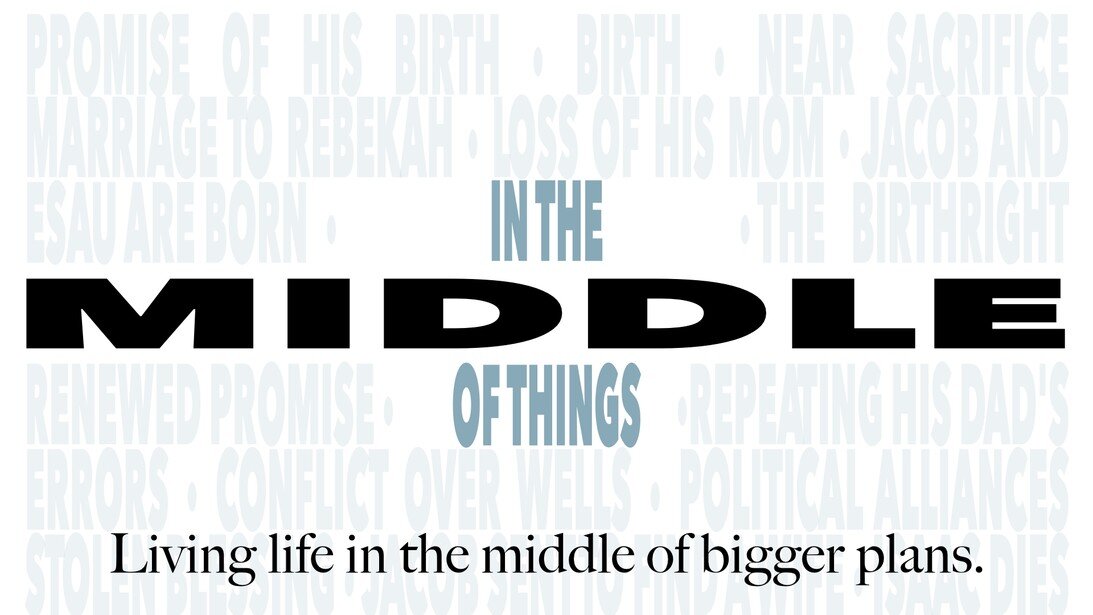
Gaps make us uneasy, so we fill them by hook or by crook—inventing tidy origins for old phrases or forcing plans into place. Genesis 27 opens on Isaac’s household doing the same around the blessing he means to give, each scrambling to close what feels unfinished.
The following study questions are AI generated and may contain errors.
The sermon mentions that we all try to “fill in the gaps” when we’re uncertain about how God’s promises will work out. What’s a gap in your own life right now—a promise you believe but can’t see how it will happen—and what temptation are you facing to “fill it in” yourself rather than wait on God to bring it about?
Isaac knew God’s word about which son would carry the promise yet still tried to redirect the blessing, and Rebecca, Jacob, and Esau each schemed in their own way as well. What makes it so tempting to treat a clear word from God as something we can improve or rearrange—and how does seeing all four characters contribute to the same destructive outcome illustrate the way our individual choices can ignite consequences that affect everyone around us?
Jacob was willing to invoke the Lord’s name itself to cover his deceit. When have you noticed yourself—or others—using spiritual-sounding language to justify a shortcut, and what does that reveal about the heart?
The sermon compares the family’s schemes to a single bullet that sparked a billion-dollar wildfire. Which “small” compromises in your own experience have produced outsized damage, and how does that reshape the way you view seemingly minor decisions?
Rebecca told Jacob that any curse would fall on her instead—and in a real sense it did: she lost her son and never saw him again. What does this suggest about the hidden costs of scheming, even when we think we’re helping or protecting someone we love?
Hebrews tells us that Isaac ultimately blessed both sons by faith and that our past failures do not negate God’s future blessing. How does that truth free you to stop scheming and simply trust the Lord with the gaps you still cannot close?
This transcript has been automatically generated and may contain errors.
Speaking of shedding light on the matter, one of the things I love to get some light shed on is where we get some of our words and phrases. It’s kind of interesting, isn’t it? The whole study behind the things that we say. How many of you know the phrase, “by hook or by crook”? Most of us, I’d say, and if you think about that phrase, what does it mean? Well, it means to do whatever is necessary, presumably including possibly unsavory means, to accomplish something.
Well, people over the years have wondered where that phrase came from. And apparently, unlike some phrases, it’s a little bit murky. We can find it going back to the 14th century. Actually, the earliest reference we have to it was from the Lollards, which were an early sort of proto-Reformation group before the Protestant Reformation, and they used that phrase in their tracts. But where did it actually originate from? What did it mean? Apparently, they knew that people would understand what it meant, so it clearly came before then.
Well, some people suggested King Charles I was the originator of the term, and he was the originator because he appointed two top justices that would weigh in on cases of deep concern to the country. And so if you had a matter in England that you needed to have solved, you would go to him. And he would refer you to either Justice Hook or Justice Crook, who would speak to the matter. Well, the only problem is Charles comes centuries after the phrase was first used, so that can’t be it.
Others have suggested it actually originated with King Henry II. We get to rewind a number of centuries there, and King Henry landed in Ireland, in Waterford Island, and he did so perhaps coming between the Bay of Crook and the Tower of Hook. If that were the case, arriving by hook or by crook meant that he was going to arrive in Ireland one way or another. Well, that’s a little more possible.
Others suggested maybe it was actually that same landing place but Oliver Cromwell. Well, once again, as much as you can find it, you’ll find it all over the internet. Cromwell comes after the Reformation and after the phrase first came into being, so it can’t be that. So where did it come from?
Well, perhaps one of the most appealing options was that it came from the idea that there were villages in England that had a common grazing land for cattle, and when it got cold, you’d need to go and harvest timber, and it was agreed that anyone could take a shepherd’s hook and take another device called a crook and cut whatever you could pull down with the crook. Is that it? Well, we don’t really know.
One thing, though, that’s been suggested is that actually in much of the English of the time, talking Middle English in the medieval period, hook and crook were synonymous with each other. So it may have been simply like we often use two words that mean the same thing. We don’t know.
But then as I was thinking about this phrase, what really started to go into my mind was how there were so many stories on where it came from. And ironically, a phrase that talks about we’ll use whatever means necessary to get to the place of explaining where it came from, they made up things oftentimes, things often that were wildly inaccurate, often hundreds of years away from when it actually occurred that this phrase came into our language, because they just wanted to fill in the gaps and have an explanation. And they weren’t weird for that because we love to fill in the gaps.
We don’t like having gaps in our lives. We don’t like having gaps in where we’re going. We don’t like to look at our lives and think, well, I know I’m supposed to arrive here, but I’m not sure how I’m going to get there. So we fill it in. And if we really think about this next story we’re coming to in Genesis, as we turn to chapter 27, the thing that strikes me is how everyone in this story is trying to fill it in. They have gaps. They have places they’re not quite comfortable with. And as they look at the situation, they try to figure out some way to bring it together in the way they think it’s supposed to come together.
Let’s go ahead and turn to Genesis chapter 27. And as we look at the first four verses, here’s what we read:
It says, “When Isaac was old and his eyes were dim so that he could not see, he called Esau, his older son, and said to him, ‘My son.’ And he answered him, ‘Here I am.’ He said, ‘Behold, I am old. I do not know the day of my death. Now then, take your weapons, your quiver and your bow, and go out to the field and hunt game for me. And prepare for me delicious food such as I love, and bring it to me so that I may eat, that my soul may bless you before you die.’”
Well, in some sense, that’s a very simple request and a very simple plan. It turns out to be very, very convoluted in how it plays out, just like oftentimes the things that we’re trying to fill in turn out to be far more convoluted, and often because of our efforts to fill it in, we are the ones that make it so convoluted.
So, as we come to this text, let’s pray that God would help us to think about those places we’re trying to fill in and the places we’re trying to sort everything out. Because those are often the places where we’re just going to make everything go wildly off course. Will you pray with me, please?
Father, we come before you as people who don’t like gaps. We want to understand everything. Sometimes we’re willing to explain it, even if we have to make something up to do it. That’s not just true of old words and phrases or other things that don’t really impact our actions right now. It’s often those very actions and what we do next. It’s often the very things that you’ve called us to do. We start filling in wildly without paying attention to your will, because we just want to know how everything comes together. Lord, would you help us to instead hear you, hear what you say, and follow your word. We pray in Jesus’ name. Amen.
So the story doesn’t end simply there. It could have, right? If everything were going according to the way it should go, Isaac makes the request. His son goes off, hunts some game, brings it back, cooks a nice meal. They sit down, have a meal together. Isaac offers his blessing, and then he dies, right? That’d be nice, straightforward, and simple. Isn’t that nice? Only that’s not how it goes.
There’s a number of complications here, and it involves the things that we’ve been looking at thus far in the story of Isaac. If you recall, a few weeks ago, when Esau and Jacob, Isaac’s two sons, were being born, there was a prophecy given from the Lord, and that prophecy, that plan for their lives, was that Jacob was the one that was to carry on the blessing, not Esau. But as we go through the story, we learn that while that’s true, Isaac preferred Esau. He resonated with Esau. Esau was his favorite son. He wasn’t just the elder brother. He was the one that was Isaac’s son.
And so Isaac says, well, let’s ignore that prophecy. That was a long time ago. Let’s just do it somehow differently. Let’s do it my way. And that might work if you’re Frank Sinatra singing a song, but it doesn’t work if you’re Isaac following God’s calling, and it doesn’t work for us if we’re following God’s calling either. But Isaac tries to make it work.
Now, the other question, and we don’t really know the answer to this, we’re not told, but it seems quite possible that Isaac also knows exactly the details of the bargain between Jacob and Esau years earlier. At some point in the past, when Jacob bought the birthright from Esau in exchange for some soup. And as foolish as that was, the way they did it, as we saw, was solemn enough that there could be no doubt. Esau really did sell his birthright.
We probably have examples in our own lives where we’ve done something foolish, and we want to say afterwards, that was just a joke. But if we’re really willing to look at the situation objectively, no matter how irreverent we were, no matter how much we weren’t taking it seriously, what we realize is that we really did go through with it. And Esau really went through with selling it.
So there are two different things at play here that are reasons why this should not happen. First, God said it wasn’t what was going to happen. And then Esau and Jacob actually play into that as Jacob buys the birthright from Esau. But here we are. Isaac’s getting older. And arguably, if we look at the text, Isaac may have been a little pessimistic here. It appears he may have lived quite a while after this time. But he fears he’s going to die, and he wants to make sure that he is going to get things arranged the way he wants them.
And Esau says, ah, great. Because Esau, whether he’s thought a lot about what happened in the past or not, certainly likes this arrangement a lot better. Wonderful. Now, there’s only a small little detail here that goes wrong with this plan. And that’s that Rebecca hears. And as much as Isaac favored Esau, Rebecca favored Jacob. And Rebecca says, this will not do. This will not do at all. We can’t have this.
So what are we going to do? Well, I’m going to trick my husband, and I’m going to involve my son in this deceit so that the son I want to have the blessing gets the blessing. That’s exactly what they do.
Now, Jacob, he could have been the fourth person in this play that says, wait a second here. What would be the God-pleasing thing to do? Well, that’s not what Jacob says. Verse 11: “But Jacob said to Rebecca, his mother, ‘Behold, my brother Esau is a hairy man, and I am a smooth man. Perhaps my father will feel me, and I shall seem to be mocking him and bring a curse upon myself and not a blessing.’”
So Jacob’s concern isn’t, is this the right thing to do? Is this the thing honoring my father to do? Is this the thing fulfilling even my calling? His concern is, my brother’s a lot hairier than I am, and I might get caught even though my dad is blind.
Now, Isaac may have resonated more with Esau, but here we actually see that the family tree is very nice and straight in their behavior because we’ve seen with the grandfather, Abraham, with Isaac, and now with Jacob, oftentimes what drives them is, am I going to get caught? And when we think about, for example, Isaac claiming that Rebecca, his wife, is actually his sister, the driving thing is, I don’t want to be killed. So it doesn’t matter if it’s right. It doesn’t matter if it’s wrong. It doesn’t matter if it insults Rebecca or hurts her or does anything. What matters is, am I going to live? And that’s really what we see here with Jacob as well. He’s learned well from his dad. What matters is, can I get away with it?
And notice how far Jacob’s willing to go in this. Verse 20: “But Isaac said to his son,” he’s talking to Jacob here but he doesn’t know that, “said to his son, how is it that you may have found it so quickly, my son?” He answered, “Because the Lord your God granted me success.”
So Rebecca’s plan is really quite simple. She already has meat available. They have flocks and so on. She can prepare a meal faster than Esau can go and get wild game. And she knows exactly how Isaac likes his food prepared. So even though it won’t be the wild game he requested, she can make it delicious. He’s going to love it. And she can hand that off to Jacob. And Jacob comes in, pretending to be Esau, wearing fur so that he feels hairier. And he can fool his dad and beat Esau because he didn’t have to go hunting for it.
Now Isaac may be blind and he may be old, but he’s not completely out of his senses. He says, how did you do the hunting so quickly? How did you find something to hunt, catch your prize, prepare the meat, cook the meat, and bring it to me that quickly? I kind of imagine Jacob’s pulse starts elevating here. He’s thinking, okay, we dealt with what if dad touches me and I don’t feel like Esau. We dealt with by wearing Esau’s clothes, he’s doing that as well. What if I don’t smell like Esau? But he didn’t deal with what if I’m too quick and my dad’s suspicious about how I could get here so quickly.
So what does he do? He says, the Lord has granted me success. He’s willing to blaspheme the Lord for the sake of covering up his plot. How did I do it? Well, God was with me. That’s how I was able to hunt so quickly. So we see that Jacob is willing to go as far as it takes to reach where he wants to go.
It’s actually that first recorded description we have of “by hook or by crook” because the way it was first used in our language, it was used of those who would use whatever means, whether it was resources or corruption, to gain office in the church. Those who wanted to be, say, a bishop. And they weren’t holy men. They weren’t dedicating their lives to the study of God’s Word and the preaching of the gospel and to serving God’s people. They just wanted a nice, cushy place to land.
And we saw that happen all over the place in the Middle Ages. Why? Because of the way the inheritance system worked. Oftentimes what would happen in most of the cultures of the time, the first son would get everything. But if you’re from a noble family, you didn’t want to go and become a beggar. So what families would often do to ensure that didn’t happen is before the eldest got everything, the other sons, well, you just grease a few palms and make sure they get high offices in the church so they can live like nobles still. Or get it by hook or by crook.
And if you think about it, what they were saying is, I don’t care if I come by this dishonestly. I don’t care if I’m using the very church of God to simply make my life comfortable. I just want my life to be comfortable. And that’s exactly what Jacob is saying here. I don’t care if I take the very God who’s given my family the promise, the only reason my family matters at all. I don’t care if I misuse His name. I just want to get through this process, receive that blessing, the blessing that’s of value because it’s tied to the promise, to not get caught.
And we look at that and we think, that scoundrel, that horrible, horrible man. And we can think that all the way until we reach that point where we’re really trying to get something. We’re really trying to accomplish something and it just isn’t coming together. And then we hear that little voice in our head say, you just bent a few rules. Just cut a few corners. No one would ever know. I think Jacob here is thinking, God isn’t really paying attention.
And this makes the story so much more believable than if I just say, well, I’m just a really good hunter, Dad. No, you’re giving me a blessing and the Lord, He’s blessed me because you’re giving me the blessing. It sounds so much more believable.
How often is it that we think, that doesn’t really do any real harm, right? What means are we willing to take?
Now, as I alluded to at the beginning, Isaac isn’t innocent in all this. Sometimes we look at him and think, this poor old man, he just wants to bless his favorite son. His wife turns against him. His other son turns against him.
But listen to what Isaac intended to do. What blessing he intended to give to Esau. He says, “Let people serve you and nations bow down to you. Be Lord over your brothers, and may your mother’s sons bow down to you. Curse be everyone who curses you and bless be everyone who blesses you.”
This is where commentators over the years have looked at this and said, it looks an awful lot like Isaac has that prophecy from the very birth of his children in mind. He hasn’t forgotten it at all. He says, I believe I can give the power of a blessing. And if I give that blessing clearly enough, and I say, anyone who curses you, they’re going to be cursed. Anyone who doesn’t bow down to you, that person’s going to suffer for it. I can invalidate that because then Jacob can’t rule over his brother. He can’t be the one that gets the promise. Because if he tries to actually execute the promise, if he tries to be the one who really carries on the covenant, he’ll be going against my blessing and he’s going to receive a curse from me.
And so Isaac here is trying to circumvent the very will of God. So now here we are. Rebecca’s scheming. Jacob’s scheming. And really so, so too is Isaac.
And notably here, another thing that kind of, if we really think about it, it takes away from that sentimental almost—I probably shouldn’t say the name of the brand, but you know the card shop that has the nice touching commercials—it takes away from that moment in this, right? Isaac doesn’t say, son, I don’t know how much hunger I have. Let’s just sit down together. I just want to bless you. And he says, hey son, I’m hungry. Let’s do a transaction here. How about this? My tummy wants some really good food. You know what kind of food I like best? You get that food for me, and I’m going to give you a blessing. That’s what he says.
And that just played out in the way that Isaac interacts during the whole process, because what does he do? He’s totally driven by his senses here, by his hunger, by his stomach, by his nose. He smells his son to figure out if he has the right son. His son touches him. It’s all very tactile and really goes to the sense that he’s really a man driven by his stomach.
Which incidentally maybe is part of the reason why he resonates so much with Esau, given that Esau is the man who will go down in history as the man who sold his very birthright for a bowl of soup. So they have that in common. Isaac sells a blessing for some food too.
But that brings us to Esau, and we need to remember that he’s out there scheming as well on this. Let’s look at verse 36.
Here’s Esau’s response to what happens. It says, “And he said,” notice what Esau is thinking here. He knows exactly what he did in the past with Jacob. He hasn’t forgotten it. You might want to write it off. Esau is hungry. He’s kind of a wild man that just goes out in the woods. He came back. He ran his mouth with Jacob. He doesn’t even remember it. But no, what do we know here? He knows that Jacob has the right to his birthright, that he sold it. Although, he doesn’t say, well, I made a transaction with Jacob. He says, Jacob cheated me out of it. He took it, and now he’s taking this blessing too.
And the remarkable thing when you actually think about that is Esau is basically saying, yes, I sold my inheritance, but I really wanted part of it. And now I’ve gotten tricked out of the part that I really didn’t have a right to, but I thought maybe I could still connive my way into even though Jacob really has rights to it.
We should feel more sorry for Esau if he didn’t reference the previous event, because then we could at least say maybe he forgot. Maybe he just is that driven by his own hungers and passions. He didn’t even think about it. But no, Esau is very acutely aware of what he has done. The only problem is he doesn’t allow himself any opportunity to actually be convicted by it. What does he do? He goes and plays the victim. Yes, I was so foolish as to sell everything that I was entitled to as the eldest son for a bowl of soup. Yes, I am that man, but how dare Jacob? What he did to me, and he did it to me again.
He’s not willing to actually understand the effect of his own actions. And I can’t blame him, because I don’t like to understand the effect of my actions most of the time either. It’s a lot nicer not to think about it, at least if they’re not positive results from those actions, right? Why can’t people just be more understanding? I’m not going to be understanding, but why can’t they be more understanding when I’m not going to be understanding? I’m not going to be understanding, but why can’t they be more understanding when I do things?
And it’s funny, because I look at our society, I’d say that’s pretty much, if we’re going to describe our society, that’s a great description of how our society operates today, isn’t it? Because it’s really hard to find anyone who doesn’t fall into this trap. It’s a very human thing. Now it’s elevated because we put everything out on social media, so we know everything, including the rash things that people say, the rash things we say. So now we can go back to it. We say, well, but why are you being so hard on me? I just want to be hard on those other people that say idiotic things, not me. Why are you holding me to that standard?
That’s basically what Esau’s saying here. Yeah, I tweeted out that I just want some soup, so anyone who brings me soup can have my birthright, but come on, I deleted that tweet five months ago. What’s the problem?
It appears so small, but it isn’t small. It speaks to Esau’s heart. It speaks to what he values and what he doesn’t value. And God cares about the small things that we think don’t really matter, and so in each different way we see these schemes, and in each different way we can imagine those doing that are—there’s something really wrong with my mic.
There’s something really that we can see there that—well, it’s funny. Actually, maybe we have an example here. It’s interesting, isn’t it? That we depend on this technology. It’s a little bitty thing, and it can be quite problematic at times, right? It decides to explode, and suddenly we have a screeching sound that goes through, or it decides not to turn on at all, and then those of you online are trying to read my lips and thinking this is horrible. Little things, right?
We understand if we really think about it the impact of little things, but when it’s actually our little things, we say, well, but that doesn’t matter.
I was reading about the fire, the Caldor Fire that took place in California a couple of years ago. I think it was two years ago. Three years ago now. And it was one of only two fires that are known to have crossed the Sierra Nevada range and gone on both sides of it.
Now, what’s sort of mind-boggling to me is they actually go back and they investigate this, and they figured out exactly where the fire originated. This fire destroyed 200,000 acres of land. It destroyed two-thirds of a community it went through. It destroyed $1.2 billion and took two months to extinguish. And this wildfire that did all that started when a father and son were out hunting and fired one bullet that happened to spark and ignite some wood. And it went from this itty-bitty little fire that was imperceptible, something that cost over a billion dollars, injured dozens of firefighters, and destroyed two-thirds of a community and beyond.
So small and yet so impactful. And that’s exactly what we see here. There’s these small little things, these little bitty schemes going on, and yet in these little schemes going on, there’s a giant payload that comes out.
We see a son turned against another son. He wants to ultimately murder his brother. Esau says, I’m going to kill him. I’m going to wait until dad’s dead because I love my dad and I know that would make him sad. So don’t tell dad. But then, enough with Jacob. We have a wife and her husband turned against each other. We have a man rebelling against the very prophecy he knows from the birth of his sons from the Lord. And then this covenant family, this family that represents God’s promise on earth, is torn apart.
It’s interesting. For as much as we hear from all four figures in the family throughout the story, they never actually are there together, and they never are going to be.
And Rebecca, who comes up with this scheme that sets this off, well, you might say, but it worked for her. She wanted her son Jacob to get the blessing. It worked for her. But notice what happens even for her. Her favorite son was Jacob. And so that she doesn’t lose her son to the murderous intent of her other son, she has to send him off. And he never returns during her lifetime. She wanted better things for her son Jacob, and in that she never gets to see her son again.
There’s a massive amount of destruction here. No one is spared from it. And as we return to where it ignites in these initial moments, it’s sort of telling. One of the things Rebecca says early on, Jacob says, well, what if I get caught? And Rebecca says, well, if you get caught, whatever curse comes down on you, let it come down on me. And in some very real sense, that’s exactly what happens. She’s not killed, but she loses what’s most important.
Take a look at verse 42: “But the words of Esau, her older son, were told to Rebecca. So she sent and called Jacob, her younger son, and said to him, ‘Behold, your brother Esau comforts himself about you by planning to kill you.’” And off he goes. And she’s able to arrange a format for that, a plan for that, that ends up working out okay for Jacob. But the result is still, he’s gone. He’s not murdered, but he’s gone.
And maybe as we look at our lives, we look back and we think, I feel like, not the exact details, but it’s sort of describing how I try to do things. Rebecca may have been thinking of the same promise that Isaac was thinking of and choosing to ignore, and she may have been saying, I know my stubborn, stiff-necked husband, he’s going to do whatever he wants, he’s going to ignore the fact that God said that Jacob’s going to get that promise, and so I am going to make sure that Jacob gets that promise. That may have been part of what was running through her head.
But in that, in that lack of trust that God was actually going to be the one to bring it about, there’s all this destruction. And I think many of us are in that sort of place where we think, I know what God’s saying, what He’s calling me to, where He wants me, I know that, I’m going to get there by whatever means possible, and we start to get partway there and we think, I’m not going to make it at all because I’ve just blown everything up. The forest is on fire, and there’s no extinguishing it. And our scheming’s stronger than God’s plan for us.
Well, one thing we find in this story is that the answer to that is clearly no. Notice what Isaac says in verse 33: “Then Isaac trembled very violently and said, ‘Who was it that then hunted game and brought it to me? And I ate it all before you came, and I have blessed him.’ Yes, and he shall be blessed.”
Isaac starts to realize what’s really happening here, and as he realizes what’s happening here, he says, I can’t believe it. I thought I had the perfect scheme. I thought I could bring it all together. And as he’s trembling there, I think that’s pouring through his brain: The Lord said this was going to happen. I tried to defeat it, and I couldn’t. And the only thing I can say now is, yes, that blessing is exactly where it’s going to be, and there’s nothing I can do about it.
I think in that, Isaac actually understands. And something that Isaac clearly understands in that moment is that God’s plans are stronger than our human frailty.
Hebrews chapter 12, verse 14 says, “Strive for peace with everyone, and for the holiness without which no one will see the Lord. See to it that no one fails to obtain the grace of God, that no root of bitterness springs up and causes trouble, and by it many become defiled. That no one is sexually immoral or unholy like Esau, who sold his birthright for a single meal. But you know that afterward, when he desired to inherit the blessing, he was rejected, for he found no chance to repent, though he sought it with tears.”
Esau understands something of the consequence of all this, too. But as he understands it, it’s too late. And in this, we see this mystery that’s woven throughout Scripture of how our responsibility comes and plays a role in God’s plans. Because while all these people were trying to take responsibility into their own hands and bring about their own schemes that were of God, their very attempts to do that, God took and put things exactly where He wanted them. Doesn’t mean those things were good.
Imagine if this family had just followed what the Lord had said from the get-go and just done it. And they just raised that family up, Isaac and Rebekah, knowing that Isaac had the promise, but that didn’t, excuse me, that Jacob had the promise, but that didn’t mean that Esau had to be cursed.
They didn’t do it. And in this, then, we see that wildfire, that explosion, that destruction that comes that didn’t have to happen. The plan gets to where it’s supposed to be, and actually, all that destruction is directing that plan to where it’s supposed to be, but it didn’t have to be that way.
I think that’s where we’re challenged. If you think about the Exodus, what does God say? He’s gonna take that hard-heartedness of Pharaoh, and He’s going to use it to show God’s glory, but there’s gonna be an awful lot of destruction.
And in our lives, if God’s redirecting us, sometimes as we’re resisting, as we’re scheming, as we’re running, we’re running just like Pharaoh, and the plagues are pouring into our lives, and God may very well direct us right where we’re supposed to be because of those things. We may end up exactly there and say, wow, how did I get here?
How much better when we simply turn, and we hear, and we act in accordance with God’s words? By the time Esau finally, finally recognizes what God’s doing, it’s too late. Scripture says, don’t turn to the Lord. Don’t trust in His promises before. Don’t trust when it’s too late. Trust before.
Hebrews 11:20 reflects also on this story. It’s woven throughout Hebrews, and it says, “By faith, Isaac invoked future blessings on Jacob and Esau.” And I think that’s a very—I’m trying, sorry.
Little things.
Turn off the microphone and sit down.
It’s…
It isn’t…
It isn’t.
I don’t think I’m… Am I on? Yeah, you’re on. Okay.
Let’s see here. I’ll be right back.
Check, check.
Check, check.
Check, check, check, check, check.
There we are. There we are. Let’s see if that works.
Okay.
You know, it’s funny. There’s a bunch of little settings, and we’re just gonna make the soundboard into a whole working metaphor tonight, because there’s a bunch of itty-bitty little things, and you change one of them, and it doesn’t do anything, but you put them all together, and it either works beautifully, or it doesn’t.
And…
Sometimes we don’t even understand why they all work together, but they do, unless you’re an audio engineer. I’m not.
Sometimes we act like we’re audio engineers in our lives. We think we know all the details. We start playing with all the settings, trying to tweak it, thinking, oh, that sounds pretty good. It works for a little bit, until it doesn’t.
But then what are we going to do? What do we see here? Isaac says, you know, I’ve been tweaking all the gauges, trying to adjust everything. I’ve been trying to do it all my life, and here I finally know.
And I love that Hebrews tells us this, because we’re not given a full insight into Isaac’s mind in Genesis, but later on, God reveals a little bit more, because I think He wants us to not despair.
Isaac finally does what? He trusts that the Lord is going to do what He said He’s going to do. And he trusts then that the blessing that he’s conveyed, including the weaker blessing that sounds pretty bad and puny in comparison to Esau, that these blessings are actually going to come about.
And so Isaac, it’s difficult and highly destructive, but Isaac doesn’t wait too long in his life. He turns and recognizes what the Lord’s doing. And so he’s able to then proceed by faith.
And what do we find? Indeed, God does bless both Jacob and Esau. Yes, Jacob is the one that’s going to carry the covenant promise. Jacob is the one who is the chosen one to do this, but Esau is going to be the father of a great nation as well.
Esau isn’t going to be wiped out. Esau isn’t going to just be killed at the hand of his brother. No, Esau is going to be the father of a nation too.
And so in this, Isaac, he’s bumbling, and he’s made a lot of mistakes, and he’s caused a lot of destruction because of those mistakes. But ultimately what happens, ultimately, God’s blessing comes through. His plan comes through. Isaac, in his bumbling nature, in his lack of trust, he doesn’t prevent God’s covenant promise from happening.
I like what one commentator said. I thought this was so good. He said, our past failures do not negate God’s future blessing. Sinfulness does not mean hopelessness.
And that’s the gospel there, friends. Because if we think we’re only going to be able to come to God and see His plans play out if we don’t bring any sin along with us, if we think we’re only going to be used by God if we have perfectly neat and tidy and exactly straight as an arrow backgrounds, that everything is exactly how it always should have been, and that now we are going to continue on that course, then we might as well all leave right now because none of us can say that.
But if we understand what Scripture tells us over and over again, that we are sinners, that we do bring an awful lot of dirt and darkness wherever we go, but God will take us from that place and use us. And if we trust in Him, what’s He going to do? He’s going to bless us. He is going to forgive us and give us the life that He promises us. That can’t be overcome by that.
That we see that whatever areas we’ve set fire to the woods around us, there is someone who can extinguish it. And the moment that Isaac stops trying to scheme, he can finally see what God is doing. And the moment that I stop, even if I’m going to start back up because unfortunately I know I’m going to, unless this is my very last moment, I’m going to go back into that. But the moment I stop, I can start to see the beauty of how God is bringing things together in spite of me.
And then we can react to that by saying, now because of that, God, use me more and help me to quit getting in the way of it, to quit leaving trails of destruction, but just use me straightforwardly because I want to serve You, God.
Sort of like if you’ve ever tried supergluing something.
Anyone?
Yeah, yeah, yeah, exactly.
If you know, you know.
Because you know that feeling: you drop something and you think, I like this mug too much to just throw it away. I’m going to glue it back together. And of course, I’m going to use super glue because that’s going to stick. So you pull it out and you have that little tube you start to put on. I’m not going to get any on my fingers this time. I’m not going to do it. You get it on and you start to hold it and then all of a sudden you think, but you know, I’m holding this and I know I haven’t touched it but my finger’s feeling a little stiff here.
Okay, I’m going to set this down for a moment. So you start to get, wait, no, now this finger is stuck on, right? And it can feel kind of hopeless because every time you try to fix it, it seems like there’s just, this glue multiplies. It’s like loaves and fishes except with glue and it just keeps on spreading and you think, if I don’t figure out a way to break this loop, I’m just going to be just a ball of glue by the time this is over with.
What do you need to do? You need to ask someone else to say, hey, can you help me here because I must have super glue on my fingers. I’m just gluing myself all over the place, right? And it’s only when we finally ask for some help that we can quit making things worse and worse.
And if there’s anything I think that we can see in the lives of these four individuals is that the opportunity is there to say, I’m just gluing things into terrible contortions. I’m not actually accomplishing what I thought I wanted to do.
But they have the opportunity to say, but I know that God is the one who’s going to do it. And the moment they do, and the moment they quit scheming, they can see what God’s doing.
We love to fill in those gaps because it feels comfortable in the moment, but then we’re all glued up. We love to fill in those gaps, but we’re really setting everything on fire as we do. Because we think that filling in the gaps is what’s going to fix it, but a gapless life isn’t what’s going to fix things. It’s a God-filled life.
And thankfully, that’s what Isaac sees at the end of his life. And may it be what each of us sees this very day. Would you pray with me, please?
Father, would you be with us and would you help us to do your will? Lord, we yearn to somehow glue everything together in the way that we think it should be. We make mistakes and we think, oh, it’s no big deal. I’ll just make a couple more adjustments. We keep tweaking and adjusting things, but we keep making a bigger and bigger problem.
Lord, would you help us to see instead your faithfulness time and again and again and to trust in you that we would be those that despite the failures of all of our scheming, would instead see your faithfulness. That we would turn to your faithful, loving, merciful will. And as we do, you’d help us to run from that scheming, from that destruction that we leave and run towards you and the healing that you bring. We pray in Jesus’ name. Amen.
Start the Conversation