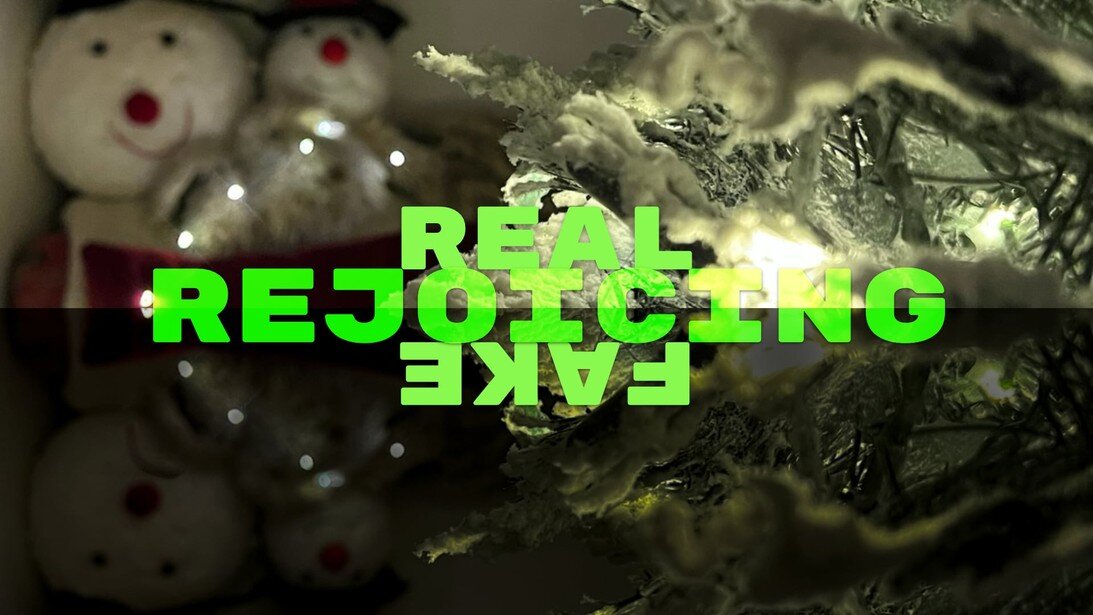
We’re always drawn to the new and the shiny. In Genesis 3, the serpent made the one tree God forbade look irresistable. Wouldn’t it be nice if everything we shouldn’t do just clearly didn’t look right?
The following study questions are AI generated and may contain errors.
The opening video shows an inverted, color-reversed image that is immediately recognizable as wrong—yet the sermon argues that real-life temptation rarely looks so obviously distorted. What practical habits or disciplines can help us develop the kind of discernment needed to recognize evil when it appears genuinely attractive?
The sermon contrasts Adam and Eve’s pursuit of the “new and shiny” forbidden fruit with Simeon’s patient trust in God’s enduring promise. In what ways do we see this same contrast playing out in our own lives or in the church today, and what does Simeon’s example teach us about what is truly fulfilling?
The pastor argues that the problem with sin isn’t necessarily that the “fruit” is intrinsically evil, but that taking it breaks our relationship with God. How does this perspective change the way we think about temptation and the choices we face—especially during a season filled with so many competing desires?
Genesis 3:15 is presented as the first promise of Christmas, spoken directly to Satan rather than to Adam and Eve. What does it mean that God’s initial declaration of redemption is framed as a defeat of evil rather than an immediate blessing to humanity, and how might this reshape the way we celebrate the season?
The sermon distinguishes between healthy newness that God may call us toward and the idolatry of chasing whatever is new and shiny. How can we practically evaluate whether something new in our lives—a job, a church, a habit, a tradition—aligns with God’s Word and draws us closer to him rather than away?
This transcript has been automatically generated and may contain errors.
December 6th, 7 p.m. in person and online.
Did you notice anything in the opening video? Did it look right at first? Well, what was wrong with it at first? What was wrong? It was upside down, yes. You just is disorienting almost, isn’t it? It’s not facing the right way. What else was wrong with it? Anything else? It was darker. Yeah, it was actually fully inverted, wasn’t it? Like it was x-ray filter, so it was like turning everything inverse. It didn’t look very pretty, did it? And so there were all kinds of festive Christmas things, but those festive Christmas things were not looking right. Wouldn’t it be nice if everything that we shouldn’t do just clearly didn’t look right? And everything we should do looked right? Right?
We moved onto the second half of that video and the colors come back and everything’s right side up and you have Christmas food and gifts and everything’s good, right? Wouldn’t it be nice if it were that obvious?
Here’s the challenge for us. It’s not nearly that obvious. In fact, a lot of times when we’re looking at what is good versus what is evil, we were being confronted with that earlier in our reading from Romans to separate good from evil and to do it in a way that God wants us to. A lot of times the evil looks really nice, and it’s good that does it. And so while intuitively, we see something like that, we say, well, that video’s wrong. It’s upside down unless we’re supposed to be sitting on the ceiling, and unless we’re using an x-ray machine, the colors aren’t right. We can see that.
Scripture’s going to challenge us to look deeper, more deeply within our own hearts and look with more discernment into the world because when we’re actually looking into the world and not a video, it’s not that clear most of the time. We know that there are things that are fake and things that are real, things that are good and things that are evil. But the reason we need Christmas? Because we do a really lousy job of discerning them.
That goes all the way back to the beginning. That’s where we’re going to start tonight. We’re going to start back at the beginning. Genesis chapter 3 if you want to turn there in your Bible or we’ll have it up on screen. And as we do, we’re going to be challenged because Adam and Eve, they’re in this beautiful place. Everything’s fresh and new. It looks sort of like, I bet it looked sort of like this. I kind of imagine, I don’t know, but…
Is there any time of the year that the world looks more beautiful than when Christmas lights are on? I don’t think so. So maybe the garden was sort of like a forest that was lit for Christmas. I don’t know. It would have been beautiful. It would have been just perfect. Everything’s fresh and new. There’s no death. Adam and Eve walk with God himself in the garden.
And what did they do? Well, they do that for a period of time. We’re not totally exactly how long in scripture they did that, but they do it for a period of time, and then… And then something goes wrong. And the serpent shows up. And we know from going further in scripture that serpent represents Satan, the devil, the forces of evil in the world. And the serpent says, God doesn’t want you to enjoy this place, does he? Yeah, it’s beautiful. Yes, you have everything you ever thought you could want. You can’t even dream up anything that you don’t have, but let me tell you, there are things that you don’t have, because in fact, God told you you couldn’t enjoy the garden, right?
So that to Eve and Eve says, well, no, not exactly. God said there was one treat. One tree that we aren’t to eat from, everything else, go for it, but there’s this one tree that we’re not. And the serpent says, well, hey. That tree looks pretty good. That tree is the new and shiny tree. Look at it. It’s the most beautiful tree in the garden.
We always are on the quest for the new and the shiny. I was thinking about that, driving back and forth to church, getting things ready this week and going down 94. There’s a shopping center with a number of different restaurants. And I know many of you like Ginghams, and Ginghams is there. So I mean, that’s basically the landmark of St. Charles, right? That’s there. Used to be Outback. It’s gone. Mexican restaurant. And for years, there was another one, Fazoli’s. Before there was a barbecue joint, but this little building on the end of the parking lot. Really nice inside, had beautiful windows, really nice dining area, just a lovely place, and it was a perfect place for an Italian restaurant, right?
Because it was really, if you were, maybe some of you went there after church sometime. And you go in there and you could see outside and you could see the traffic going by. It was nice. But the building probably was 30 plus years old, nothing wrong with it. You know, in the grand scheme of things, when you think about in the world, how many places have buildings that are hundreds and hundreds of years old. It wasn’t, it was a young building still as it were. But in the way that we think here in the United States, it was an old building.
And so a coffee shop decided to open. Fazoli’s closed, and so what did they do? They raised the building. There’s just a big area of dirt right now there where this building that was perfectly functional. It was perfectly nice, was torn down, and they’re going to put up a building that I don’t think is probably even as nice, but it’s new. And I presume if Fazoli’s closed, it was probably not doing all that well because it was old, it had been there forever. And the first few weeks that new place opens and it’s all new and shiny and the balloons are hanging in the windows and the now open banners in front of it, it’s going to be packed. You’ll have to wait forever probably to get coffee because it’s new and it’s shiny. We’re drawn to new and shiny things.
Is it better? Well, ultimately make anyone happier than Fazoli’s said. I don’t know. I do love coffee, I have to say, but it’s not really about that. It’s about us being new. And I think a lot of times when we tear things down and build new things, even if the new ones aren’t built to the same quality standards they used to build things, or you buy a new appliance and not built as reliably as the old ones. We’re drawn in though, because it’s new.
We’re often drawn into what’s empty. Satan’s a great deceiver, but he wants us to think he’s a great innovator. And so he’ll present things that look new and shiny, things that look attractive and pleasing, things that look like they’re going to make us happy. It says to Adam and Eve, you’ve been in such a rut. You have thousands of trees to eat from, but you know, they just get so old. There’s a new tree over there. See the now open sign in front of it? Go get in line there. You’ll be so much happier.
In fact, not only is it better than all the other trees, God’s just holding it back from you because he doesn’t want you to be as happy as he is. So just take from that tree. It’ll be good. Get drawn in.
Let’s pray that God, as we study his word tonight, would help us to see those places where we’re being drawn in, and see because he’s so faithful and his promise is so enduring, that he gives us the strength to turn away from that which is empty but shiny towards that which endures. Let’s pray.
Father, would you help us as we find ourselves attracted to those things that are new, those things that are shiny, ultimately those things that are hollow and empty, that you would instead turn us all the more towards yourself? Lord, too often we’re too weak to do it. We try and yet we find ourselves still online to help us turn away from all that is evil and hollow and ultimately unfulfilling and turn towards the things that you intend for us. We pray in Jesus’ name. Amen.
Let’s go ahead and turn to Genesis chapter 3. We’ll pick up there in that conversation that Eve is having with the serpent. And it says, when the woman saw that the tree was good for food, that was a delight to the eyes, and the tree was to be desired to make one wise, she took of its fruit and ate. She also gave some to her husband who was with her, and he ate. Then the eyes of both were opened, and they knew they were naked, and they sewed fig leaves together and made themselves loin cloths.
So, it doesn’t go as expected. Seems like it’s really promising. Seems like they’re getting in line for one of those stores where if you get in line and wait overnight until it opens, you get a year’s supply if you’re one of the first 100 customers. They’re going to get a lifetime supply of better fruit than what God intended to give them. Because this helpful serpent stopped by and pointed out to them. You know, yeah, the God of the universe is dwelling with them in the garden, but I mean, there’s a serpent here and he says there’s something better, of course.
And I say that sarcastically. Until I realize, but wait. How often did I read one thing in God’s word? It’s right here. Read it whenever you want. You pull it out on your phone and really read it whenever you want, have it here. And yet the new and shiny draws me away.
Even in the church. How often do we chase after the latest trend in the church, the latest hot new technique to teach the Bible, but somehow it doesn’t seem to spend very much time on the Bible? But it’s new and shiny. Or we leave one church because the next church has better sound system or better landscaping or better giveaways.
Not that everything new is evil. I’m not arguing for the Luddite gospel, but what we need to do is be discerning. And the flaw for us is not that we seek to explore and expand our knowledge and to better understand this world that God has made for us. The flaw for us is that as we do that we’re not constantly asking, but is it in line with God’s word? Sometimes God wants us someplace new. Maybe wants you to move someplace. Hopefully not those of you around here unless it’s in the general area. I don’t want you to move away. Now, if you’re a part of our online church family and part of the new that God wants is for you to move here to St. Louis, wonderful, that’s great. That sounds perfect.
But sometimes God wants us to move. Maybe he wants it’s a new job. Maybe he wants us to simply rework the way that we go about life and get a new routine. It could be all sorts of things. That doesn’t necessarily mean it’s bad. New is not bad in itself. The problem is when we chase after an idolatry of the new and the shiny.
The problem isn’t the fruit of the tree. The problem for Adam and Eve is that God has told them not to take it. I don’t think there was anything intrinsically good or bad about that tree. God chose to make that tree off limits to them. That’s all that really matters. Full stop. It doesn’t have to be that there was some kind of internal poison in the fruit. This is not a Disney cartoon eating a poisoned apple or something. This is simply, God said, you can have everything but this, and all they had to do was obey.
The poison is not in the fruit. The poison is in our hearts when we say, but I think I know better than God. I think I need what God has said I shouldn’t have. That’s what’s going to fulfill me. That’s what’s going to make me happy.
And maybe it’s a bit of a bitter irony when we think about the Christmas season and what we’ve turned it into that a lot of times we’re far more focused on what’s going to make me happy and fulfilled than what’s going to actually draw me closer to God. Now, if you’re here, I know that all of us are striving and seeking after what’s pleasing to God. You know, we fall into the same traps. We need to constantly guard ourselves and ask as we go about this season and every season of life, but this is a great time of preparation to say, okay, it’s really smack dab in front of me. There’s all this stuff going on. There’s all these different things that happen. There’s things that I want, there’s things that I know other people want. But what is it that God wants?
Imagine if Eve here, she looked at that fruit said, yeah, you know, that’s really pleasing. What is it that God wants? What does he want for me? See, the problem with the fruit is really simple. And check humanity away from the Lord. It created a separation. We see that in verse eight.
And they heard the sound of the Lord God walking in the garden, the cool of the day, and the man and his wife hid themselves from the presence of the Lord God among the trees of the garden. But the Lord God called to the man and said to him, Where are you? And he said, I heard the sound of you in the garden, and I was afraid because I was naked and I hid myself.
He said, who told you that you are naked? Have you eaten another tree of which I commanded you not to eat? The man said, the woman whom you gave to be with me, she gave me the fruit of the tree and I ate. And the Lord God said to the woman, what is it that you have done? And the woman said, the serpent deceived me and I ate.
Lord God said to the serpent, because you have done this, cursed are you above all livestock, and above all beasts of the field; on your belly you shall go, and dust you shall eat all the days of your life.
See, the problem isn’t the fruit is to break down the relationship. And we spend a lot of time. People have spent so much time trying to say, well, what was that fruit? What kind of fruit? What did it taste like? What did it do internally? What were those physical properties? How did it affect us? It doesn’t really matter. The key thing that matters is the fact that it’s the one thing that God said not to do.
I mean, think about it. There are a lot of things that God tells us not to do because there are a lot of ways in this broken world we can mess up and just throw everything off. They had one thing. Doesn’t that sound nice? Only one thing you—there’s only one way you can mess up. And yet, we’re human beings. If you give us one way to mess up, oh boy. Let’s see how we can do this.
Eve looks at the fruit and says, it’s beautiful. She thinks my life will be happier if I have this particular, beautiful fruit in my life. It’d be so much better if I taste this beautiful fruit because it has to taste delicious. I’m so tired of everything else on earth. That’s what’s going to fulfill me.
But what really matters? What really matters?
So much of what we chase after, so much of what we think is going to fulfill us only fulfills us for a moment. Like any of you love Black Friday shopping? Have any Black Friday shoppers? No. How about online, Black Friday shoppers? Yeah, okay, now we’re talking, right? That’s my, you know, introverted Black Friday shopping is great. Go on and watch lightning deals on Amazon. Yeah. Okay, it’s coming.
And you find that deal and wow, okay, got it. And then you get it. You think, okay. Is there anything else I can find? Right? Because it’s the pursuit of it. I know this is going to make me fulfilled but really, when you click the order button, it’s not that fulfilling in and of itself. And I say that as someone who is a bargain hunter, I love finding bargains.
But, so we’re like, okay. Did they really get the best deal? Yeah, now it’s going to arrive in several days. Now what? Not really that fulfilling.
And that’s so much of what we do with sin. We’re scrolling down the catalog of items we can buy in life, and we see that thing and there’s a little Satan’s choice logo above it, you know, store pick, Satan’s store. And we say, I know if I buy that, I’m going to feel fulfilled. The world says it’ll bring me happiness. Look at the 5 star reviews.
We don’t pay attention to is the fact that this customers about this also bought, and we see all the other things they keep buying because that sin only fulfills for a moment. It only seems to be okay for a moment. And moments are relatively speaking, maybe it provides happiness for a month or for a year, maybe even several years.
What about the span of our lives? What about eternity? Does it bring happiness? Does it break down warranties?
So often we’re scrolling in, we see that and we click on those things that have all the flashing colors and lights, and we miss the fact that there’s this little plain, unexciting looking, link on the side that says, God’s choice. You scroll by it. It’s not that exciting.
Because our question is, what’s exciting? What’s going to make me happy?
What God wants us to ask is what’s going to draw me closer to him.
Imagine if every Christian, a lot of people that celebrate Christmas and aren’t maybe more than culturally Christian, Christian at all, plenty of people who are very much not Christian. I saw the one joking the other day. Actually, it was William Shatner. He was on X writing about this and joking about being Jewish and making a Christmas album, which he has done incidentally. You can get the William Shatner, Shatner Claus Christmas album. It’s a lot of fun. Lots of people celebrate Christmas for all sorts of different reasons.
But imagine if every Christian, every Christian said, I want to celebrate Christmas this year with the framework, with the guide here, how I’m going to look at everything I do this next season. I want to do what draws me closer to God. That’s my goal.
Now, there’d be a problem, which is, as we do that, we’d find we start seeing those shiny things again. Shiny and new. Now open. Brand new. And we say, you know, God’s way is so old. I already tried it before. I want something different.
But imagine if we said, you know, I know every time I’ve tried it differently, I ultimately come up empty, I ultimately end up coming up empty. Whatever we chase after, success, power, appreciation, they come up empty.
I said, okay. Now, maybe God’s way isn’t an old dilapidated restaurant that should close down, maybe it’s that famed hole in the wall diner that lasts for centuries because everyone keeps going there. And soon it’s one of those, it’s like those medieval places you can go in England that have been open for hundreds and hundreds and hundreds of years, and people still go there not because it’s fresh and new and has brand new modern day decor, but precisely because it doesn’t, but it stood the test of time.
That’s what God’s word is.
We don’t get to walk in the garden with the Lord like Adam and Eve did, but you and I have his word written right here telling us that he’s with us right now. We can choose whether to chase the new and shiny or to hold on to what he has given us here. Are the things I’m doing, are the choices I’m making drawing me closer to him? Or away from him? That’s really, that would solve so much if we simply ask that this season, and then kept doing it in the new year.
Because, yeah, sometimes we’re not very discerning even at that and we should read his word and help his word, use his word to find those places where we think something’s going to draw us closer to him, but it’s actually drawing us away from him.
We absolutely should do that. But so often we don’t even get to that point. We just need to ask the question, does this seem to be, is the point of this to make myself well pleased in what I’m doing at the moment or is it to be closer to God and pleasing him?
Notice here’s an interesting contrast, I think. Eve, she’s never known death. Everything is fresh and new, and yet she’s still seeking after the new.
Contrast that to Simeon in Luke chapter 2. We read in verse 25. Now there was a man in Jerusalem whose name was Simeon. This man was righteous and devout, waiting for the consolation of Israel, and the Holy Spirit was upon him. It had been revealed to him by the Holy Spirit that he would not see death before he had seen the Lord’s Christ.
And he came in the spirit into the temple when the parents brought in the child Jesus to do for him according to the custom of the law. And he took him up in his arms and blessed God and said, Lord, now you are letting your servant depart in peace according to your word. For my eyes have seen your salvation, that you have prepared in the presence of all peoples, a light for the revelation to the Gentiles and for glory to your people Israel.
Think about the difference here. It was really striking me over the last few weeks. The story of Simeon and versus the story of Adam and Eve. Adam and Eve, they don’t know death. Everything’s good, everything’s new. Simeon, here’s an old man whose hope that he’s been hanging on to is that the Lord said, you’re not going to die until you see my salvation enter into the world.
And he sees Jesus and the Spirit says okay, here it is. And Simeon doesn’t say, oh no, now I’m going to face death. You’re going to say, oh, God, I couldn’t have done this sooner so I could have lived and seen the grandeur of this when I was able to enjoy it more. I’m old, I’m going to die soon now.
Let me and praises God because Simeon isn’t thinking about what’s going to be next in this moment for him. He realizes his life is transient and passing. What he sees, though, is that there’s something better ahead.
Eve sees the fruit in front of her and doesn’t think about the consequences of that in a relationship with the Lord. Simeon, well, he knows that death is coming for him. And ironically, in his case, it’s part of the promise. He isn’t going to be freed from death just yet in an earthly sense. He’ll experience it. And yet because of what God’s doing, he knows that there’s the eternity.
Everything isn’t so new and shiny for him. But trust in God’s faithfulness, it’s called the lasting promise.
Adam and Eve, they don’t even need the promise. They have God right there in front of them right in that moment before they eat of that fruit. But after they do, what does God do? Let’s go on to verse 15.
God says to the serpent, I will put enmity between you and the woman and between your offspring and her offspring. He shall bruise your head and you shall bruise his heel.
So Eve’s going to have a child who likes to step on snakes. Is that all there is to this? Oh, snake hunter? Sort of the first St. Patrick, except a little bit more violent? No, a little bit more than that.
You see in this picture here, God is speaking on a much bigger level. Here you have Eve, and he sang to Eve, you represent humanity. And to the serpent, you represent everything evil. And here’s what I want you both to hear. Evil is triumphing in this moment, but just as the happiness we chase over, chase after that involves doing what is evil and displeasing to God is transient and passing, so too is evil ultimately in itself, evil doesn’t get to stay.
And so in this moment, as he’s speaking to the snake instantly—this is something I’d never thought of until I was preparing for this sermon and reading some of the commentaries over it—I thought, you know, that’s kind of odd when you think about it. The very first promise of God’s redemption is given to the devil.
Yeah, Adam and Eve, they’re in earshot. They’re hearing it as well. It is genuinely for their benefit but he doesn’t say it directly to Eve. He doesn’t say it directly to Adam. He looks at the serpent. He looks at the devil and says, this is what I’m going to do.
And so we need to hear what he’s saying here in that light first, which is that he’s first telling Satan, you think you have the upper hand. Evil often thinks it has the upper hand. But you’re going to be totally defeated.
It actually starts earlier in verse 14. People have written in the past about serpents eating dust and I remember reading at some point someone saying, well the Bible doesn’t really understand anything about how the world works because if you actually pay any attention to snakes, snakes don’t eat dirt.
Ah, I’m also dumb. But the Bible here, God isn’t speaking of what the cuisine of the average snake in your yard is. He’s talking to Satan here.
What does it mean to eat dust? It means defeat. Satan’s face’s going to be face down in the dirt. He thinks he’s going to taste sweet victory, that he’s going to triumph, that he’s going to place himself in the place of God. He promised it to Adam and Eve, but he’s really looking out for himself. And when we look at people trying to lead us into evil, they’re looking out for themselves. And we chase after evil. We’re looking out for ourselves.
God gives us a promise. And he wants us to hold on to what he’s told Satan. Satan, you think you had the upper hand but you’re not going to win.
Kind of funny. You come in pretty lights, everything looks so festive. And you look at that and you think, oh Christmas is so beautiful and shiny. And you, Tim, you’re talking about how shiny things are bad. Well, not necessarily. I’m not saying that. I’d imagine all the fruit in the Garden of Eden was shiny and beautiful. It didn’t need to be polished. It was just nice. It was just wonderful. Weren’t any pest destroying it.
Someday everything will be beautiful. But in the process, it gets pretty ugly. And so it is the very first promise of Jesus coming into the world. Really the first promise of Christmas, what is it? It’s someone taking his foot and stomping on a snake. You know, maybe that’s what we should put up at Christmas time. Big banners with a foot stomping on a snake. That, because that’s the original promise of Christmas.
And as Eve hears this, she may not have fully understood what was being promised. You may not have fully been able to put it together, but here is the thing with that.
Eve was going to not directly defeat Satan, nor were her immediate descendants. But someday one of those descendants was going to come into the world and be more than just a descendant of hers. He’s going to be God himself. God incarnate in flesh in this world. And when he came into the world, he was going to do exactly what had been promised there. Not. Jesus didn’t go around and look for all the snakes in Israel and stomp on them. Nothing wrong with a garden snake. They’re perfectly fine. There’s nothing especially evil or wicked about the snakes we encounter. That’s not the point. The point was what it pointed to.
And just as Eve pointed to the fact that God was going to work through humanity to defeat evil, so too, all the descendants of evil from Satan, we’re going to face utter conquest and destruction. God acts because he’s the one who’s in control.
And so you can say this and mean it from the beginning. And notably, as he speaks to Satan, this he’s not saying Satan, there’s so much hope for you. Here it’s saying, I’m going to utterly defeat you. You will not triumph.
And so why does he do that? He does it for because this is about his rule and his reign. And when we sing of God’s glory and triumph at Christmas, we’re hitting on what God is actually doing here, that God draws us in for his glory, that Satan seeks to rule, but God is the one who does rule.
Listen to what the prophet Ezekiel says in Ezekiel 36. It says, but when they came to the nations, wherever they came, they profaned my holy name, and that people said to them, these are the people of the Lord, and yet they had to go out of his land. Speaking of the time of the exile after the people are so unfaithful to God.
But listen to how it goes on here. But I had concern for my holy name, which the house of Israel had profaned among the nations to which they came. Therefore, say to the house of Israel thus says the Lord God, it is not for your sake, O house of Israel, that I am about to act, but for the sake of my holy name, which you have profaned among the nations to which you came. And I will vindicate the holiness of my great name, which has been profaned among the nations, and which you have profaned among them. And the nations will know that I am the Lord declares the Lord God. When through you, I vindicate my holiness before their eyes.
Notice what God says here. I’m going to achieve victory because I’m holy, and the world’s going to know that.
And yes, when we’re unfaithful, when the church is unfaithful, and we’re not doing what he’s called us to do, when we’re not loving each other, and the world as he’s called us to do, when we’re not obeying his word, we are profaning his name. We talked about taking the name of the Lord in vain during our first half of the Ten Commandments series a few weeks ago. We take his name in vain every time we act in a way that’s displeasing to him. And the world sees it.
But God says, yes, you are unfaithful. But I have adopted you as my people. I have called you mine. And so guess what? I am going to restore you, so the world sees that even your own rejection of what I’ve called you to do, will not stop my plan.
I can say what he’s going to do to the serpent. He’s already determined not to allow his creation to lose sight of his glory and his grace.
And now the challenge is for us. Are we going to chase after the new and the shiny things this season and beyond? Or as we go into this time of preparation we’re going to say, God, even when other things look more exciting or more entertaining, yes, reading the Christmas story, it warms my heart, but it’d be so much more fun if I watched the latest Christmas movie. It’d be way more fun.
Yes, spending time with God’s people this season is nice, but maybe it’d be more enjoyable if I went to some really nice restaurants over the season and they have all their Christmas foods. And if I don’t have time to actually do churchy stuff, that’s okay, right?
Maybe it’s going into the new year and saying, yes, there’s another year ahead. But I have time. New year, the date of it isn’t in the Bible. And so just because it’s January 1st doesn’t mean anything. I’ll get around to God in July. I’ll say that’s my new year.
And just to be clear, there is nothing sacred about January first, but the point really is, today is the right day to say the stuff that draws me away from the Lord, I don’t need that as much as I need God.
I learned a bargain hunting lesson for my grandparents. They restored antiques. My grandpa could fix anything. I know some of you knew him and those of you that haven’t have to hear stories about this. But, I mean, he could fix anything. It was amazing, and he always knew just what to do.
And so they, in retirement, sold antiques. They were antique dealers. And they went around and looked for things that people thought were worthless or beyond repair and they would get them and they restore them and they sell them.
You know where they didn’t typically find that stuff? It was in the really bright, well lit, fancy prime real estate location antique mall. You go there and the prices, well, they’re high. Why? Because it’s the prime, well, easy to get too attracted to spend time in antique mall.
Where did you find the stuff? The real treasures. You found it driving down the road at the little flea market where the roof on one side is caving in a little bit, and you kind of have to step over stuff, and then you see under a shelf, there’s something underneath there that looks sort of intriguing, and you, oh, huh. You pull it out. And then you go haggle with the guy up front who’s listening to the radio and reading the newspaper and find a treasure.
Here’s the thing that we miss when we’re dealing with God’s word. We think it’s going to be like the video at the beginning, where clearly the good is the stuff that’s fully colored and right side up, and it’s in the well lit beautiful mall. But Satan loves to open malls. Satan loves to open brand new strip malls that they have big bright signs and great parking and convenient access to everything. He loves to hook up his sin store to broadband of the best sort so that we can access it at full speed and stream all kinds of videos on how tos on how to do it and it’s just great and easy.
We drive right by a little store that says salvation for all mankind. Because God doesn’t play those games. Game humbly. You entered into this world humbly. Tells us to seek after the humble king. Not after all the flashiness.
And if that’s true, it says something about the season as we’re going into. Maybe you go into the season, you don’t feel very Christmasy. You feel actually a great deal of despair because things have not gone how you hope this year. Maybe your health is a question mark or your job. Or you did have a rough go at Thanksgiving and did not go smoothly. And then you’re dreading what comes over the next month.
God’s in the dirt with us. We look at this present moment, dirt, and we think this means defeat. And we miss the fact that the true dirt of defeat is ahead. Yes, the serpent will eat dirt and he will have his head crushed. In this moment, though, Jesus comes while we are the ones feeling crushed. We’re feeling defeated.
What happened that first Christmas morning is that he came into the world and he got down in that dirt that really belongs to everything evil. And he got down into it and said, it’s okay that you didn’t—you don’t have a beautiful shopping center for me to be in. It’s okay that everything isn’t bright and easy access. I’ll come into a manger. In fact, that’s the way I’m going to plan it. And I’ll suffer this in this life because I’m going to walk right step by step with you, whatever dirt you’re in right now.
Don’t look for the shiny fruit that somehow is going to make it all better, because you know what? You grab that shiny fruit and it’s just going to get all dirty and dusty right with the dirt that we’re in. But God offers a hand out of it as he steps into it with us. He says I’ll pull you out.
It was quiet. God’s promises can be quiet. But he can make a promise at the beginning of time that would be fulfilled throughout all time. That promise endures. And his promises can be quiet. May we know in this season that his quietness is mighty.
Would you pray with me, please?
Lord, we do pray that you would help us in this time to truly understand what you were doing. Lord, a lot of times we get so distracted. Ironically, by the celebrations of Christmas that we miss the quietness and the dirtiness and the ugliness of this broken world that you’re willing to step into and how you are willing to step into that ugliness.
And yes, salvation doesn’t look often shiny and beautiful, but it looks downright ugly and unpleasant, and yet you come into that, not deserving it. But doing it out of your love.
Would you help us to trust in you because your promises do endure, and that you are the God who deserves not a drop of dirt and yet we’re willing to come into that dirt to draw us out of it.
We pray in Jesus’ name. Amen.
Thank you, Chris.
Start the Conversation