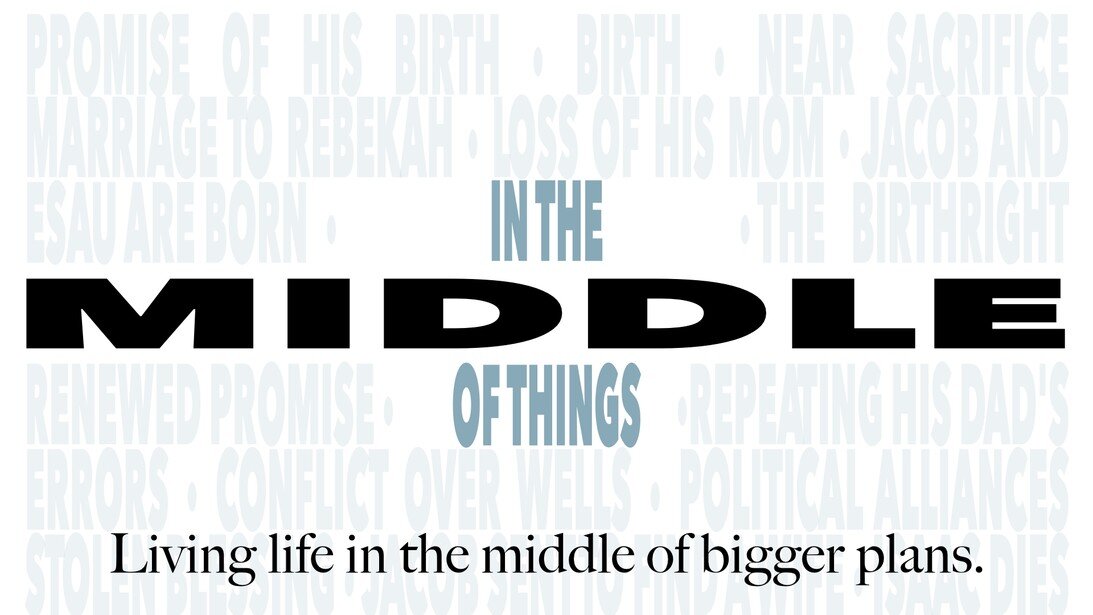
Family conflict. Our attempts to force a good outcome. So often our all too human messes and efforts leave life looking like a train wreck that gives sin the final word. Yet Genesis 35 closes Isaac’s story by calling him “old and full of days” and placing his divided sons together at his burial. Maybe even our broken lives still have hope of being full?
The following study questions are AI generated and may contain errors.
This transcript has been automatically generated and may contain errors.
Well, we’ve been on a bit of a journey to explore the life of Isaac, and tonight is going to be an uplifting night because we’re going to talk about Isaac dying. Everyone ready to just feel uplifted by the death of one of the patriarchs? Now, I admit that sounds kind of silly or weird, but actually, there’s reason for it. I’m not just being weird, even though I know that’s part of who I am—I mean, you’re all used to that—but it’s more than that.
But first, how many of you have watched House Hunters? The famous HGTV program, right? I mean, is there a program that is more quintessentially HGTV than House Hunters? I’m not sure that there is. The concept is the same in every single episode, whether it’s just the original classic edition House Hunters, House Hunters International, House Hunters Mansions—I think they have all these different House Hunters. Whatever one you happen to watch, the concept is the same.
The people are going to go. They’re probably going to have jobs that sound like they don’t pay very much, and they’re going to have a massive budget. I mean, that’s just part of it, right? They’re going to say, “You know, we both work minimum wage jobs, and we can only spend a million dollars on this house.” You know, that’s going to be part of it. But anyway, they’re going to have their budget, they’re going to talk a little bit about themselves, and then they are going to go to three houses. They’re going to have a dramatic decision to make, and they’re going to buy one of those houses, and then at the end, you get to see them all moved in and comfortable.
Well, a few years ago, it came out—someone who had been through it went ahead and revealed the process of going through House Hunters. That House Hunters, I hope this doesn’t ruin it for anybody, typically films the show after the couple has already bought the house. How does that work? Well, what they do is they find someone who’s looking for a house, you sign up, you go ahead and buy your house, then they bring in a moving team, move all the couple’s furniture out of the house, make it look like it’s for sale, take several of the other houses they looked at or similar houses, they look at those houses, they film it all, they try to reenact something like what they did but probably a little bit more dramatic, and they’re told how to heighten the drama and so on. Then at the end, they move the family’s furniture all back into the house, and they show the three months later or six months later or whatever it is scene. That’s what they do.
Now, why would they do that? Why go through all the work of moving the furniture in and out? Why would you take away the drama of actually following real people buying a real house? Well, so they know that’s going to make good television. They want to make sure that the people actually decide they want to buy the house and don’t say, you know, in retrospect, “Our house is really nice,” or “We really like our apartment. We don’t want to have to pay a million on this new mortgage.” Maybe dog-walking doesn’t pay for a two million dollar beachside resort house in California. You know, strange things happen sometimes. They want to make sure it’s actually going to happen, and they want to make sure they can tie it all together and make it a package into a 30-minute show so that you can tune in and you’re entertained.
Because what do you know if you’re shopping for a house? What do you know if you’re shopping for some big purchase? There’s often a lot of really boring periods in the process, right? Those times where you think, “You’re interested,” and then you wait for approval from the bank. You’re interested in it, but you have to wait for inspection, or you’re waiting for when the house actually goes on the market, or you’re waiting to get everything packed up and moved, or there are contingencies or this and that—and that doesn’t make good television. So, skip to the end, make sure it’s okay.
And this wasn’t someone just making this up. Actually, after this came out, the production company did admit that while they were portraying accurate experiences of purchasing houses, they did have to reconstruct parts of it. You ever wondered how they could always have the camera on the people when the real estate agent calls with the good news? Well, now we know why.
When we look at a life, it’s often hard to tell where it’s going, and if you take just a snippet of it, we don’t necessarily know where it’s going. We think about the life of Isaac that we’ve been going through these past weeks; there are a lot of moments in it where it looks like a complete train wreck. And if we had to live the span of time that Isaac lives to see where it’s going, we could watch it for a great deal of time and then give up, turn off the television. I’m not going to watch a hundred and something years worth of the life of Isaac. It’s just not that interesting to me—I’m going to go back to House Hunters at least they’ll buy their house in 30 minutes.
But in some sense, we have the benefit of being able to do a House Hunters approach as we look at the life of a biblical figure because it’s already written down for us. And so we spread out a little longer than House Hunters, but over these past few weeks, we’ve looked at the life of Isaac, and now we get to see what happens in the end. Does he get to move into the house? And how does all the furniture look in it? And while it is sad because we’re talking about death, I’d encourage us not to dwell so much on “Oh, Isaac died,” but rather the implications of that tonight.
Because it looks for an awful lot of Isaac’s life like sin gets the final story. It gets to tell the tale. That’s not the case. It doesn’t need to be the case in our lives either.
Let’s pray and ask God to help us to see the hope and the truth we find in the death of Isaac and then see how that hope speaks to our lives as well. We pray with me, please.
Lord, we do pray that you would help us, that you would direct us to see more clearly the bigger picture of what you’re doing; that a lot of times we’re sitting in the real life, unreconstructed, unabridged experience, and it feels like sin is going to win, that the house is never going to get purchased. Father, would you help us to see what you were doing, that we would have hope, that we would see a glimpse, and indeed, you show us those glimpses in your word—that we would see a glimpse right now as we await, and in that be strengthened to do what you have called each and every one of us to do. We pray in Jesus’ name, Amen.
So what’s Isaac’s final story? How do we wrap up his life? There are two things I think we can draw from the end of Isaac’s life. The first is that he actually lives a full life.
There’s a lot that’s going wrong. It starts before he’s born, with attempts to figure out God’s plan that his parents embark on that don’t go well. It leads into conflict as he’s born. It then leads to him being sacrificed by his dad. Has anyone here been set up for almost child sacrifice by your parents? Anyone? Oh, Levin has? Okay, well, so glad you made it. But generally, that doesn’t happen. He’s gone through a lot.
And then he gets to adulthood, he gets married, he has kids, and there’s conflict from the moment they’re going to be born, and that conflict runs out. One brother wants to kill the other brother. It’s a life that feels like sin is constantly just powering over it. How can we say that Isaac lives a full life?
Let’s take a look at verse 27 of chapter 35:
“And Jacob came to his father Isaac at Mamre, or Kiriath Arba, that is Hebron, where Abraham and Isaac had sojourned. Now the days of Isaac were 180 years, and Isaac breathed his last and he died and was gathered to his people old and full of days; and his sons Esau and Jacob buried him.”
Notice that phrase “old and full of days.” It might vary a little bit from translation to translation, but you probably have something like that if you look in your Bible. That phrase isn’t just saying he wouldn’t kick the bucket for the longest time. Not what to say—what it’s saying is that he had a complete life, a full life. Might go so far as to say a happy life.
How can that be? There’s an awful lot of Isaac’s story that looks like it’s not going that way. How can it be that Isaac has a long and happy life when so much is broken around him and in him? Let’s take a look at some of what’s happening in the background here. We’re jumping over some of this to the end because it doesn’t deal directly with Isaac; it deals with his sons, but it’s important to have that in mind as we think about the end of Isaac’s life.
Genesis 28:15. Here’s what the Lord says to Jacob:
“Behold, I am with you and will keep you wherever you go, and will bring you back to this land, for I will not leave you until I have done what I have promised you.”
Jacob shortly thereafter vows to the Lord. Because then Jacob made a vow, saying, “If God will be with me and will keep me in this way that I go and will give me bread to eat and clothing to wear, so that I can come again to my father’s house in peace, then the Lord shall be my God.”
Let’s jump a little further along here. This is actually after Isaac’s death. Esau and Jacob are not going to dwell in the exact same spot, but why not? Because their possessions were too great for them to dwell together. The land of their sojournings could not support them because of their livestock.
So as Isaac watches what’s happening with his sons, you see several really important things. And the first one of those is that they come back together. Jacob returns. Jacob’s been in exile for a very long time, and Jacob would be dead and unable to return had he stayed because Esau had murder in his eyes. He was ready to eliminate his brother.
But the Lord promised that he would return, Jacob. He told that to Jacob. Jacob made a vow to the Lord—you have that scene there. What happens? God does it. Jacob returns. And he returns in a way that isn’t Jacob and Esau warring against each other.
We can see this very clearly at the end of this passage we’re looking at right now. The sons are restored. Listen to this again:
“Now the days of Isaac were 180 years, and Isaac breathed his last; he died and was gathered to his people old and full of days; and his sons Esau and Jacob buried him.”
There isn’t some kind of false peace here, where Esau and Jacob put on a nice front for their parents, and Esau says, “Well, I know what I’ll do. I’ll wait till they’re both dead, and then it won’t be anyone to be angry at me when I kill my brother.” No. What happens? Jacob and Esau come together, and they bury their father together. And in that, you see two brothers that are able to come back together and to give that one last honor to their father.
But before that, they have come back together. And so Isaac gets to see part of this. Isaac doesn’t have to look at his household eternally broken, but rather he gets to see a reunification of his sons even before his death that allows them to honor him that one last time as they bury him together.
In his death, Isaac himself has been on a journey of faith, a progression of faith that we’ve been looking at especially the last few weeks. And when we think about how Jacob tricked Isaac, and then Esau begs Isaac to essentially rescind the blessing you had given to Jacob and give it to me, “Can’t you give me something?” And there’s that moment that we spoke of where it appears very clearly that what Isaac is doing is he’s wrestling with how God has been working, how he’s been running against God’s will, and he finally admits, “No, God’s going to do what he’s going to do.”
Even more so, what we saw last week, Jacob is sent off by his father to go find a wife in the homeland and to do that with an explicit blessing meant for him this time, not a blessing that was seized through dubious means, but an actual full-fledged “the father wants to give it to his son” blessing.
And so we see a transition in Isaac’s mind, and I think that is as important as anything as we get to the end of Isaac’s life. I believe he continues on that journey. And when Jacob returns and Jacob and Esau are not killing each other, Isaac isn’t surprised. And I believe he isn’t thinking of how to scheme things to work like he might have earlier in life but rather he says, “I’ve been following the Lord. I knew this is what the Lord was going to do.”
It’s been a lot of pain, a lot of unpleasantness, but as Isaac lets go of trying to force his will onto things and instead accepts that the Lord is working, what does he see? Well, he’s going to get to actually something closer to what he really wanted than he could on his own power.
And that’s the funny thing that the Lord calls us to. He calls us to be willing to let go of the things we want most, not because they aren’t meant to be, but rather because we trust the Lord is the one doing them.
The problem for Isaac is he was trusting that he was the one that was going to bring about the blessing he wanted in the way he wanted for his sons.
What do we see here? Yes, Jacob is the one who’s going to carry the promise. Yes, Jacob is the one who is the son, but Esau is certainly being blessed as well. Esau and Jacob both have so much livestock they can’t live in the same exact spot because the land can’t support it.
Think about that for a moment—that’s a lot of livestock. They’re both incredibly blessed.
Besides, it looks at his children. He looks at them and can see, yes, the Lord really is carrying that faithful promise on to the next generation and he hasn’t even forgotten my favorite son who isn’t the one that the Lord intends to fulfill the promise.
I think it’s to see that as he turns to the Lord in a way, from his own will, it seems counterintuitive. I think sometimes we hear about conversations like this, and what we think we’re being told is “Don’t hope for anything, don’t aim for anything in this world, don’t try to imagine what would be good or to seek after it in any way.”
And that’s not what’s being said. It’s very clearly: be receptive to how the Lord is going to bring it about, and sometimes it means doing some trimming, some pruning.
This year I planted back at the beginning of the pandemic… I’ve shared before I got into sourdough starter before I even realized that was a trendy thing as part of the early pandemic. But another thing I did was plant some berry bushes because, you know, those are the sorts of things you did when suddenly the world seemed like it might be crashing down. And I wasn’t all that worried that the world was genuinely going to crash down, but it seemed like a good thing to do. It just was nice; it was peaceful.
But if you know about things like berry bushes, they don’t always produce in the first year or the second year. It takes time for them to establish.
And finally, this year I was able to pick a few berries. And I also had some help picking berries. If you look there, I have a little turtle friend, and, you know, he’s innocently saying, “I’m not doing anything here,” but if you look really closely on his head, there’s a berry still on there—a telltale berry giving him away. He thought he got away with it, but no, I know what he was really up to. He had found the berries and was just having a great time harvesting them. And I’m glad he was. Just, it was just—how could you not smile? A little turtle covered in berry having just enjoyed the fruit of the harvest.
So I finally have some berries, and they were growing great. After the berry season, even the branches are getting so tall and big. It’s so, so neat. But here’s something that I know I’ve not done, but I know I need to cut some of those branches.
And if you read about proper berry bush care, if you don’t cut certain branches, if you don’t keep them a certain height, if you don’t keep them from growing too many branches, they don’t have enough energy in the future to produce fruit. They have to be trimmed in order to produce fruit.
So if I want the sort of berries I got this year, or I’d like even more berries, and maybe someday I’ll have so many berries we’ll have a berry party here—it’s like, yeah, wouldn’t that be nice—I need to actually cut back.
The thing I wanted to grow seems counterintuitive, and yet far wiser people than me know that’s how you get the berry bushes to keep growing and producing and be healthy for years to come.
That’s what God does with us. John 15, verse 1: Jesus says, “I am the true vine, and my Father is the vine dresser. Every branch in me that does not bear fruit, he takes away, and every branch that does bear fruit, he prunes that it may bear more fruit.”
Two things we see there: one, God is going to prune away the unfruitful. Those who are a part of his people, he is going to separate the sheep from the goats. He is going to make a judgment there. That is that level. So if you haven’t trusted in him, it would be a really good time to do that. We should turn to him, we should trust in him, we should follow him, and want to be a part of his people.
But then, when we are a part of his people but, like Isaac, it feels like everything’s continuing to explode, and we think, “Well, is God trying to cut me away? Is God saying I don’t want you?” I kind of wonder if maybe at times Isaac wondered about that, and I think probably most of us, if we’ve been following Jesus for some time, have had moments where we wonder that as well and struggle with that.
But I think it’s really important: Jesus doesn’t just say the unfruitful, the unfaithful, are going to be cut away. He says, “I’m going to prune the faithful to make them more fruitful.” Isaac has to be pruned. You and I, we need to be pruned, and that pruning is a process that Isaac can actually see.
I think what he really wanted in life happened in a way that was dependent on the Lord and not dependent on himself.
Would he have preferred that you saw was the favored son? Yes, of course, we know that’s what he wanted. But I think as he nears the end of his life and he sees his two sons both incredibly successful, I don’t think Isaac is thinking, “This is such a failure. Esau is suffering.” No, what he sees is, “Wow, the Lord’s big enough; He can do this.”
Do we see that God is big enough to let go of our forced attempts and instead watch as the Lord brings together even the very things He’s placed in our heart to yearn for and dream of?
It’s not about saying we shouldn’t have any dreams or hopes. It’s not about even that the ones that we have are necessarily wrong. It’s about trusting the Lord to do the work to bring them about.
It’s easier said than done because a lot of times it feels like going and taking that bush that’s been growing so beautifully and going and trimming it.
The reason I try to avoid that as much as possible is as I look at, well, this branch is beautiful, this branch is beautiful, this branch is beautiful—why would I want to trim any of the branches? I don’t want to.
Many of the branches, the pruning is not something that I—I need to outsource that or something. It’s just not something I—I don’t want to do it.
But God is the patient gardener who prunes us, and sometimes that’s not to redirect us totally. It’s because that’s the spot where we’re supposed to put out a new branch that’s going to be more fruitful, and He intends the very direction we’re going.
But He wants us to be dependent on Him for He wants us to be directed as we go towards it.
Now, you might say, “That’s all well and good, Tim. Sounds nice, but there’s one little bitty inconvenient detail you’re ignoring: you—I think you’re dead.”
He’s dead. As Hamlet said, he’s become a meal to worms. He means that he is dead, and you can talk all about how he lived a full life, but the simple fact remains that now he is not living a full life any longer. He’s dead.
And you can tell me all you want that God intends a full life for me, but I don’t want to just be that someone reads in a book someday or reflects back—they knew me, and they reflect back and say, “Yeah, that person, he had—she had a full life. I want to actually experience life.”
What about that?
What’s the matter if we get what we want if we just die afterward? You ever think about that even in the context of everything went really well for the rest of your life? You didn’t run into a single problem; you got everything you wanted, everything you dreamt of, your family, everything was going great, you had the house you wanted, even better than the ones in House Hunters, everything is going fantastic, but then you die. And all that perfect furniture placed in that house is going to be put up for sale. All those times that you looked forward to sharing with people, they’re gone; they’re done. What good is it?
But here’s something that we learned about Isaac’s life that goes beyond that. He lived a full life. Indeed, he did. I think it’s important to start there because the point of being a Christian isn’t to live in some sort of extreme asceticism, always giving up everything and never enjoying this world that God has made at all, but it’s never being fixed totally to this world either.
And here’s the thing that we see with Isaac: verse 29. He lives an everlasting life.
“And Isaac breathed his last and he died and was gathered to his people old and full of days; and his sons Esau and Jacob buried him.”
We already read that passage. Why are we reading it again? He’s still dead.
Notice that phrase “gathered to his people.” I think we see that phrase, and we think, well, it’s a literary framing. It’s a way of politely saying they buried him, right? We’re not reading an instruction manual to be a mortician. We’re reading an overall picture of God’s people. So it’s very polite about it.
There’s more to it than that. That same phrase is used when Abraham dies. Indeed, it is a literary framing. It is something that keeps being used.
But the notable thing that has been observed about Abraham’s death is it says the same phrase, “And he was gathered to his ancestors.” Well, where was Abraham buried? Abraham was buried in the tomb that he purchased for his wife Sarah. There weren’t any other ancestors in it.
In fact, and yet it says he was gathered to his ancestors. So it’s not talking about a physical gathering—they put all the bones in one place. It’s not talking about if your family has a graveyard where you can point back to generations and you say someday I will be gathered with my ancestors in this graveyard. That’s not the phrasing here.
Well, God doesn’t choose to fully reveal His plan at any point. We still have many questions about what it’s like to be in His presence in heaven and the new heavens and new earth someday. He does reveal it further over time. Here it’s just a glimmer. But there’s an important glimmer.
That glimmer is that when Isaac dies, he’s not just thrown in a tomb with his parents. When Isaac dies, he’s not just left to rot in the ground, and it’s over. He’s gathered with his ancestors. He goes where the faithful go. He’s with them. There’s life.
His bones aren’t just decaying next to his dad’s; he’s actually with his dad.
And as we think about the full life that we can experience as we trust in the Lord and celebrate His blessings as we go throughout life in the good and the bad, a key part of what we need to hold on to is the fact that yes, when we get to that endpoint and hopefully as we do we’re praising God for all the ways He’s pulled things together that we’ve yearned to see happen: that broken family relationships healed, the things that you cared about and sought to serve this world with, they’re being left in good form. Yeah, those are good things to hope for.
But it’s not then—you just—you’re done and it’s over and there’s nothing, but rather, we run the race well—that’s the prayer—and then we enter into God’s presence, that’s even better.
Notice what Jesus says in Mark 12:27. He says of the Lord, “He is not God of the dead but of the living; you are quite wrong,” when the scribes came up to Him.
What’s Jesus referring to there? Well, as we see it in the formula throughout Scripture—and Jesus refers to there—the Lord is often referred to as the God of Abraham, Isaac, and Jacob.
Now, if we have some patriarchs’ bones in a tomb and that’s it, then to refer to the Lord as the God of Abraham, Isaac, and Jacob is rather morbid and not very encouraging. He’s the God of the people that used to live one day long ago.
But Jesus knows that sounds as absurd to those people as it does to us, and He says, “It isn’t that we just live and we make the best use of this moment in history and then it’s over. I want you to know something about you, about the people that I’ve made.”
The reason the Lord is still called the God of Abraham, Isaac, and Jacob is because Abraham, Isaac, and Jacob are in the presence of the Lord praising Him right now. They are alive.
Isaac really does get to see fulfillment. There’s a lot fuller than anything he could have even dreamed of because as he is alive in the Lord’s presence, he sees that a very descendant of his own saved the world.
We talk about blessings; are there blessings in this life? Absolutely does.
Does God care about right now, whatever you’re going through, whatever eats at you in the pit of your stomach, and you think, “I just don’t know what to do about this, I don’t know how this is going to work, I don’t know how I get from here to there, I don’t know how I keep hoping, I don’t know what God is doing right now?” Does He care about those things? Yes, He does.
But as He cares about them, He calls us to trust in Him and to do so because we have an eternal focus that says, “But I know there’s more than even the best of what’s to come in this life.”
Everything we do on earth, when we do it because we’re serving a God who isn’t going to stop caring about us, isn’t going to stop bringing us closer to Him in 30, 40, 50, 60, 70, 100, 200, thousand, 2,000 years.
Master cryogenics, and you live for 10,000 years; you keep being on thought every time you get some kind of illness that they cure and come back out for a little while, look and have another one, go back in again.
Even if we could do that kind of thing, that’s not all there is.
Eternity, and so the Lord is still the Lord of Abraham, Isaac, and Jacob, and always will be because Abraham, Isaac, and Jacob are alive, and that’s the promise.
As we turn to Him, that we can live a life focused on Him and the eternity we have with Him.
And in that, as we trust in Him, in that He provides that full life, try something even better, in a sense.
If we think about it, most of Isaac’s story is in chapters 20 to 27. You get this little footnote here in chapter 35.
I thought about it; I thought it’s sort of like if you watch one of those big-budget superhero movies—maybe you’re a fan of the Marvel Cinematic Universe, and you know how it all interacts together, and you also know the background that they’re developing out of the comic book, so you’re even predicting what’s going to come next. You know it all.
But if you’ve done that, or if you’ve just gone to the theater and seen any of them or similar movies, you know something else— a lot of times, you don’t really know what happened in the movie unless you watch the credits.
Now, I’ve always been prone to watching credits. I’ll listen to the music playing and take interest in all the different credits being shown, and so on. I just have always wanted to do that. But it takes on a new importance with this particular moment in moviemaking that we have.
Because how often is there a mid-credit or end-credit scene? And a lot of times, that scene answers a question that came up just as the camera cut at the end of the movie.
And sometimes I’ll have a conversation about one of those movies with somebody, and he or she is just confused. You know, “It just ended so unsatisfyingly.” I said, “Well, what about the mid-credit scene?” “There was one of those in that.” “Yeah, there was, and it answered the question.”
That’s sort of what we have here, in a sense. It feels like Isaac’s story has already ended; the credits have already rolled. But then, as you think, “Well, that was unsatisfying,” here is the middle patriarch, and it feels like things just were broken and left broken as we come to the end of those credits, and the big studio logos coming up for God’s Movie Presentations.
It cuts; we see something more. We see Isaac walking into the very presence of God, looking back on a life that has been fulfilled.
That’s what he offers to us as we keep our eyes focused on Him: that when we’re waiting, when we wish we could get that abridged House Hunters version, when we wish they didn’t stick that scene in the middle of the credits—but it was just jammed onto the end of the movie—that we watch those credits and we keep watching with our eyes focused on the Lord.
Because as we do, we experience the fullness that He intends for us, and we live on the hope of the everlasting life that He has for us.
Would you pray with me, please?
Lord, we do pray that you would help us to be people who keep focus on the things that we really are meant to focus on. Lord, turn our hearts towards You more and more each day as we seek to depend on our own strength, our own abilities.
Would you help us instead to depend on You? You are the source of our hope, and better than any mid-credit scene or post-credit scene, better than seeing it all abridged if someone’s shopping for something, so much better. It is to see that You take each and every life of a person who follows You and bring it to the best end possible, and ending in the eternal presence of our God.
Would You help us to live in that hope today and to serve You in that hope every day to come? We pray in Jesus’ name, Amen.
Start the Conversation