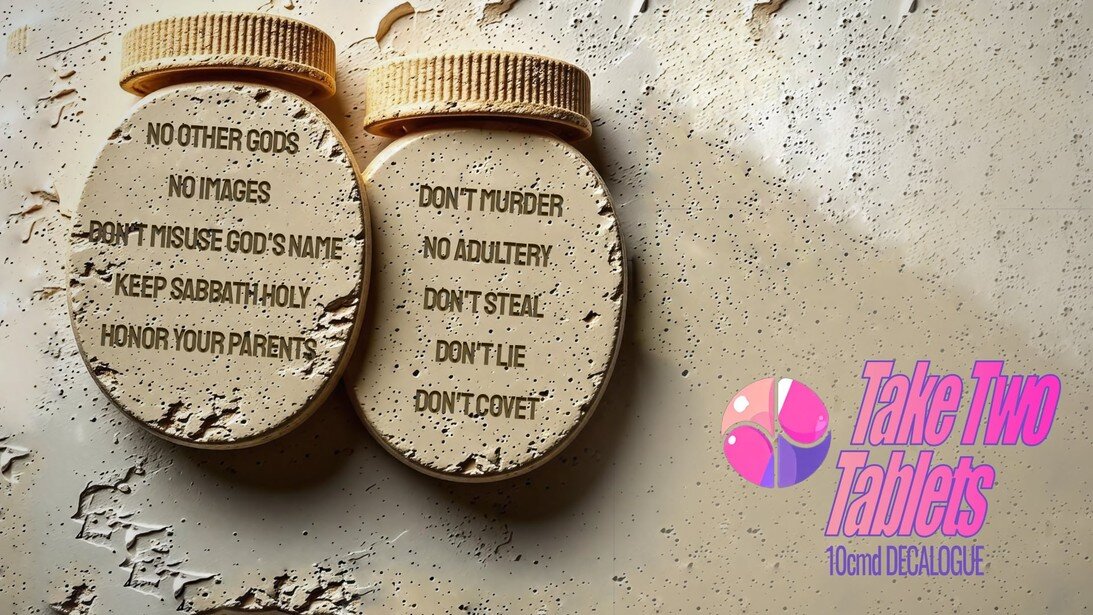
Pharmaceutical commercials fill the screen with daisy fields and frolicking joy so you’ll tune out the side effects. Are God’s Commandments filled with killer side effects, too?
The following study questions are AI generated and may contain errors.
This transcript has been automatically generated and may contain errors.
It’s true, bringing peace and joy to everything you do. Side effects may include happiness and cheer. Ask your doctor if tooth’s health is right for you, my dear.
Got troubles with commandments, feeling a little stressed? Two tablets are the answer, helping you feel blessed. From honor to honesty, it’s the way to go. With two tablets by your side, you’ll be in the know.
Does that remind you of anything that we see all the time? Yeah, commercials. I mean, if you’re going to see a commercial for a pharmaceutical, it’s exciting because you dance in fields of daisies, and cute animals will frolic around you, and you’ll suddenly be a marathon runner, and you will dance your way through work because everything is good as you lower your cholesterol, right? I mean, that’s how they go, right?
Now, why do they always show all those beautiful pictures? It’s not because they want to make us happy. It’s because they need to put all the disclaimers in, and they don’t want you to be listening to the disclaimers. So they show you wonderful, happy things, so you’re focused on that, not the fact that to remove that slight itch behind your ear, take this pill, and only a few patients reported symptoms such as death. Isn’t that how it goes? And so we wonder when we’re told, well, here’s what’s going to solve things in life. Here’s how you should approach life. What are the side effects?
And it’s not just pharmaceuticals. It’s everything we encounter. Solutions, people always have ideas. Maybe you go online, you see one weird little trick to solve whatever. There’s always a catch. There’s always a problem. And so, yes, there’s the cute scenes of the kittens frolicking in the field of daisies, but, well, they don’t actually end up when we try it quite like what we see. Maybe it’s more like this cat.
Notice him for a second here. Let’s just watch this little cat. He’s trying to frolick in the daisies, but we’re going to slow down a little here. Let’s watch him. Something is going terribly wrong here. It’s horrible. And then look at this cat. Boy, I mean, it may cause your tail to detach and for you to turn into a weird dark cloud thing. That’s how it really goes, right? You see the cats frolicking in the drug commercial. You take the drug, and it feels more like that.
Well, as it turned out, I was trying to use AI to create a few frolicking cat videos so I could put them in our opening video, and that’s what it produced, and it was sort of like, yeah, that’s really how it often turns out, right? We hear the advice, we take it, and we don’t end up frolicking in the field with kittens. We end up being a disentailed cat with his head turning into a cloud. We say, you just can’t trust anything, can you?
Well, the Israelites felt the same way, and as we come to the Ten Commandments, we’re used to hearing about them, right? We think, oh, the Ten Commandments. But imagine you hear them for the first time, and you’re a people that’s been led out of Egypt, and you know how you thought you were supposed to do things, and God says, no, this is how you’re supposed to do things for a good life. And you think, what are the side effects, God? What’s going to happen if I do that? Is it going to work, or is it going to be like everything else? Everything else everyone’s ever told me, it never works out as good as it sounds. Is that what I’m actually going to be facing? Am I going to be one of those cats?
Today I don’t think we’re really all that different. Yes, you survey people, are the Ten Commandments good? Most people say, yeah, the Ten Commandments are pretty good. And yet, how often as we explore them, and we’re going to be exploring them over the next few weeks, do we find that when we’re actually trying to live them, we think, I don’t know if I can trust that God’s right on this. Maybe I should do it a little differently. Because I bet there’s a bunch of side effects to God’s way. It’s not going to lead to the happy frolicking in daisies life I would like. And so maybe I shouldn’t. Maybe I should modify it a little bit. Maybe I shouldn’t take it as prescribed. I should tweak it a little bit.
And God’s going to challenge us to recognize who He is. And because we know who He is, to recognize that we can actually follow what He prescribes for us and know that unlike everything else that people prescribe, the side effect is being closer to God. The side effect is actually fulfilling what we’re supposed to do in life. And so it’s not a side effect at all.
Let’s pray as we approach these Ten Commandments. We’re going to look at five before the Advent season, five after. Let’s pray that God would help us to see how they apply to our own hearts and our own struggles, and how we can draw closer to Him as we study them.
Let’s pray.
Father, we do struggle at times to do what you’ve called us to do, even something that most people would say sort of abstractly sounds good. Would you help us to understand how it truly is good? That unlike everything else we encounter where it seems like there’s always side effects, there’s always a catch, there’s always something else, when we follow you, you are always faithful and good and true. The rock that we stand on, when we stand on the solid rock, is always firm and secure. We pray this in Jesus’ name. Amen.
God doesn’t start out with His people by saying, here’s what you need to do. And this is really, really important for us to understand because it speaks to how we approach God, and it also speaks to how we ought to communicate about God. God doesn’t start with what we should do. God starts with who He is. God says, the proof’s in the pudding. You can look at me and how I interact with you, and then you can decide if you can trust what I have to say for you.
That’s what we see as we look at the first few verses of Exodus chapter 20. It says in verse 1, “I am the Lord, your God, who brought you out of the land of Egypt, out of the house of slavery.” That’s the start of the Ten Commandments. The start of the Ten Commandments isn’t what we should do. It’s not what we’re going to get to in a moment, that you shouldn’t have other gods before Him. The start of the Ten Commandments is, here is who I am and what I’ve done for you. God wants them to understand that first. Why? Because it’s a whole lot easier to trust Him if we understand who He is.
If you are told, hey, you should take this prescription, and it’s from a doctor you’ve had for years who’s trustworthy and has always led you down the right path, it’s a whole lot easier to swallow than if it’s some new physician that you wonder, well, did he get a kickback from the drug company? Is he just trying things out to see how it works? You might wonder. But then when you actually have that relationship, you know you can trust. And God says, you have that relationship with me. And humanity as a whole has that relationship.
Because the beautiful thing is, as we look at His Word, they had just the experience that they were having at that moment. But we have the entirety of His Word and His interaction over history. If you’re going to take a prescription, what are you going to do oftentimes, if you’re a bit more of a researcher type? Well, you might say, the doctor says, well, I really think you should go on this medication. Well, then, sorry, Rob, I know this makes every single doctor cringe. Where do we go? We go to Dr. Google, right? We’re going to go there, we’re going to look it up, and Rob is beating his head. He’s going to need a couple of tablets himself for that headache.
But we do that because we think, well, I want to know, have people reported side effects? I want to know if the cost is worth it to me. And so I want to think about this, right? And we do that on all kinds of things. If you’re going to buy a car, well, what do you do? You go read reviews and see if people say, well, it’s really comfortable, but the steering in bad weather leaves a little bit to be desired. If you’re going to move into a new home, you might look up and see, well, how’s the school district? Or how are the parks in the area? That sort of thing, right?
We want to know the details. So we look at the history, crime reports, right? Is it safe in this area? Well, we can look at the neighborhood of what God’s commanding us to do, too, and see, oh, wait a second. He’s faithful, and he loves us. And if he’s faithful, and he loves us, then when he calls us to do something, it’s not because he takes some kind of weird, perverse pleasure in seeing us in contortions, right? It’s not some practical joke. I’m going to keep telling them to do these weird things and spend my time up in heaven laughing at them. It’s not that. It’s because he knows what’s right for us and what’s good for us. Do we understand that?
God proves his love for us. Now, something that should be said, I just want to have a sort of keep in the back of our minds as we’re going through all the Ten Commandments. God proves his love first. So if we’re sharing about God with someone, we don’t start with finding where they’re not following the Ten Commandments or any other commandment of God and say, well, you need to fix this. God doesn’t like that. Because that didn’t work for the Israelites, it doesn’t work for us, and it doesn’t work for anyone else. What do we do? We start with that God loves them.
Now, we don’t stay there. We move on from that and say, and God knows what’s best for us. But the first thing you have to have is a relationship with the Lord. And we know that prescription because the heavenly physician’s the one who prescribed it. He knows that first we need to know him. Nothing else is going to work if we don’t know him first.
A little sidebar for just a second. It’s interesting when you try to number the Ten Commandments, and we’re going to number them a specific way, and if you go online and you view a list of the Ten Commandments, it may or may not match. It’s not because the text of Scripture changes. You can look at the list of the Ten Commandments in Exodus 20. You can go over to Deuteronomy 5 and look at it there. You’re going to find the exact same list, but they’re not numbered. And so over time, there’s been some disagreement on where do the commandments start and stop.
And, for example, in modern Judaism, at least portions of it, and also in, for example, Catholicism, in Lutheranism, the way it gets broken up changes a little bit from the way that we’re going to do it. But we’re going to follow what I think is probably the more straightforward numbering. And it goes back to before the time of Jesus it was understood. And the good thing about it is that if you start it here, where what we’re talking about at this moment is half of the First Commandment and not the full First Commandment, is that the other way it gets broken up is that, and we’ll talk about this when we get down further, the Tenth Commandment gets broken into. But in the retelling of the Tenth Commandment, it’s not always exactly in the same order. And so you can’t cleanly split it, but you can split here.
So I say that just so that if you’re used to a different numbering, you’re not spending the rest of the sermon thinking, wait, that doesn’t sound quite right. There’s agreement there’s Ten Commandments. In fact, Scripture refers to the Ten Commandments. It’s just a matter of, well, how do we divide up? Here’s the important thing to take away from that. If you do all of it, you’re good. It’s not like splitting it one way or the other really changes anything. It might put the emphasis a little differently because you pull it out on the list, but it comes down to the exact same point. So it’s not a big deal. Like I said, I just didn’t want us to get lost as we’re going. Like, why is he dividing it that way? We’re just following the ancient division, and I do think that’s helpful. But it’s not that big a deal.
Okay, so why then is this part not its own commandment? My second half of that. Well, it’s because it’s what we might call a preamble. And that’s not just because I want to number it that way. This is how they constructed lists of laws in the ancient world. So, for example, if you were a great king and you have this mighty army and you have your vassals out there who can’t really defend themselves against the other mighty armies of the world, and so you say, well, I will protect you. And so you make a covenant treaty with them. We still sort of do that today, right?
We make treaties with different countries around the world, and we say, okay, we’re going to come up with a mutual defense treaty, and here’s your obligations and here’s our obligations. Well, in the ancient world, the way you’d do that, you’d have one clearly superior entity involved, right? One king who was much more powerful. And that more powerful king would rehearse what he’d done to protect his vassal in the forming of the covenant. So I have defended you from the evil barbarians to the east or the west or the north or the south or whatever, and go over that, and then say, okay, now that we’ve established that, now here’s what you’re going to do. You are going to provide me so much from your tax revenue. You’re going to conscript so many people. You’re going to do this or that, or you’re going to provide so much food for the capital. There’d be different things that would be described, but it started with remembering why there was the covenant at all. It was because the mighty king had served the people.
God says the same thing. He knows how the people understand you’d negotiate these things. We have other ancient texts out there from this time period that would describe these earthly relationships between powers, and here God says, I’m going to use that mold to describe this heavenly relationship that we’re going to embark on. Not only does he have the opportunity then to remind directly about his love, but it also does something else if you think about it. God is saying, yes, I’m the great king of all the universe. I’ve made everything. I can do things however I want, but guess what? I’m going to speak in a way that you understand. I’m going to speak the language of you.
You understand that a king that’s mighty speaks to his people in this way, and so that’s exactly the way I’m going to speak to you because I want you to understand what I’m doing. God could have declared from on high in heavenly language things that no one could understand except for the fact that don’t do this and I’m going to zap you, and he could have. He would have been within his rights, but no, what does he do? He rehearses a covenant language. He explains it to the people because he wants the people to actually understand who he is. He wants them to know that he cares.
And as we think about God’s word, every time we look at it and it makes any sense at all to us, it’s a great opportunity for us to say, “Huh, God understands me.” Every time I turn to the Gospels, every time I turn to the Psalms, every time I turn to any part of God’s word, it’s a declaration. God cares that I actually can interact with him. He wants me to get him. He doesn’t just say, I’m really powerful and I can zap you. You don’t need to know anything more. No, he wants us to know who he is. He wants us to know that he loves us. He wants us to look at the evidence.
The evidence can lead to all kinds of interesting things. For example, it can lead us to discover whether lions are actually man-eaters or not. Here’s two famous lions from about 100 years ago. They were shot by colonists in Africa. They like to eat people. At least that was the legend. And it was said that many of the locals that lived there and the British soldiers that had come into the area were consumed by these lions. They said at least 30, and a lot of people thought, that sounds ridiculous.
But the British leader who was in that town had managed to shoot those two lions. And he took them and he decided to make rugs out of them. He had them in his abode. And then after a while, eventually those lion skins were sold around and they ended up at a museum in Chicago. And they managed to apply taxidermy techniques to them, and now you have them on display. And so it was a display of the famous man-eating lions.
And yet, many people said, lions don’t usually eat people. Why would these lions have eaten people? Well, finally someone said, I wonder if we could determine if they really did eat people or not. And so they did a study on these lions’ teeth. And they looked, because the lions, they didn’t floss between meals. And so they looked at the teeth and they found what? They found actual embedded hairs in their teeth and other particles that they found had human DNA. And they could determine several distinct DNA patterns and say, aha, these lions, they really were man-eating lions. And yes, probably women eating lions too, if you were wondering.
They looked at the evidence. This was decades and decades later, obviously, because they didn’t have DNA technology at the time it happened. But they were able to go back and say, oh yeah, it does look like, I think they’d also found some wildebeest DNA or something like that. They found these different samples, but they could prove, yes, these lions, they lived up to their name. They could eat human beings and they did eat human beings. And then that led to all kinds of interesting studies on them.
Well, thankfully, God doesn’t eat people. He could if he wanted. He doesn’t need to. He doesn’t eat food, for one thing, but he also loves us. And so we look at him for evidence, but we look at him and his word for evidence, not that he seeks to destroy us, but rather that he loves us. And what do we find there? We find the very DNA, the very fingerprints of that etched all the way through his word. And so as we see that, we realize, wait, when he’s calling us to do something, he actually means he’s going to come through on it.
When you look at those lions and you see their teeth, you wonder, well, did they really do that? Yes, they did. When we see God call us to do something, did he really do the things he said? Is he really going to be faithful if we follow his way rather than the way of the world? Yes, he will. Isn’t that amazing? God calls us to trust him, but he calls us to trust him because he is trustworthy. And so that’s something that each of us can hold on to.
We wonder, should I follow God’s way today? It would just be so much easier if I didn’t, if I just did the things the world says are okay. But we look at his word and we find etched in it not our DNA being consumed, but the blood of the Savior being poured out for us. And we say, yes, he will come through. And may that also be, then, what we communicate to others. What people need to hear. Yes, God does have a way. Yes, it doesn’t look like the way of the world. But yes, it starts with and ends with and is filled with the fact that God loves us. Take away that and you have nothing.
Lots of people can come up with laws. We’re very good at doing that as human beings. The difference that God gives us is that he can back those laws with his love so they lead to something good every single time. Isaiah 42:8 says, “I am the Lord, that is my name, my glory I give to no other, nor my praise to carved idols. Behold, the former things have come to pass and new things I now declare. Before they spring forth, I tell you of them.” And we’re going to get more in a moment to the very specific command here that’s mentioned once again there. God does call us to focus on him and him alone. But notice what he says there. He’s hinting at his love. It sounds sort of strong there, right? But what does he do? He says, things are going to come and I’m going to tell you about them.
Did you ever think about the fact that when we look at his word and we find prophecy, that’s God declaring his love for us? He doesn’t need to tell us anything that’s going to come. Why does he tell us? It’s because he loves us and he wants us to know that he’s working. And when we see things happen, when we look at the past and we see those prophecies fulfilled, we can say, there’s more evidence that God really does what he says he does. And when we look at prophecies to come that haven’t happened yet, like when Jesus says he’s going to return, we look at everything that has come and we say, he’s going to do it.
Prescription is good. It works. I don’t need to go to Dr. Google. I know it’s going to work. So that’s God.
Now we need to talk about us. Because what about us? Well, we’re very much not what we’ve just been talking about. We struggle to show our love to God. God is faithful. Every time the evidence is there, it’s right there as clearly as that DNA was on those lion’s teeth. It’s clear in us that we’re faithless, that we constantly stray, that we constantly find a million reasons why we don’t want to do what God’s called us to do. Or we excuse what we’re doing and somehow try to pretend it’s what God wants us to do.
Take a look at verse 3. Really straightforward. You shall have no other gods before me. This is ground zero to following the Lord. There’s no mistake that this is where it starts.
God says who He is, and then He says who we should be. We need to understand that we’re His people, and that therefore we live as those who only follow Him, that there is no one else that we have loyalty to. The world’s constantly trying to cause us to trust in other things, but God says, I’m the one. I have no other gods before me. I’m called to be loyal to God.
Now sometimes people say, why does the Bible say other gods? Well, the people of Israel lived in a world where many people worshipped multiple gods, and in fact, even those that worshipped one particular god believed the other gods were around and active. They just weren’t those weren’t their gods.
And God’s concern isn’t to get into right here a discussion on the falseness of that worship, that they’re worshipping things that don’t exist, or demonic forces, or whatever you want to say. But rather, He wants them to understand something very simple. You don’t have to go that far. You don’t have to get into the abstract, into the theological. All He wants them to really hold on to is the fact, don’t even question it, just follow me.
Just like Jesus would later say to His disciples, follow me. If you understand that God is faithful, that the evidence does point towards Him being consistently trustworthy, then it doesn’t, nothing else really ought to matter. It does, we constantly struggle with that, but we can full stop, just follow Him, and we’re already on the right path.
And if you’re wondering about following the Lord tonight, the first thing isn’t to get all the details right. It isn’t to understand everything about Him. It’s to understand enough. He’s the one who rescues, and He wants you to follow Him. And you start there, and yes, we build, we grow, we ought to, but that’s where we start. That’s where everything else builds.
Those that divide the commandment in two that I mentioned earlier, one of the reasons they do, and it’s a great point, that the first commandment is then really to understand who God is. “I’m the Lord, your God, who brought you out of the land of Egypt.” And that’s certainly embedded in this, because God doesn’t just say, don’t have multiple gods. Well, okay, then I’ll pick out a God I like, and then I’m obeying the Ten Commandments because I only have one God.
No, the God that should be the one God, the only God who’s going to rescue you, is the same God that brought Israel out of the land of Egypt, out of the house of bondage. And as he brought them literally out of their enslavement, he brings us out of the enslavement of sin. Because if God can take one of the most powerful kingdoms of his time and bring it to his knees and bring his people out, then whatever’s bringing us to our knees, he can take down as well. So we can trust him.
The language here causes some consternation. It’s kind of unusual the way it’s worded, but essentially it’s thought that it very well is echoing how you would speak back in those times. Not only did they have multiple gods, many men would have multiple wives. Well, not many. If you were really wealthy, you did. And it would be the language of taking a second wife while the first one was still alive. You’d have another wife before her, in front of her. And that’s the language God’s using because God’s primary concern isn’t the abstract and the theoretical. God’s concern is relationship because there’s a change in relationship if you have multiple spouses. And there’s a change in relationship if you have multiple gods. And God wants us to understand that our relationship should be exclusive to him and to him alone.
Now, because it’s relational, that also reminds us that this isn’t about earning a relationship with the Lord. This is about living the relationship that we have. We sometimes get rung up on that, but we understand it in friendships. We understand it in all human relationships, family or friends. There are times that we need to do things to live in that relationship, to love well. But in a healthy relationship, it isn’t earning it. It’s living the truth of it. And that’s a very key difference.
We know people who our interaction with them, our relationship with them is purely transactional. And sometimes that’s an okay thing. You go to the store and someone’s trying to help you with something. Well, they could be very nice, but they’re also paid to do that, and they’re paid to do that so you can buy things. And if you go to the store and you just want to hang out all day and socialize with the workers, eventually they’re going to say, you’re a very nice person. I’m glad you’re so friendly, but I have to help paying customers. You say, well, I thought you cared about me. No, you wouldn’t say that. You understand. We understand that.
But if you come here at Little Hills and you’re talking to someone and the person says, well, you haven’t done anything for me lately, so enough time talking. Well, that would hit differently because it’s not what it’s supposed to be. And God isn’t that way either. He’s not saying, as long as you do enough for me, I will love you. And that’s why he starts with who he is again. He didn’t say, if Israel loves me enough, I’ll take them out of Egypt. I’ll rescue them from slavery. No, he rescues them. But then he says, because I’ve rescued you, because you have that relationship with me, now live as people who have that relationship with me.
Don’t follow other gods. Don’t think that they’re going to solve your problems. I’ve solved your problems for you. You don’t need to worry about them. You don’t even have to question whether they exist or not. Just focus on me. That’s really all that matters. They don’t exist, by the way, the other gods.
But the funny thing is, when we get so busy focused on the theoretical, it’s a great excuse not to actually deal with the practical. And the practical is we follow God. That’s what matters. Are we living in accordance with who we are? Following him is what makes the difference.
Romans 10:12, “For there is no distinction between Jew and Greek, for the same Lord is Lord of all, bestowing his riches on all who call on him. For everyone who calls on the name of the Lord will be saved.”
Notice what saves us. It’s not having a thick enough confession of faith that we can write out spontaneously. Someone says, what do you believe? And you can write down 10 pages of what you believe. It’s not about making sure you can always open the Bible to the exact right spot and know the verse for any topic. Great skill. It’s wonderful if you can do it. I know people who grew up practicing sword drills where you practice to see how quickly you could get to a verse, and it is incredibly useful.
But that’s not what saves you. It’s not showing up at church enough. What saves you is calling on the name of the Lord. You can do all those other things and not call on the name of the Lord, and you’re toast. Where do we start? We start by calling on the Lord. That’s where we receive salvation. That’s where we receive hope.
There’s a lot of other different parts going on, but that’s the part that really gets everything else to make sense. Sort of like Faithtoberfest the other night. Here’s a picture. I just had to share one picture. We’ll be sharing more in the near future. But I was just looking at that room full of people praising God and how wonderful it was and how loud it was in here.
It wasn’t just amazingly loud as everyone was singing. It was just wow. Yeah, we might as well just… Yeah, yeah. Praise God for that.
And what did that require? Well, it required promotion. It required having the different elements that were going on. You had to have the right musicians. You had to coordinate those musicians. You had to have food because people come and they’re going to have a meal, and the games brought… It all comes together. And all that comes together for what? To ultimately then lead to a time where we’re praising God.
But what if we took God out of that? We could have a meal. We’d listen to some good music. Could even hit the same decibels as we were all singing at the top of our lungs. You could go to a concert for a famous artist. It might get really loud, louder than it was here because people just know all the songs by heart and they can sing them. But what made Faithtoberfest special? What makes any gathering we do special? It’s the fact that we’re following the Lord, that we’re turning to Him.
All those other things make it wonderful. They add to it. But that’s the one key thing that holds the rest together. As we’re having the meal together, as we’re playing the games together, as we’re having fun contests to win prizes together, as we were singing together, the thing that pulls it all together is the fact that it was a testimony of God’s faithfulness to us. That’s what it was all about. That’s what it’s all about in our lives, too.
Because we might have a very respectable public appearance. Everyone looks up to us. Pillar of the community. We might be really smart, really talented in some way. But what brings it together is the fact that we build all that on top of knowing the Lord. And even when we talk about the Ten Commandments, is our world a safer place, a generally more harmonious place if everyone’s following the things in the Ten Commandments outside of the relationship to the Lord? Take out the first few commandments and just, you know, they’re not murdering and stealing and coveting and so on.
I mean, is it a better place? Well, yeah, it would be a safer place, right? If none of that was going on, you could leave your doors open all the time and leave your car unlocked with keys in the car and not worry. I mean, yeah, it would be nicer. But if it’s missing that first part, it’s still empty. Because if you can go all your life without ever having anything stolen, without ever having a moment to fear, would that be nice? Yeah, but it’s only a few decades of niceness. What adds any purpose to it? Knowing the Lord.
And the key difference and the key building block is we move from that then to doing those other things, not because we don’t want someone to do the negative version of it to us. We do it because we want it to look more like Jesus. As we look more like Him, all those things happen. And yeah, there’s that natural result that things work better. But that’s not the thing in itself. It’s a virtuous side effect.
Now, we often speed past this command. Because I don’t know a single person in this room and of our normal folks online, I don’t know a single person online who has built, say, a stone idol and you go and bow down to it. Now, maybe you’re joining us tonight and you do have one. Well, now we’re talking about literal idols. But I don’t know anyone who does that. In fact, I don’t know anyone who worships another god in this room in the literal sense. If you’re here, well, that’s not surprising. You don’t usually walk into a church when you’re looking to worship a Hindu god. Because there aren’t any Hindu gods being worshipped here. So you go to a Hindu temple, right?
So we say, oh, okay. I’m clear on this then, right? No. We find other gods. God’s popularity and success and money. It’s not a mistake that Scripture points to those things as well. And it’s not merely a cliché that we’ll say, oh, we find idols. We need to understand this is the heart of it for us.
We might not trust another god today, but we find other things that we think are going to solve our problems, just like the people of the ancient world might say, well, you know, my neighbor’s gods seem to be doing better for the farm crop. Maybe I should worship Baal. Maybe I should worship Moloch. Oh, I have to sacrifice a child. Oh, well, I have several. That’s fine. I’ll just sacrifice one and maybe the fields will grow better and all will be well, right?
I mean, I make light of it, but people actually thought that. And today we say, well, God said I should do these things, but that’s not how I get ahead. That’s not how I have success. So maybe I sacrifice a little righteousness on the altar of success, but I know that’s how you get ahead in the world.
Here’s the question I think all of us need to ask ourselves. What is driving you that isn’t driving you closer to God? Before you say, well, I don’t have any other gods. All of us have those, those split loyalties, those things we chase after. What are mine? What are yours? They might not even stay the same. They might be one thing in one moment or one part of life and something else in another, but what is it that you do, that you seek meaning and fulfillment and happiness in?
What is it that you do that you think is going to solve your problems that is actually driving you away from the Lord and not towards Him in this moment? No one has to volunteer an answer. I’m not looking for that, but just hold on to that question because it’s so important.
And here’s another interesting thing. I like what Walter Kaiser says in reflecting on this passage. He says that inactivity can be what we worship. Sometimes we say, well, I’m not going to worship any other gods. I understand. I’m not going to go to some other religion’s ceremonies and worship another god, and I’m not even going to trust overly in money or power. I know from Scripture it’s okay that I use those things as long as I’m not trusting them too much.
But sometimes it’s just our laziness, our comfort in not doing that becomes then the god that we worship. As long as I can just keep things nice and calm, I’ll just not do anything. You know, the risk if we try to follow the Lord is, well, what if I start to follow the Lord and He tells me to go someplace and I start to follow Him there and then I’m tempted and I start to do something that’s not pleasing to Him. Maybe it’d just be better if I don’t do anything. Then I don’t have to worry about it.
The guy says, no, don’t you see, if you’re doing that then you’re trusting in your lack of activity. Put another way, what are you trusting in? What am I really trusting in? Because that, that is the thing that’s getting in the way of the Lord.
And a lot of times we even think it’s leading us to the Lord because I’m not always, I’m going to cut some corners. Maybe I’m going to fudge the numbers a little bit so it works out better for me at work. But then I’m going to give more in my offering and that will make it all worthwhile.
There are so many lies that we’re putting in there because we’re thinking, I’m going to make this work out for the Lord, but the Lord is just saying, I just want you to trust me.
Sometimes, well, I need to go to a church that’s really big. I need to go to a church that’s really small. I need to go to a church that sings this way or prays this way. I need to… No, we need to follow the Lord.
Now, does that mean we don’t care what church we go to? No, of course it does because God cares that we do things that are pleasing to him and I pray that we do here at Little Hills and may we always do that and may we do that better and better over time.
But it’s funny how much we focus on those externals. Oh, I’m going to have a great food in my life party. I’m going to barbecue every day. It’s delicious. It’s tender and juicy. Am I following the Lord?
And you can go to a perfectly Bible-believing, wonderful church, and if what you’re focused on is all the external trimmings, all the barbecues and the games and the quality of the music, that’s not what made Faithtoberfest successful. That’s not what makes a church successful. What makes a church successful is following the Lord and that’s what makes us successful. It’s following the Lord.
So whether it’s the lack of doing something, the action of doing something, or trusting in something, what is it that is causing us to think this is where I find my hope and my security and my comfort rather than the Lord?
Remember the story of Old King Midas, one of the great stories of Greek mythology, and in Ovid’s telling, he’s given this gift. He’s given a chance to ask for anything he could want. He’s acted favorably and God wants to bless him with whatever he wants, and he thinks, oh, well, gold is really nice. What if I could touch anything in terms of gold?
And so what does he do? He asks for that, and he’s given that. And so he can touch anything in terms of gold. He goes and touches flowers. They turn to gold. He can touch rocks. Suddenly he has gold nuggets. Isn’t this great? Until he sits down for a meal. Touches the food and the drink and it turns to gold. Well, then he didn’t want gold. He wanted to eat.
Some tellings have him touching his daughter to comfort her after all the flowers turn to gold, and she turns to gold. And it goes from something he thought he could trust and if I can make gold out of anything, I’ll be okay all the time to actually something that’s destroying him because he can’t actually get access to anything. He can’t touch anything and not ruin it by turning it to gold.
And Aristotle in his reflection suggests that the king dies of starvation because he can’t ever get anything into his mouth without turning it to gold.
Now, of course, that’s a myth. It’s a story that nowadays we can look on and we don’t think, oh, well, that’s a serious historical account. But as we think about it, it struck me how often we do that with the different gods that we end up worshiping.
We think, I’m going to chase after success and we even do things that are pleasing and good in and of themselves that would allow us to do good for God’s kingdom, but because we’re trusting in that everything turns into a step towards success rather than honoring God.
Or we think, I just want to be comfortable and so everything turns into avoiding discomfort. And comfort in itself isn’t bad. We can’t live in a constant state of stress or we’ll die. I mean, it’s not bad to want to be comfortable. God comforts us, and yet if that becomes all that we do, everything we touch becomes how do I get from here to comfort? How do I get to here to riches? How do I get from here to fame? How do I get to here from whatever goal I’ve set? And we’re the whole time starving. Starving from what actually gives us life. And we die.
And here in this first commandment is God calls us to focus on the Lord. He says, I am the one who can actually nourish you. I am the one who can actually give you life. Turn to me. Don’t trust those other things. I’m going to give you blessings and those things are going to be a part of it, but don’t trust them. Don’t make them the thing. Don’t look to other gods and say, well, somehow they’re going to rescue me from what the Lord can’t. Just turn to me because I am absolutely faithful and no one else is.
Don’t ask for that Midas touch. Because as you chase that, you’re just going to starve. And when we realize that God is absolutely faithful to us, the only thing, and this is what the Ten Commandments are urging us to, the only thing we can do that will feed us and nourish us is to be exclusively faithful to him. And as we do, we can know that we can trust it because he will come through. We don’t need the big disclaimer of side effects because the thing that’s going to happen when we follow him is we’re going to live.
Would you pray with me, please?
Lord, would you help us to understand that we can exclusively trust you day in and day out. That you are the one who is always faithful. Lord, would you help us to flee those temptations to trust in other things and to trust in you every single day knowing that you are good and true. And to live knowing that we are loved by you because we aren’t even strong enough to trust you on our own, but because of your love we know that you are the giver of the strength that we need.
We pray this in Jesus’ name. Amen.
Start the Conversation