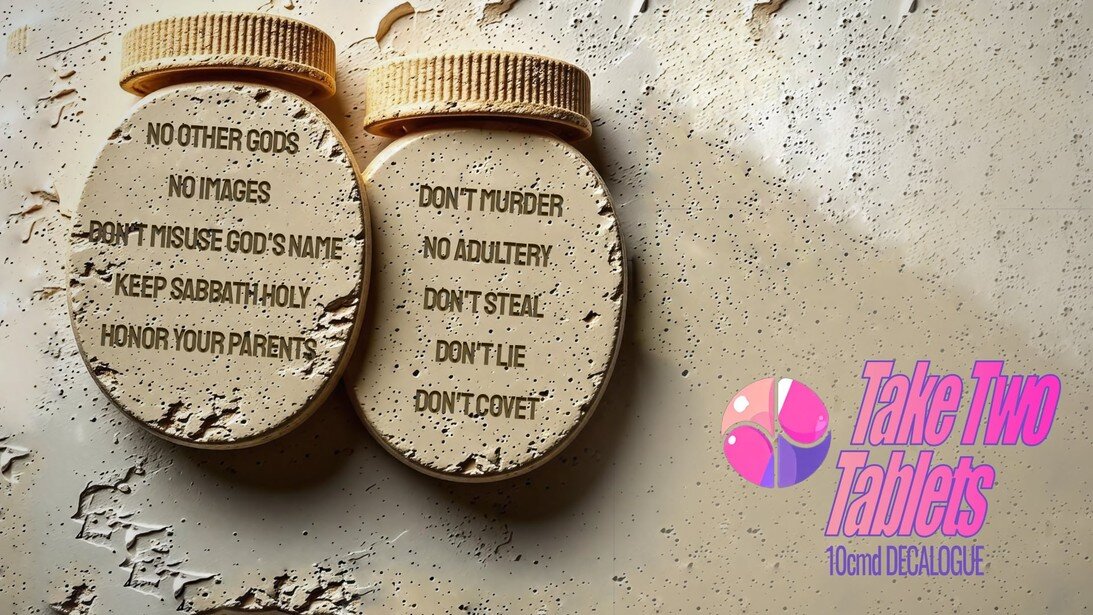
Most of us hear “You shall not make for yourself a carved image” and assume the second commandment is aimed for some folks worshipping a metal statue long ago. But the same human frailty that raised the golden calf still reaches for something visible, manageable, and reassuring. What have we begun to trust, protect, or worship in place of the God who rescued us?
The following study questions are AI generated and may contain errors.
The sermon argues that we create “idols” not just through physical statues but through concepts and objects we trust in—jobs, buildings, possessions, even political victories. What are some modern idols in your own life or in our culture that you think people are most tempted to trust in instead of God?
The story of the golden calf shows the Israelites trying to represent the very God who rescued them through something visible and tangible. In what ways do we still fall into similar patterns today, and what does it reveal about our need for something we can see or feel?
Pastor mentions that during the pandemic, many realized they had placed their trust in the church building rather than in God’s presence. What other circumstances or crises might reveal where our true trust actually lies?
God chose not to provide a physical description of Jesus, despite being able to do so. How does this shape the way you think about worshiping “in spirit and in truth”? What difference does it make that we know Jesus through His words rather than His appearance?
How do you understand the distinction between appreciating good things God has given us and idolizing them? What’s the practical difference between gratitude and idolatry—and how do we know when we’ve crossed the line?
Martin Luther’s concern about indulgences centered on people trusting a piece of paper for forgiveness rather than trusting God Himself. What modern “quick-fix” substitutes do we sometimes seek for forgiveness or security, and how might we guard against similar patterns in our own faith?
This transcript has been automatically generated and may contain errors.
Everything’s better with scoops, tablets, it’s true. Bringing peace and joy to everything you do. Side effects may include happiness and cheer. Let’s cheer! Ask your doctor if two saps is right for you, my dear.
Got troubles with commandments? Feeling a little stressed? Two tablets are the answer, helping you feel blessed from honor to honesty. It’s the way to go with two tablets. Oh, with two tablets by your side, you’ll be in the know.
So, all it takes is two tablets, right? We talked last week, well, what are the side effects of the tablets? Do I want to take a risk with those side effects? And when we’re talking about what God calls us to do, whether it’s the Ten Commandments, those two tablets, or His law in general, His calling for us in general, there can be unexpected side effects for us, not for God. Unexpected for us, though, where, for example, we find that people don’t appreciate us being faithful to Him. But sometimes the side effect strikes much closer to home because what God requires us to do strikes at the things we want to do. Strikes at the things that we like to hold on to, the things that we don’t want to let go of, and it can be a very painful process if we’re going to actually allow the Holy Spirit to speak to us and say, “Okay, I know that this is what you want, but it’s not what’s good for you.” Sometimes we just don’t want to do that.
Today is Reformation Sunday, and I can’t help but weave in a little bit of Martin Luther in today’s sermon. I just can’t resist. And as we do, I think it’s interesting if you think about the life of Martin Luther, you might say, “Oh no, it’s going to be a long time. Oh no, he’s going to go do one of those boring history illustrations.” But you know the thing with Luther is he’s never boring, and he wasn’t boring at any point in his life. He was always a colorful character.
But Luther, the last thing he really wanted to do was to stand out and be this central figure of an earth-shattering Reformation. He was a monk that wanted to stay in his cell and study God’s word, teach future priests, and generally be ignored. His point was not to become the center of this giant controversy. So why did he do what he did? Why on October 31st each year do we commemorate the Reformation and Luther going and nailing the 95 theses on the Wittenberg door?
If you’ve been here for a while, you’ve heard me tell the story. It was the Wittenberg door, and it had 95 theses nailed to it. If you look up on top, it actually says Castle Wittenberg, right up there: Castle Church Wittenberg. I should say. And why would Luther do that if he didn’t want all the attention? Well, you see, at the time it wasn’t that.
When we go online and we share a meme, sometimes we want attention. Sometimes we’re going to share something, and we’re really trying for controversy. But a lot of the time we aren’t really trying for anything. We just share it. We think it’s humorous. Maybe it affirms something that we expect everyone else is going to affirm as well, and then we’re taken aback when it turns out, “Well, we’ve shared it, and apparently all of our friends hate cats or something, and they’re angry. How could you post a picture of a cat and ruin my morning?” Well, get new friends.
But besides that, it kind of takes us by surprise. He wasn’t expecting to start a big thing. He posted a meme of a cat on the Wittenberg church door. No, he didn’t have ideas, and he didn’t have concerns, and he felt that those things needed to be addressed. He was a Bible scholar, and as he studied God’s word, struggling like I think many, most of us do at times, “Can God really forgive me? Does God really love me?” He’d been overwhelmed by God’s love and disturbed by the fact that it often didn’t come through in what he heard in preaching and teaching.
And so he did have a point to make, but he actually thought he was making points that no one would notice. He’d actually made more controversial points that would reoccur later in the Reformation earlier—no one even paid attention. It was just at this moment that God chose to use it. But it’s interesting thinking of that progression because really, if you boil it down, in some sense, we could almost say it’s about idolatry.
And if you read them today as a Protestant, you’d probably read them and say, “Well, it doesn’t sound very Protestant. It doesn’t sound much like the Reformation.” It was very, very narrowly focused. He was concerned about indulgences, and what he didn’t like—he wasn’t even against indulgences yet at that point. He hadn’t gotten that far.
What he was concerned about was that people were trusting in these indulgences, and those giving them and teaching about them were encouraging people to trust in the indulgence to save them. Now properly speaking, if you were to talk to a Catholic theologian today, they’d say, “Well no, indulgences can’t save you.” Now that was true at the time, but there were a lot of people that were willing to imply it would. And some less scrupulous people would even go so far as to say it would and allow that to be because it made a lot of money.
And so we saw actually, in some forms of idolatry, we saw those buying them saying, “If I just buy this thing, it will make me okay.” And in some ways, you think about all the pharmaceutical commercials in the world—what are they saying? “If you just buy this, you’ll be okay, or your health insurance will buy it,” or whatever. Probably a little of both because it’ll probably cost more than your insurance will cover. Just buy this and it’ll be okay. And that’s a very appealing thing.
And for those selling them, it was, “If we just do this and squint a little and pretend it’s okay, we can be really rich and really powerful, and we’ll make ourselves feel better about it because it’s going to do things like build St. Peter’s in Rome, and it’s going to be beautiful.” No, they weren’t going to build the city of St. Peter’s—the basilica—be beautiful. So it’s okay, right? That’s how we get into idolatry.
We’re either looking for how it’s going to make our lives easier and more comfortable, and we excuse our sin because we’re trusting in that success. Or we grab onto it because we’re desperate. We want a solution, and we think that somehow this is going to do it.
As we’re going to come to the second commandment tonight and talk about idolatry and making images, before we go into it and we start beating up the Israelites and saying, “How could they be so stupid? I don’t have any household gods. No problem.” Their basic human frailty that brought them into this is the same that we have today.
And sometimes it takes the form of indulgences. It wasn’t then a little statue. You weren’t receiving a statue to worship. No, you were receiving a piece of paper that said God forgave you, and you were putting your trust in that rather than God. It can take different forms of things that we can trust instead of God. And that’s really what it comes down to.
So as we come to his word tonight, let’s pray that he would help us to see those places we are doing. Will you join me in prayer?
Father, would you help us to hear your word tonight? Would you help us to see those places where we are idol worshipers, where we turn away from you, where we turn away from your glory to the wrong things? And as we do, would you return us to that which we confess? We believe that you are the one who provides us with all the hope and all the salvation. No one else adds anything. No one else can. And in that, would you give us the security that only comes through following you? We pray in Jesus’ name, Amen.
You shall not make for yourself a carved image or any likeness of anything that is in heaven above, or that is in the earth beneath, or that is in the water under the earth. We want to boil this down to something simpler. That’s a lot of words, right? What’s a graven image? What’s an image in general? Do I have to physically bow down?
Here’s the heart of it: Don’t represent God. Don’t represent God. It’s really that simple. Now, simple to say, not simple to live out, but that’s really the heart of it. If you think about that entire list and all the things, it’s sort of like when you go and you sign terms of service for anything today—there’s a ton of stuff, there’s a ton of legal theory. This has to be said a little differently, or that or whatever. God is basically saying here, “Here let me give you some examples. I’m telling you these are things to avoid.”
But sometimes we get so stuck in, “Well what does this exact thing mean? And what does that exact thing mean?” We miss the big point, which is don’t do it. And if we get to the point where we say, “I’m not sure if what I’m doing is idolatry or not, how close does it come to the things that are listed here?” We probably have a pretty good indication we’ve already gone too far.
God doesn’t want us to represent him. Yes, represent him personally in our lives, right? We go and we live the love of God. He doesn’t want us to find something to represent him. Now that can be an actual literal statue, a literal idol, a literal picture that is meant to portray him to receive worship. He doesn’t want us to do that.
But it can also be a little more abstract. Maybe it’s a building. I heard someone talking a while back, “Well, you know, for it to be a church, it has to be a standalone building with a steeple.” Well, we don’t have one here. I dare say I believe God is working here as his church. But you know, we didn’t have a building at all. We were online only during the pandemic.
And one of the best things, I think, this can get people kind of feeling like they need a cringe, but one of the best things about the pandemic—how’s that for a phrase? Suddenly no church could depend on its building. And you know, that was a wonderful thing. Not because buildings aren’t useful things, but because the building isn’t the church.
And if God takes away the building tomorrow, His church prevails. If tomorrow it became illegal to be a Christian here in the United States, and we couldn’t have any buildings at all and we had to go find someplace in the woods—and I’d be in trouble because I’ve already told you in the past about how I deal with ticks and chiggers and stuff—but we found some place in the woods and we’re meeting there trying to avoid government surveillance. You know what? God’s church would still be there.
And see, that’s the difference between when we’re trusting in something and we’re trusting in God. What revealed that discomfort at the beginning of the pandemic that many of us, to a greater or lesser extent, had put our trust in a building and not in God? I’m not getting to worship God; I’m not in the building.
And I have to think that God was using that to challenge us. And unfortunately, I think we didn’t really hold on to that lesson. But now that we can, and I’m thankful we can, let us not forget the fact that the building wasn’t the thing that brought us together as a church. I mean here at Little Hills we may never forget that, especially since we were a church quite a while before we ever met in a building together. Isn’t that amazing? And it would be so sad if someday we actually think that the building is what makes us—that’s true of every church.
And God at times is going to take that away to challenge us, and he’ll take our idols away. Here’s the thing: I’m referring to images and statues, and I don’t want to make this too metaphorical and lose the thrust of that. That is something that God is very explicitly directly literally concerned about.
But if we ask what’s God’s heart in this? It’s that we don’t put our trust in something, only in Him. And every time we create something that we can worship, we will. It’s amazing when you look at the story of the Exodus. The people, Moses receiving the Ten Commandments—do you remember what happens when Moses comes down the mountain with the Ten Commandments? What’s going on down below? They’re worshiping an idol.
Now notably, they’re not worshiping, at least directly, one of the idols of the people around them. It’s modeled presumably off of those idols. But what does Aaron say? “The people are your gods who brought you out of the land of Egypt.” Aaron’s tying it very directly to the Lord. “Oh, now that we’re out of Egypt, let’s see who the desert gods are, and we’ll worship them.”
No. Here’s this continuing story. People of Israel, now you can see it manifest because there’s this physical bull in front of you made out of gold, and you can worship that. I would imagine here we’re worshiping the Lord, the one who rescued us out of Israel, and he had a good strong representation, good idol.
And you know, maybe to an extent he had great intentions with that idol because a bull—a bull’s strong, right? Fierce, representing the power of God. But there are all kinds of cultural symbols that a bull referred to, and what God wanted is for people to look at Him and trust in Him, not in some cultural thing.
A bull doesn’t encompass everything that God is, and it can encompass things that God isn’t. God said, “But I’m with you. You don’t need a bull. You need me.” And so they were denying, in essence, even though they might have said, “Well…” They were denying the very rescue they’d received because they were saying, “Yes, this almighty God who doesn’t need anything to portray Him rescued us and pulled us out of Egypt. All those idols back there, they couldn’t do anything for the Egyptians.”
But we want an idol, and so we’ll worship that idol even though that idol didn’t do anything to get us out of Egypt. Because it makes us feel safer. We can see it; we can feel it. If I wake up in the morning and I’m feeling uncertain—do you ever get that feeling? You just wake up and you just think, “I just feel like the weight of the world is coming down on me. I don’t know how I’m going to get everything I need to do done. There’s too many things to worry about. I just can’t take it. Can’t I just go back to sleep?”
Some of the Israelites are feeling that. They get up and they look across the field, and they see that glistening gold bull, and they say, “Ah, but our gods are with us.” That bull didn’t do anything for them and couldn’t do anything for them. It’s like taking that placebo tablet, and you talk yourself into thinking that you feel better. It’s just a sugar pill, not doing anything. So for a little bit, they felt better, but it was actually taking them away from the God who cared for them in that rescue and provided the general care they received, as providence over all time for all people.
I like what James Bruckner said. He said they were to experience the world as created by God, never to create gods themselves. And every time we fall into idolatry, whatever it is for us—and we’re going to keep pushing on that as we go through this text—whatever it is for us, every time we do it, we’re taking something that’s good in itself, by the good creator—and God declared it good at the beginning of the world—or it’s something He gave our minds, it’s something that He gave us, something that could be used for good, and we take it and say, “This is what I’m going to put my trust in because I know that I can look at this. I can feel this; I can sense this. I can feel in control with this,” and we say, “That’s what’s going to rescue me.”
And we take this world, these things that God gave us that are beautiful, and we take them and we say, “This is the one glory instead of the one who made them.” And there is the breakdown. There is the problem.
Do you ever have a bowl of some leftovers, say, and you go and you get the saran wrap out, the cling wrap, and you think, “You know, I can see that bowl over there,” and you rip off a piece. “I know how big that is; it’s going to be just right.” And you put it down and you stretch, and there’s this much left, and you think, “I never just eyeball it and get it the right size. I always make it too small because I don’t want to make it way too big. I always make it too small.”
That’s what we do when we worship idols. We’re saying, “I want to visualize God, and I can apply it to something that’s right in front of me,” and you know what? Every single time, it’s not enough to cover the needs that we’re experiencing, the problems that we’re facing, the life that we need healing in. It’s always going to come up short. Every single time.
We’re always going to limit God’s size whenever we try to shape God in our image rather than being shaped in His image. We’re going to somehow make a deficient God, a God who isn’t the God of the Bible, a God who isn’t the God who’s provided every good thing that we have.
Now, we are going to do that. That’s what we do in our sinful state. But we need to fight that impulse because the more we stand against it, the more we flee it, the more we can see the God who actually is there. The more the saran wrap starts to cover the dish so it doesn’t spoil. It’s there. There’s plenty on the roll. God is big enough to cover everything in life. And yet we cut that little piece of something that looks sort of God-like and think that’s going to do it.
John Calvin said, “For as soon as anyone has permitted himself to devise an image of God, he immediately falls into false worship.” This is why God doesn’t want them to make statues. He doesn’t just say, “Remember those statues. Remember those pictures. Remember those things. I remind you of me.” He doesn’t say that. No, he says don’t make them. Why? Because as soon as we make them, we start to transfer what we’re seeing of Him onto them. No matter how much we try not to, we are going to do that.
For some people, it’s a little bit of a shock if you come in here to Little Hills and you notice— and we’re not by any means the only church to do this—most churches have pictures of Jesus around. Notice we don’t have pictures of Jesus around. Why? Because God said not to make images, so we don’t make images. We don’t put up images of Jesus. Because why? If we had a portrait of Jesus right here on the wall, do you know what would happen? And as much as I feel this way, I know I would do it too. If we were all standing here singing about “What a Friend We Have in Jesus,” and Jesus is up on the wall holding a lamb like we’ve seen so many times, do you know what we would do? We’d be looking at it and thinking, “Ah, there’s Jesus holding the lamb. What a friend we have in Jesus.”
Jesus doesn’t want us thinking about some artist’s imagination of what He looks like. He wants us to be thinking about the God whom we see in the word. And every time we portray him, we’re opening up a giant temptation.
You might say, “Well, but I don’t do that; I wouldn’t look at it at that point. It would just make me smile and remember how He goes after the lost sheep.” But as you sing, and I’m describing that, I bet all of us have seen those pictures. As you sing a song about Jesus as we close the service tonight, and we’re going to be singing “How Nothing Is Impossible with God,” as we’re singing that, close your eyes for a moment. This is going to be weird. I’m enticing you to sin, I guess.
Just imagine closing your eyes. Don’t actually do it, maybe, but if you were to close your eyes for a moment and think, “I’m going to imagine Jesus as I’m singing this because I want to be thinking about Him,” as I sing about how nothing is impossible, do you know what? He probably would look like the picture on the Sunday school wall that you grew up in, if you grew up in church. Why is that? Because we’ve internalized that.
Why didn’t God want to be represented by that bull? Why didn’t He say, “Well, here let me tell you what I really do want to be visualized as. I’ll describe it, and you can make it. That way you’re not tempted to make a false idol,” because He knows that then that thing becomes the thing.
Think about if you, if a loved one dies, and you have that picture—we all have pictures, we all have pictures of loved ones that have passed. That picture, for example, in the room that I always preach from on Monday nights, over on my bookshelf, there’s a picture of my grandpa. And now that picture is taking on double meaning because that picture was printed and framed by my cousin Donna, who passed this summer. So now it’s like I see that, and I think about my grandpa, and now I think about Donna as well.
It’s all in there. And if you came with an axe running into the room and you start swinging that picture, do you think I’m going to react? I mean, I’m going to react anyway if you’re swinging an axe, but do you think it’s going to hurt me? And I’m going to say, “No, not that.”
We all have those things we protect because they remind us of loved ones. And I think that’s the notable thing when you think about how we also then can make an idol of God. And I’m not saying that’s an idol. I’m not saying you should throw away all the pictures of your relatives.
God actually instructs later in Exodus, as they build the tabernacle, they’re making pictures of fruit and so on. There’s cherubim that hold up the ark. God isn’t against any kind of depiction of anything because obviously, if you have a picture of a loved one sitting on your desk or on your bookshelf or whatever, you’re not worshiping that, hopefully. You don’t actually think that person is God.
But what if you do it, and the one you’re depicting you’re saying is God? Well then when the person comes in swinging the axe, saying, “Don’t hit God; don’t hit Jesus,” and the moment that suddenly that thing takes on that extra symbolism that it’s not merely a reminder but wait, this is sacred.
Do you realize what we’re doing? Why does it matter more? Well, because God is Jesus. The thing is, friends, it’s not Jesus; we don’t know what Jesus looks like. God could have put a perfectly clear description of what Jesus—the second person of the Trinity, the Father’s very Son who came in the flesh—looked like. He would have written down what He looked like.
He didn’t. Why? Because we’re not meant to spend our time thinking about what it would be like to stare into Jesus’ face and visualize it. We’re meant to meditate on the wonder, the glory of God that descended, and no matter what we imagine, no matter what the best artist in the world imagines, it will never capture the glory of God.
And so the moment we start trying, we start putting that saran wrap on, it’s going to come up too short because maybe you’re in a moment where you need someone who’s going to heal you, and you say, “Well, He’s great with those sheep that I remember Him seeing as a kid, but can He deal with what I’m dealing with? Maybe at this moment, you’re being tossed and turned on the sea of life, and you need someone who’s going to be a ship’s captain, not a shepherd.”
Well, God’s that too, but the picture can’t depict all of that. Jesus is so much more. And that was the problem with indulgences. Was it wrong to charge money for forgiveness? Yes. But you know what was even more insidious? The fact that it was implied that as you came and you repented of your sin, because you were supposed to do that as part of an indulgence—it was all about repentance. There was something true in the midst of it. It wasn’t all false.
But as you did that, what were you trusting? You weren’t trusting the God who forgives. You were trusting the piece of paper that was signed and sealed and delivered and said you were forgiven. And sometimes we’d really like that because we’ve done something and we think, “I’m not sure if God can forgive me,” and you could just have this official sealed certified paper that said, “Yes, God has forgiven you.” Trusting that and not God. And it was narrowing God’s forgiveness. It was narrowing the immense power of God’s grace.
And that’s the problem. It’s all the trimmings. God doesn’t want us to hold on to the trimmings. He wants us to hold on to Him. And so He starts by saying, “Don’t make them,” and that’s the first part of what we see in the second commandment.
The second part, though, is equally important because whether we make them or someone else does, we still could potentially worship. “You shall not bow down to them or serve them, for I the Lord your God am a jealous God. I’m the God who shows steadfast love to the fathers and the children, to the third and fourth generation of those who hate me, but showing steadfast love to thousands of those who love me and keep my commandments.”
God speaks about who He is. He’s just done that in both of the first two commandments. “I’m the God who brought you out of Egypt. I’m the God who shows steadfast love to those who follow me for thousands of generations.” That’s who I am.
Those earthly idols, those earthly things you trust, they don’t do that. They’ll never take you out of Egypt. They certainly never will love your family down through the generations for time immemorial. But I will, and I do. God says, “That’s why you don’t want to make an image of Me and don’t worship that image. Yes, the other people are doing it. Yes, all the other nations they have their gods.”
Did He defeat one of the mightiest kingdoms in the world by the power of His word alone? No. Did He shape the world by the power of His word alone? No.
So why do you want their gods? Why do we want our gods? Whenever we try to visualize God, whenever we find something to idolize, whether we call it—we somehow wrap it in religious wrapping and try to make ourselves feel better about it.
“I’m not trusting in my job. God provided me with this job, so when I say this is—I’m putting all my hope in this. I’m not really trusting in the job; I’m trusting in the God who provided.” No. We make a really quick redirection there, right? It’s the job itself that we’re trusting.
“I’m not trusting in my house. That’s not what makes my life okay. No, not at all. God provided that house.” What happens when it’s gone? Comes back to what I mentioned earlier about the church building. “I’m not trusting in the church building. I know the church is the people.”
What if we can’t use the building for whatever reason? Burns down. There’s a global pandemic. Who would have imagined that? What else could it be? I don’t know. Maybe a locust invasion next year. I hope not. But whatever it is, the fact that we said suddenly, “But now the church isn’t meeting,” and I cringe every time I hear people reflect back and say, “The church couldn’t meet during the pandemic.”
The church did meet every single day. I’m not saying we should all say, “It’s great if we never get to go in a building again.” No. There’s a reason why we’re here together if we’re in person, and there’s a reason why when we’re online, we try to time it and watch it together as much as possible.
I love the fact that we can time shift if we need to, but what’s the value of being in the chat? What’s the value of being in the building? Well, because it’s building our human relationships and strengthening us. There was so much value as everyone was online together, and we’d pray together and we’d talk together—and we still do.
I love going on after the service and I see the conversation, and sometimes it’s something just funny and amusing, and everyone’s enjoying together. Sometimes it’s a deep application. It’s all mixed in together. It’s human life together. I love as we exchange messages as a church during the week. But what it is is we’re together in it in different ways, but we’re together in it.
But if any one of those ways becomes the thing—this building becomes the thing, the live stream becomes the thing, any one thing—then it’s become an idol. God doesn’t want us to place that as the thing. God wants us to place Him as the one, and that’s so, so important and so, so hard for us as human beings.
The gods that were worshiped by other people, they were part of creation. They looked like creation. They were animals; they were people. Think about the Greek gods. It’s just a giant soap opera before they invented soap operas. And yes, I do love Greek mythology. I’m not a classicist amongst us. Don’t take offense.
Humans are not good people, much less good gods. But they were people—the ones that wrote it down—they were describing people. God isn’t a human being that’s fallen that just is bigger and more powerful. And sometimes, okay, and yes, there’s commonality, but we need to let Him tell us the commonality rather than us trying to create the commonality. Because when we create it, we’re pulling our picture of God away from Him. When we listen to what He’s saying, we’re being pulled towards Him.
That’s so, so, so important. That golden calf came loaded with all kinds of earthly binding. God wanted them to look to Him, the one who actually rescued them, so they got nothing but pure, 100% holiness to encounter.
Colossians 3:5 says, “Put to death therefore what is earthly in you: sexual immorality, impurity, passion, evil desire, and covetousness,” and listen to what Paul says next—which is idolatry.
If we think about how we stray from God’s calling in our lives, sometimes it’s really big things, sometimes it’s little things. But what is it? This will make me happy. This will make me comfortable. This will make me successful. This will help protect my loved ones. We come up with these different reasons, but whatever it might be, whether we want more money or power or admiration, we’re saying that thing is what’s going to do it.
God wants us to say, “Wait a second here.” Because the thing is, when we’re focused on God and our eyes are on Him, not a visualization of Him but Him—our spiritual eyes—then we see, “Well, He’s the one that’s the source. He’s the one that’s the hope.” But when our eyes are on those things, whether they’re concepts, whether they’re people, whether they’re objects, we’re taking our eyes off of Him and putting it on those things and thinking that’s what’s going to make it okay.
We do that. Calvin once reflected that our hearts are an idol factory. And I know I’ve shared that phrase before because I think it’s so picturesque, but it’s so true. Whatever is good, you think about it: whatever good blessings God’s giving into our lives, pouring into our lives—they go into our eyes, they go into our mouths, they go into our ears. Sometimes what do you hate? Because there’s a security in hating something.
Is it our political opposites? We get a lot of security in hating our political opposites. Our country’s really, really good at that at the moment. You know what? It’s an idol. Defeating our political enemies will not give us the security we think. Winning will not give us the security we think God will give us, the security we need.
So then we have a problem, don’t we? We’re not supposed to visualize Him with earthly things. We’re not supposed to try to imagine what He looks like. We’re not supposed to have some object we can focus our attention on. What in the world are we supposed to do? How are we supposed to know who our God is? How do we do it?
His word. Now, as I say this, there’s a danger which is that the physical object—His word—becomes an idol. It’s not this particular Bible. And it’s—what do we call it now? Vegan leather? It’s not that. There’s a translation in particular, although we should want an accurate translation. It’s the fact that God spoke through people throughout the ages, His words, and they were written and passed down to us.
And it is those words that form the Bible. That is how we know who God is. That is how He chose to reveal Himself. I don’t think it’s a coincidence when we’re told about God coming into the world, how does John portray it? The Word made flesh.
Because how has God from creation on represented Himself to the creation? By speaking. He spoke the creation into existence, and He’s spoken to the creation. When He walked amongst us, He spoke and talked.
Do we want to know how do I know who God is? We look to His word.
Deuteronomy says, “Then the Lord spoke to you out of the midst of the fire. You heard the sound of words but saw no form; there was only a voice, and He declared to you His covenant, which He commanded you to perform.” That is the Ten Commandments, and He wrote them on two tablets of stone.
God doesn’t portray Himself there.
And I think maybe part of the reason we might ask the question, “Why didn’t Jesus just arrive at the Exodus? Why wasn’t God made flesh, incarnate? Why didn’t that miracle happen at the Exodus, and then Jesus could have led the people and they wouldn’t have had to go through all what they went through?” You know, I think the problem is, as they were coming out of Egypt, they were so ripe for idolatry.
You know what would have happened if God in the flesh was right there in front of them? They would have been busy painting pictures of Him. They would have been busy making statues of Him. And when He ascended into heaven, you know what they would have done? They would have been busy making pictures and those statues.
You know what did God do? He waited for centuries as He taught His people, “I don’t want you to portray Me,” over and over again. He called them away from idolatry. And it was only when they had a lot of lessons—they still hadn’t gotten down; they still needed to learn a lot just like we do.
But it was only when that particular lesson was getting to the point that people around Jesus failed. Something they didn’t fail in was trying to capture for future generations what Jesus looked like.
Why? Because that was one thing you can say about first-century Judaism—that they understood really, really well, “Don’t portray God.”
And as they looked at Jesus, they knew that if they portrayed Him, they either were going to break that commandment, or they were going to say that Jesus wasn’t really God.
And I think it’s telling that they go the path they do. They said, “This man is worth dying for, and you know what? We don’t want to tell you what He looks like. We’re not even going to tell you whether He was considered handsome in His time. We’re not going to talk about how long His hair was or how tall He was.” We’re even told sometimes in Scripture— not a lot of visual detail.
But if someone was really tall or really short, we’re not told that about Jesus. We’ve encountered God Himself. All we need to know is we need to hang on to His words. That’s what we’re going to portray; that’s what we’re going to carry forward.
Jesus in John chapter 4, as He talks to the Samaritan woman, “But the hour is coming, and it’s now here, when the true worshipers will worship the Father in spirit and truth, for the Father is seeking such people to worship Him. God is spirit, and those who worship Him must worship Him in spirit and truth.”
He said to the Samaritan woman who was hungry for God, but the Samaritans—they’d gotten their religion mixed up—they had intermingled with the idolatrous cultures around them. They had a whole history in the northern kingdom of having idols that were supposed to portray the Lord.
Jesus says, “Those who follow Me, they’re going to move to worshipping in spirit and in truth. It’s not about the hilltop you’re on. It’s not about having the right cultic objects that you can stand before. What it’s about is coming before the God of the universe and depending on Him.”
What’s beautiful about that Samaritan woman’s story is that as she encounters Jesus, she recognizes whom it is that she’s encountering. I believe that day she makes the transition from worshipping the things that had been passed down to her, that she held on to, to worshipping in spirit and in truth. And she knew she did.
I think we might do something new here next week at Little Hills. I just want you to sign up. You need to give me a show of hands: How many of you would like me to give you next week a fresh new thousand-dollar bill? If you would, just put your hand up.
I will bring one for you next week.
If your hands—yeah, Jeff wants two, and we’ll throw in a third. Leo’s getting two as well. Oh boy, we have some wise people. Hey, I have two hands; let’s go ahead. Okay, I’m going to trust in that money. Bring it on.
Okay, great, wonderful. I have a printer in the back. I’ll get them all printed. Is that okay? Everyone okay with that? I’ll run off the laser printer. Be nice and crisp. It’ll be a perfect replica. I’m going to issue a thousand-dollar bill. Is that okay? Is that here? Yes? Oh, okay, great, Chris.
I don’t care how much you torture me. Law enforcement, when you come, I will not tell you where she lives. No.
Why did your hands go down, though?
It looks like a thousand-dollar bill if I do a good job of it. It might even spend like a thousand-dollar bill. It’s not—you know, it didn’t come from the normal source. Let’s just put it that way. It’s of unique production. Well, no, you don’t want it.
Why? Because even though it looks pretty good and maybe to an untrained eye, I could even make it—for the record, I really can’t—but even if I could make it where it looked just like it, and there’s people that can, none of us would want the counterfeit bill.
Because it’s not the real thing. And even if it looks really close, even if someday someone draws or paints or carves an image of Jesus that is so uncannily like Him that if He were standing next to you and you were kind of far enough distance, you couldn’t see which one was breathing and which one wasn’t, you’d say, “I’m not sure; they both look the same.” Even if it were the case, one of them is the very eternal God who created everything and can save you, and one of them is a piece of dust that won’t do anything for you.
And that’s why God is calling us to faithfulness, and He wants our worship, and He wants it, and He wants it alone. He uses the image of—He uses an image that would be applied to a jealous husband here, and it’s not jealousy in the sense of, “Oh, someone has something nicer than me.” Because we belong to Him, and He wants us to understand that.
He wants us to understand that if we grab on to that counterfeit bill, that’s exactly what we’re doing. And we might think we can get it to spend, and sometimes, you know, for the moment, it seems to work. It pays that one bill because it doesn’t get detected.
And we follow something other than the Lord. We put our trust in something other than the Lord. And for a moment it doesn’t get detected, but we’re going to come up short in the end.
God wants our worship alone. He wants us to worship Him as He chooses because He knows what’s best for us, and He wants us to worship Him in spirit and in truth and to actually know Him and not know an approximation of Him.
May we be a people who do encounter Him every day and know the real, true God, the God who offers His rescue to us.
Would you pray with me, please?
Lord, we come to you as those who are fallen, and because we are fallen, our hearts are idol factories. We make idols, and sometimes they’re very much like what’s being described here. We actually make an object that tries to portray the God of the universe. Sometimes it’s a metaphor, but Lord, our trust is drawn away from you.
And even when we think we’re strong enough and we say, “Well, I’m not going to trust in this or that; I’m going to trust in God,” we still find our loyalties divided. We still find our trust divided. Lord, would you draw us back to faithfulness in you? We worship you in spirit and in truth. You are the only one who can heal our wounds. You are the only one who can take the sting of death away from us and give us life.
You are the only one who can restore us and make us into the very men and women You’ve called us to be. And so, Father, we pray that you would this day and every day. We pray this in Jesus’ name. Amen.
Start the Conversation