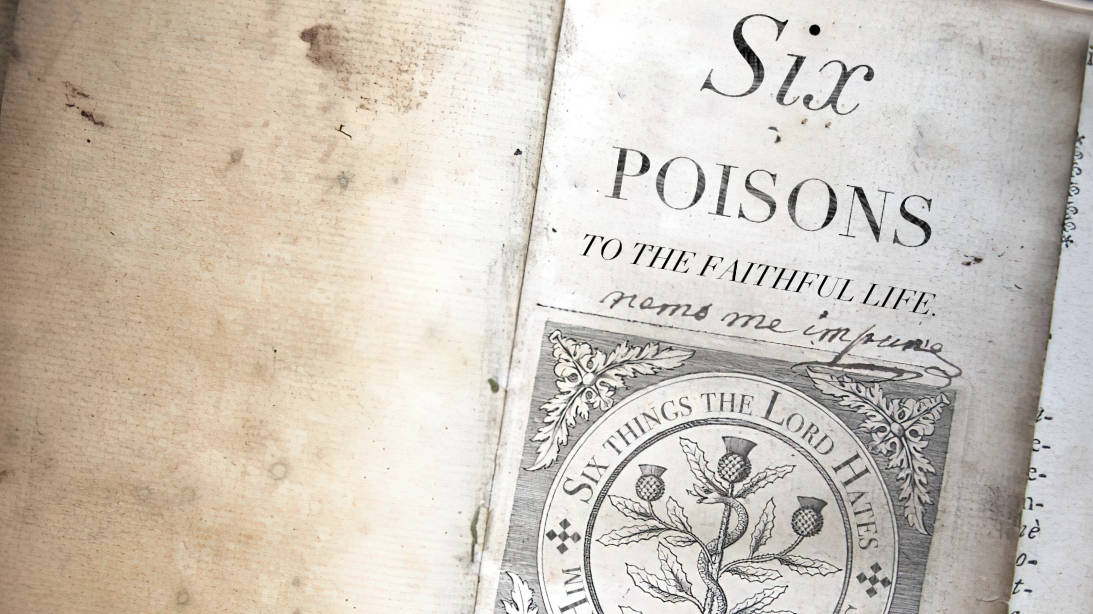
As Pastor Tim begins our new series on the six poisons listed in Proverbs 6:16-19, we turn to one that often leads to the others: pride.
The following study questions and transcript are AI generated and may contain errors.
The following study questions and transcript are AI generated and may contain errors.
Father, thank you for your goodness and your love. Thank you for being with us even when we fall short, especially when we fall short, even as we always fall short. Lord, as we think about things that you hate, things that poison us spiritually, things that turn our focus away from you, would you help us to flee them, to see where those poisons are in our lives, to turn to you for the cure, for the help that we can only receive from you? Lord, would you guide us tonight as we begin this series? We pray in Jesus’ name. Amen.
Well, we’re beginning tonight with pride. It’s the first in the list of the six things, no seven, that the Lord hates that we’re going to look at in a moment in Proverbs 6. And it’s a fitting one to start with. I think it’s not accidental that it’s first because so often when we look at the history of the world and when we look at our own lives, I’d say probably most of the time when we fall into sin, pride is lurking there no matter what we do, because we elevate ourselves. We think we’re more important than we are. We think we’re entitled to things. We think we can get away with things. We think we need to know more than we do. All these different ways that pride chips away at our guardrails that keep us from sin.
And so we should start with pride. And as we do, I was looking for the perfect illustration to open up with, an illustration of someone doing something really dumb, really just stupid, that was prideful. There’s a problem with that, though. If we go and we read about someone doing something really stupid, if we see a video of someone doing something really stupid, why do we enjoy it? Well, sometimes it’s just really funny. Sometimes all of us, including the person who did it, can all sit there and laugh at it. But a lot of times, at least part of the reason, even if we don’t want to admit it, is we see this person doing something really stupid and we think, I am so glad I’m not that person. I’m not that dumb. I might be dumb. I may have done a lot of stupid things in my life, but I haven’t done that, or I haven’t done that recently, at least. I’m so glad I’m not that idiot, that stupid, stupid person.
And so here’s the challenge. As I started to look at illustrations, I thought, as I prepare an illustration of someone’s pridefulness as they did these stupid things, the challenge is how do I do that without coming at it myself and thinking, oh, look at that stupid person. See, pride creeps in really quickly. That in itself shows the danger, the toxicity of pride. And so as we begin this series and we read about what the Lord hates, we start with pride because pride slips into everything we do.
Let’s go ahead and look at Proverbs chapter 6, where we see this list of the things that the Lord hates and that he calls us away from. It says, “There are six things that the Lord hates, seven that are an abomination to him: haughty eyes, a lying tongue, hands that shed innocent blood, a heart that devises wicked plans, feet that make haste to run to evil, a false witness who breathes out lies, and one who sows discord among brothers.”
The first one there is haughty eyes, and we might say, well, what are haughty eyes? Well, they’re eyes that look down at other people. In other words, they’re prideful eyes. We see the phrase there translated haughty eyes throughout scripture talking about prideful actions, sometimes in the eyes, sometimes in the hands, where we raise up a high hand against other people. But the thing that it boils down to is when we take ourselves and we elevate ourselves at the expense of others, we have pride.
I hardly even need to turn to the scripture, although we are going to, for all of you to be able to complete this. I think all of us could fill in this phrase: pride goeth before the fall. We see that in Proverbs chapter 16: “Pride goes before destruction, and a haughty spirit before the fall.” Throughout scripture, we see time and again that pride is the thing that often leads us into a false sense of security, a place where we set ourselves up to do things that are displeasing to God and damaging to ourselves. Pride gives us an overconfidence in ourselves.
We live in a society that is all about building up self-confidence and to an extent that might be a good thing, but too often we’re way over self-confident. We think of ourselves as too good. We think of ourselves as too capable. And as we build ourselves up and we focus on that, and we make sure to give ourselves plenty of me time and me encouragement, and we’re focusing on me, me, me, what happens? We start to feel very prideful. We look at other people and we say, those other people, they aren’t as good as I am. They aren’t as important as I am.
Maybe we won’t say that directly. We don’t just beat up on other people, at least verbally most of the time, because we know it sounds bad, but it’s the things that play in our heads, those ways that we start to think, well, at least I don’t do that. At least I have that figured out. At least I’d never say anything that backward. At least I would know the answer to that question. All these different things we do.
I’m entitled because I’m a little better than the other person. And that starts to spill out as that plays in our head. Sometimes it spills out in the way that we talk about other people when they’re not around. It leads us to gossip because those people have it coming to them anyway. Sometimes it leads us to actually even say something while they’re there that would put them down because it doesn’t even seem like we’re putting them down anymore. It’s just obvious because we’re better.
That’s what happens to the disciple Peter at the Last Supper. Take a look at Mark 14. Jesus is talking to them at the supper and he says, “You will all fall away, for it is written, ‘I will strike the shepherd and the sheep will be scattered.’ But after I am raised up, I will go before you to Galilee.” And Peter said to him, “Even though they all fall away, I will not.”
Peter says, “You know those other disciples? Yeah, we know they’re idiots. They’re always getting things wrong, Jesus. I’m not going to do that, though. I won’t fall away.” Of course, we know how that story goes, right? Peter ends up being the disciple who falls the farthest outside of Judas. He actually denies Jesus, swearing oaths that he doesn’t know who Jesus is. The others go away in the night. Peter has to confront very directly this pride. And it’s a pride that I don’t think Peter is in the moment really thinking, “Oh, I am really putting down these other disciples.” It’s just obvious. He’s the enthusiastic one. He’s the one that’s going to follow Jesus to the death.
What does he do? Well, he puts himself in a place where he’s going to fall and fall mightily. God knows that we can’t do it on our own. And he calls us not to focus so much on ourselves and make ourselves so important. And yet we do time and time again. We do it when we’re preparing things, just like those slides that just popped up that I didn’t intend to have pop up. And I get very confident, I get everything polished and then it doesn’t work. What happens? Pride goes before the fall.
And what happens is we start to look down on other people and how and how they’re prideful. And then we start to look down on them for their pride and we become prideful about that. We look pridefully at them when we think that we’re following the Lord more faithfully. And as we do that, ironically, it can even turn us against God. We become so prideful in ourselves, we forget our need for him. We forget our place in the universe.
We think back to Genesis and the Tower of Babel. What happens? The people think, “Well, we will just build up a tower and exalt ourselves to the heavens. We don’t need God.” We see great kings throughout the Old Testament come to their ruin because of pride. Nebuchadnezzar, Sennacherib. We see David, the man after God’s own heart, as he becomes full of himself, committing terrible sins because he became prideful.
So what does Christianity call us to do? It calls us to the opposite of pride. It calls us to focus on the Lord and his mercy instead. But what do we do when we accept Jesus and we start to follow in the Christian life? Well, we start to create new categories to allow us to be prideful about ourselves. We start to create new categories to allow us to once again feel prideful because we don’t want to stay in that spot where we realize that we are those who are inadequate, who are in desperate need of God showing his mercy, and that we’re just on a level playing field with everyone else in that regard.
Whether it’s becoming very prideful of having better theology, or knowing the scriptures better, or going to the most popular church, or going to the least popular church, or going to contemporary worship, or whatever it might be, we create categories that allow us to look down once again on other people. I think this is only accelerated in the era of social media when we can go ahead and have hashtags promoting our favorite causes even within the church and look down on those people that don’t want to retweet that or share it. Look down on people who might have a different emphasis, even a biblical emphasis, than we do because we want to be prideful.
In the moment, it feels like everything is going well when we do that. We build ourselves up and some people go ahead and come along with us on the ride and say, “Yes, you’re so good, you’re so smart, you’re so aware of this situation or that situation.” And it seems like it’s working really well. It seemed in the moment probably to Peter like it was working really well as he built himself up at the expense of the other disciples and said, “Even if all the others fall away, I won’t.” He was probably feeling really, really good in the moment.
What we need to do is ask ourselves, am I looking at other people’s struggles and the weaknesses I perceive in them and using that to build myself up? Or am I focusing on my own weaknesses and struggles as I come before the Lord? Do I follow the example of the Pharisee who goes into the temple and prays, “I am so thankful I’m not like that sinner over there.” Are we the sinner that comes before the Lord humbly and says, “I don’t deserve your mercy, but have mercy on me?”
You see, as we allow that stack of things that elevate us to start to build up, we think, well, I can just add a little more. It’s not really prideful yet. There are a lot of people that are far more prideful than I am. It’s all okay. And for a time, then we feel so good because we’re building up. We’re like Sennacherib going across and conquering the land. And he didn’t even realize that the Lord was using him as an instrument of justice, of God’s judgment, but his own pride would ultimately catch up with him. He kept building up onto it. We keep building up on it. Peter kept building up that stack of pride.
And it reminds me of, if you’ve ever tried to carry a bunch of books, I’ve been a number of times, I’ll be at a store that has bargain books, or I’ll be at one of the academic libraries that has a, like a free bookshelf, and you can just take as many books as you want for free. And I start finding good books and you start building up this pile of books. And you think, well, I can carry one more and one more. And the thing is, if you get some books that have nice, glossy hardcovers, what happens? You start to try and you’re trying to carry it and you think, I can carry it. I don’t need to ask anyone for help carrying these books. And then you start to see it’s like, oh wow, I did a really good clunk. It all collapses to the ground.
That’s what pride does to us. What do we end up with? We end up with books that have damaged covers. We’re carrying a box and we do that and we end up with broken Christmas ornaments or broken things that we were depending on for our office or any number of different examples. We’ve all probably done that where we’ve carried too much stuff. We carry too much stuff when it comes to pride too. We build ourselves up and up and then we ultimately fall.
We see that in Isaiah chapter 2. It says, “The haughty looks of man shall be brought low, and the lofty pride of men shall be humbled, and the Lord alone will be exalted in that day. For the Lord of hosts has a day against all that is proud and lofty, against all that is lifted up, and it shall be brought low, against all the cedars of Lebanon lofty and lifted up, and against all the oaks of Bashan, against all the lofty mountains and against all the uplifted hills, against every high tower and against every fortified wall, against all the ships of Tarshish and against all the beautiful craft. And the haughtiness of man shall be humbled and the lofty pride of men shall be brought low, and the Lord alone will be exalted in that day.”
We see a list here of all the high and lifted up things that the people that heard Isaiah’s message could have thought of. The great trees of Lebanon that were so famous for their height, beautiful ships that could sail the sea at a time when, like most times actually, Israel never had a very successful bout at sea. It just didn’t work well for them, and so these grand ships that could sail the oceans would look so high and lifted up, high towers and people who were prideful. But what are we told? All of them are going to fall. All of them that are listed there have fallen or will fall. They may rise back up and then fall again.
And yet we think, well maybe this time is the time I can put one more book on that stack, one more box in my arms, and it won’t fall. Maybe this time I can just go ahead and build up my ego because I need to feel important. And it’s just true, right? Take a look at this calf here. He says, “There’s a big party tonight. The master’s lost son has returned home,” and he specifically requested for the fattest calf to be there.
Now if you know the story of the prodigal son, of course the fat and calf is going to be prepared for dinner. But here he’s just like we are so often. We think I am really important and we allow those half-truths, “Oh, they want me over there. I must be really important,” to cause us to be blind to the coming danger. It’s sort of a silly example and yet it really does strike exactly where we are going to fall.
And so we need an antidote and antidote rather and not an anecdote. That was an anecdote. But we need an antidote. We need something to cure us. We need humility. What happens when we come to the Lord with humility? It takes away that poison of pride and starts to restore us.
That famous passage about pride going before the fall? Well if we turn to the next part of Proverbs 16, we see that this antidote is described as the very next part. The author of Proverbs writes, “It is better to be of a lowly spirit with the poor than to divide the spoil with the proud.”
Pride doesn’t just go before we fall, but if we have a lowly spirit, if we come as those who are the very lowest, the very poorest, the very example of those who are on the ground who have no reason to be lofty, no reason to think that their own power can do anything, that’s when we’re coming and we’re prepared for what the Lord has to do for us.
The very first beatitude in Jesus’s Sermon on the Mount is “Blessed are the poor in spirit, those whose spirits are set like someone who’s terribly impoverished and can do nothing.”
Because when we have that sort of attitude, when we’re not building ourselves up and thinking how important am I but we see that we have nothing to give, then our even our good actions start to take on a different meaning. Instead of thinking, wow, I can please God and then he’s going to give me lots of rewards and everyone’s going to praise me and I’m going to be so important, why do we do the things that we do?
We do them because we love God and we look at his mercy and what he’s done for us and we want to respond. Paul says to the Colossians when he describes praying for them that he has been praying for them so as to walk in a manner worthy of the Lord, fully pleasing to him, bearing fruit in every good work and increasing in the knowledge of God. We know God when we know who he is and we’re increasing in that knowledge as we do good works.
Yes, we’re doing them to please him but please him in the sense of coming before him as one who really has no reason to be entitled to come before God and yet we do because he loves us.
In a Bible study a number of weeks ago, we had a discussion about whether it’s okay to take pride in our work, in the things that God has enabled us to do, and the answer is if it’s the sense in which we’re so excited to share with God how we’ve gotten to use the talents he’s given us, we just want to share it, we have joy in doing what God has made us to do, then that’s a good thing. That’s doing things to please God.
The danger is when we think, wow, I am so talented, I am so gifted, aren’t I wonderful? That’s when it becomes a deadly poisonous sort of pride.
What’s the object? What’s the reason I’m doing what I’m doing?
Just over a week ago we had Valentine’s Day and I was thinking back to, do you remember in grade school, I guess they still do this, where you’d go and buy the little box of Valentine’s Day cards that you’d break apart? They’re just little postcards basically, and you were required to give everyone in the class one of these cards. And so you’d have these little cards and you’d try to find ones that were interesting or creative or exciting or what have you, but the thing was you had to give it to everybody. And so what did it really become about?
It wasn’t about expressing how much you cared about every single person in the class. The truth is probably none of us actually cared in grade school about every single person in the class in the sense that we wanted to give them a card. We just couldn’t wait.
What was it about? It was about trying to find the card that other people would remember or talk about. It was about in some sense building ourselves up.
And so often when we do good works, we’re ripping out those little postcards and we’re even as we look up to God, we’re trying to hand him one of those postcards that we’re busy handing out to all kinds of people so they’ll take note of our creativity or our humor or whatever it might be.
What are we called to do if you’re going to give a card or a gift to someone that you actually know well, whom you love and care about? You try to find things that aren’t just a box of generic cards. You try to find something that actually expresses the friendship and the background, the stories, the shared experiences that you have with that person.
When we pick out gifts for our family, we try to find things that we know they will like because we know them. Even when we pick out a card, it may have our humor in it, but we’re picking out the aspect of that that relates to them.
And that’s what we’re called to do. We do good works too. We do them not because we want to somehow earn favor, get people to talk about how great we are, but because we love God and we know what he loves.
And that’s when we, his children, use the gifts that he’s given us in a way that’s pleasing to him.
So let us ask this question tonight: Am I elevating myself, or am I elevating Jesus? Elevating myself, or am I elevating Jesus?
That sounds like a simple question but I think so often it isn’t because you see so often we become concerned with, in some sense, doing the things that are pleasing to God, but what we really want is for other people to stand around us and say, “You’re doing such a good job of being faithful.”
We do it because we want to see other people not do quite as good a job.
Have you ever seen someone even serving in church and you look at that person, you want them to not do quite as good a job as you do because you want people to be able to say that you’ve done a better job? Someone that maybe you went to school with and your heart sinks a little when you see that they’re more successful and secretly in our hearts, I think all of our hearts want to see that not happen because we want what we think we really deserve.
In our pride we think we deserve a little more. We deserve a little more praise. We deserve a little more success. We deserve to be the one exception that actually can earn God’s favor.
The one we quit tearing off those Valentine’s cards and instead we come before our God and we simply offer him what he’s given us and we realize that there’s nothing we can do to make things right, but God has made them right, that Jesus is the one who’s made it possible for us to do anything.
Then we realize that it’s about elevating Jesus, that as we do good acts, we’re not doing them so that people will praise us, but people will look to Jesus, the one who has enabled us to do them and praise him.
When we’re doing that, then we’re succeeding at what God has called us to do, which is simply to be his children, to be in his family and to follow Jesus, and as we do that we find over time — it doesn’t happen immediately — but that poison of pride that is in our heart starts to be drawn out little by little.
It doesn’t happen in a moment, and sometimes it feels like we’ve really made a lot of progress on that, and then it comes roaring back because there’s a whole bunch of latent poison still hiding in our system.
But what do we know? Someday, someday Jesus is going to take out the last drop of that poisonous pride in us, and all we’ll have left is that joy in using the gifts that he has given us for his glory.
And in that day we’ll no longer be worried about making sure we get the praise of those around us because it won’t matter. All that will matter is that Jesus loves us and that he is with us.
Let’s go ahead and close in prayer and ask that he would do that in our hearts, that he would help us in this moment to be less prideful and be more focused on him. Will you join me?
Lord, so often that I can become so prideful of the things that I feel like I’m good at, so prideful because I think I have everything just right and then things go wrong. I focus on wanting to somehow earn my place rather than recognizing that you have given it to me and all you want, all you’ve asked me to do, is to use the gifts that you’ve given me.
Come before my heavenly Father with joy, not saying, “Look how great I am,” but, “Look how wonderful the things that you allow me to do are because you love me, because you love me, because you love me.”
Would you help all of us in those places where we’re prideful, where we’d rather see other people do not quite as well as we do, where we’d rather see ourselves be elevated rather than you be elevated?
Would you help us to flee those things? Would you help us to be those who are genuinely humble? Humble in the sense that we know that we come before you totally unworthily, totally deserving of your rejection, that you have instead accepted us because you love us, and would you help us to base our value on that, your love, absolutely nothing else?
We pray in Jesus’ name. Amen.
Well, next week we’re going to pick back up by thinking about deceit. We deceive ourselves in pride, but we also deceive other people. We live in a culture that often expects a certain level of deception, and we see in Proverbs that that is the next poison that we face: the poison of fleeing the honesty and the truth of scripture, fleeing telling other people life-giving truth, and instead being those who speak with deceitful false tongues. So I hope you’ll join me for that.
Again, it’s a very heavy topic, but just like we saw this week, God is with us in these things. God gives us his mercy. He doesn’t leave the poison in us. And so I do hope that you will help spread the word and encourage people to come to that.
In the meantime, we’re going to look at someone who withstood incredible pressure to break and to fall and to be unfaithful in the movie Unbroken on Friday night at 7 p.m. I hope that you’ll join us for a movie watch party. We’ll watch the movie at the same time and then we’ll come together for a video chat discussion where we can all share what we got out of it.
It’s called Unbroken. I know it’s going to be a wonderful, thought-provoking time. And I can’t wait to see you at 7 p.m. on Friday for that, and then of course again next week at 7 p.m. for Steadfast.
Please do share this video, give it a like if you were encouraged by it, and help us to get the word out about the God who gives us the antidote to all the poisons that make us spiritually dead.
If there’s any way I can be praying for you this week or encourage you, feel free to shoot me an email at the email address on screen or leave a prayer request in the comments so we can pray together.
It’s been a joy to be with you. I hope you have a wonderful and blessed week, and I look forward to seeing you again next week.