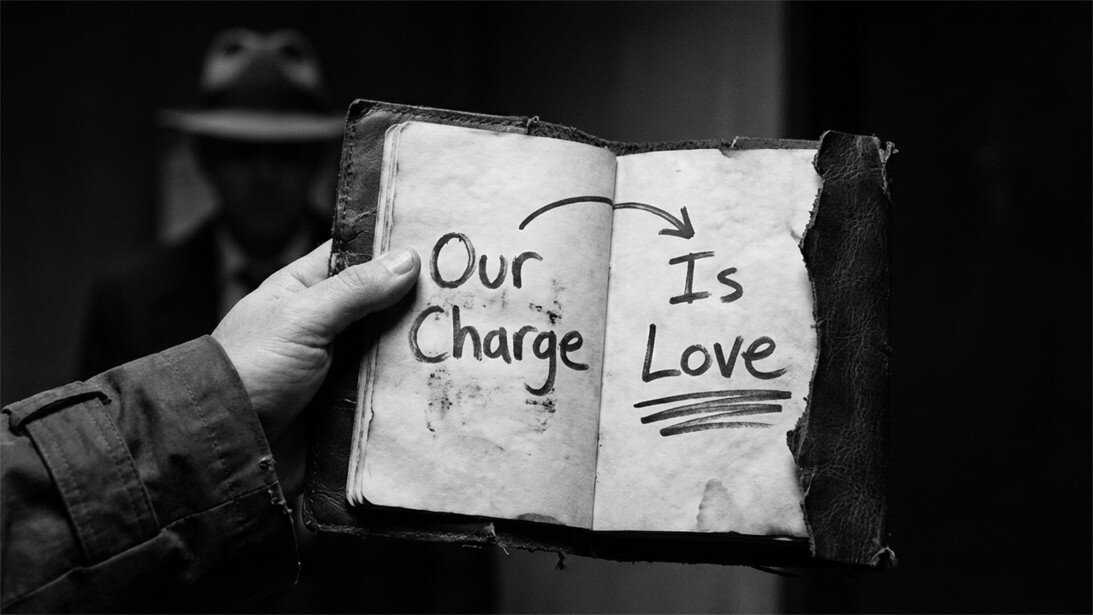
It’s great to know about how amazing Jesus is and wonderful to find out that the angels are incredibly powerful creations He made, too. But, where does that leave us?\n\n\n\nbreak.
\n\n## Study Questions\n\n\n\n_The following study questions are AI generated and may contain errors.\n\n\n\n1. The Milky Way illustration reveals how small we are by any cosmic or historical measure, yet the sermon insists that smallness and significance are not opposites. What does it mean to you personally that God assigns purpose to people who are, by the universe’s scale, barely visible?\n\n2. Paul grounds himself in the command of God and the hope of Christ even as he faces persecution and approaching death. What anchors do you rely on when life’s circumstances threaten to shake your faith, and which truths from 1 Timothy 1:1–2 proved most stabilizing in a difficult season?\n\n3. The sermon describes faith as a “relay” stretching back 2,000 years through sons and daughters in the faith. How does understanding yourself as part of that generational chain change the way you think about your own role in passing the gospel on?\n\n4. Timothy wasn’t Paul’s biological son, but Paul calls him his “genuine child in the faith” and entrusts his mission to him. Who has invested spiritually in your life, and who are you currently investing in? What does that mentoring relationship look like in practice?\n\n5. The sermon contrasts God our Savior with Nero’s claim to be savior of the world. What modern equivalents compete for that role in our lives today, and how do we keep from quietly granting them that power?\n\n6. When the preacher asks “what are we going to do with the charter we have,” he is asking about stewardship of the gospel. How does viewing the Great Commission as something entrusted to you to pass on—rather than something you accomplish for yourself—change your approach to faith and evangelism?\n\n\n\n## Transcript\n\n\n\nThis transcript has been automatically generated and may contain errors._\n\n\n\nHow significant is your life? How significant is my life? That’s the sort of question we like to ask ourselves at times, and for good reason. We want to know their significance to what we’re doing. Hi, welcome to Steadfast. I am so glad that you’re here tonight as we’re going to be diving into 1 Timothy chapter 1 together over the coming weeks with this new series, Our Charge is Love.\n\nI found myself asking that question about significance last week when I saw a video. Someone ingeniously decided to size up the Milky Way Galaxy and give us a sense of scale. And so the question was, what would it be like if the Milky Way Galaxy were sized the size of North America? Something that we kind of understand, right? We get a sense of how the states are spread out across the continent and our fellow countries, Canada and Mexico, we get a sense of that. So North America is huge, but we understand the vastness of it.\n\nWell, if North America were the actual size of the Milky Way, what would everything inside the Milky Way be like? What would be the massive thing we call the sun be like? And that’s where the video went. It starts zooming in on the North American-sized Milky Way. And then it’s suddenly showing a city. And it keeps going, looking for the sun. And it keeps going, and it comes down to a neighborhood. And you can see the houses. It keeps going to a park. And you can see a park bench. And you think, how much further do we need to go here? And then it zooms in, and you see the food on the picnic table by the picnic bench. And you say, oh, okay, it’s going to be, you know, a barbecue burger size or something. And then it keeps going, and you see a little bitty fly getting ready to attack the picnic food. Well, now we’ve hit it. No, we go even smaller than that, and there’s this little bitty thing dwarfed by what now looks like a mutant giant fly. That’s the sun, the biggest thing in our solar system, the thing that looks so huge and provides us light all the time. How much smaller is the Earth, then? And you see something like that that just speaks to one aspect of the scale of our position in life and in the universe. Just one little glimpse of that.\n\nWe can also go other directions, like, how do we fit into the scope of human history, for example? And we realize that there’s an awful lot of insignificance in there. But we like to think of our own little moment. We want to think there’s something to it. And the good news is, Scripture says there is something to it. But the key thing, the important thing, is that we actually pay attention to the right stuff, that we understand what really is there, rather than the stuff that we often focus on that isn’t God’s priority. Because when we’re focused on what God says is important, suddenly we’re not just a little bitty subatomic particle on a little microscopic thing next to itty-bitty, almost invisible to the human eye, sun. No, we actually are those who have meaning because our God has called us to do something.\n\nSo that’s what we’re going to be thinking about tonight. Let’s pray and ask God to help us to understand that, and then we’ll dive in. Let’s pray.\n\nFather, thank you for this evening. I want to thank you for everyone who’s here, and the chance we have to start a brand new series, to dig into 1 Timothy 1. As we do, and we think about what it is that you’ve called us to be and to do, would you help us to understand more truly and fully, and be ready to go and do the significant things you’ve called us to do? We pray this in Jesus’ precious name. Amen.\n\nHey, as we begin tonight, would you hit that like button, hit that share button, hit the subscribe button to our channel, do all those social media things, because as you do, help someone else who’s looking for significance find a place where we’re going to explore that together, and explore that together in the most important way we possibly can, by going into God’s Word. Thank you so much for doing that.\n\nWe’re going to look, just for starters, at just verse 1 of 1 Timothy 1, if you want to turn there. We see Paul writes, “…from Paul, an apostle of Christ Jesus, by the command of God our Savior, and of Christ Jesus our hope.” The sort of verse that we just go speeding over oftentimes, because we know, if we’ve read the Bible for a while, that Paul starts letters like this. This is a traditional epistle. And, in fact, it wasn’t even unique to Paul or epistles in the Bible, letters in the Bible, that is. It was the way in the ancient world you wrote a letter. So we just go speeding on.\n\nBut there’s several things we want to note in how Paul talks about who he is and what he’s doing here that deserve attention, that we shouldn’t just go speeding by this. And the first one, I think, that we really want to note, and the key to this, and it speaks to how we understand our own key as well, is that Paul isn’t just a person writing a letter. He’s a person sent with a purpose. He’s a person sent to proclaim the gospel. He’s an apostle.\n\nNow, that’s Paul, and we’ll get to the moment how that has anything to do with us understanding our own purpose. But the starting point is, Paul has a purpose. God has sent him, and God has sent him not just to go visit people, not just to administer the church, but specifically to go and communicate the gospel to people, to point to Jesus, to bring people who hadn’t yet heard into a situation where the Holy Spirit would work and transform them and make them part of the body of Christ, to do that. That is what Paul’s purpose was. That made him an apostle.\n\nAnd in a sense, then, we’re also talking about something very unique here, because Paul isn’t just sent because he felt like he had warm fuzzies for the gospel. No, Paul says here, it’s by command. He was commanded to go do this. And if you know the story of Paul, you know this. Paul isn’t trying to go preach the gospel. In fact, he’s trying to persecute the people of the church. And he has that Damascus Road experience, where Jesus blinds him and sends him into a home of a believer, so someone who is Paul’s enemy at the time, sends Paul into that home, and Paul is transformed. He goes from being a persecutor of the church to the apostle to the Gentiles. Amazing transformation, and one that he knows here by saying that he is by the command of God doing this.\n\nHe didn’t do it by his own volition at all. God said, this is what you’re going to do. And Paul, recognizing that God was working, does say, okay, this is what I’m going to do. And if you were knocked to the ground while traveling, and blinded, and had the voice of God speaking to you, yeah, you would probably take that pretty seriously. But notably, Paul brings that up. He establishes several things that are really important for later in the chapter that we’ll talk about. He establishes that what Paul says is authoritative. It’s not just the musings of a first century man, but rather someone sent by God to communicate this stuff. So it affects how he deals with those who are trying to preach a different gospel, and how we should interact with him today. And so that’s important. We’re going to leave that for another week, but it’s something to keep in mind.\n\nBut it also is what grounds him in everything he’s going to face. Because this is not a promotion, so to speak, for Paul. When Paul was off doing his persecuting of the church, you know what? He was a more important man, by earthly standards. A more admired man. And when we talk about being admired and important, what do we really have our eyes on is, do I have ease, do I have power, do I have success? And Paul had those things.\n\nBy rejecting that life, and actually doing a 180, suddenly preaching the gospel, Paul goes from having those things to not having those things. So it’s not an easy transformation. We know, we just looked at Acts 13 and 14 on Sunday nights, that oftentimes, going and preaching the gospel brought what? Persecution. Rejection. Sometimes it was not just mild persecution, a few insults, someone saying, oh, that’s stupid, Paul, not that kind of thing, but we’d like to take you out and introduce you to some big rocks and see how your head does with them. Literal stoning. Literal threats to life. And of course, most of the apostles ultimately face death. So you really need to be grounded in something.\n\nWhat is it that Paul’s grounded in? Well, notice here what he says as he goes on to the end of verse 1. Of Christ Jesus, our hope. And our hope is a phrase that’s unique here for Paul. He uses the hope of glory in phrases like that. But here, Paul just says, our hope. I think this is a picture of older Paul, more reflective Paul, Paul approaching the end of his life. What it really comes down to is not how much glory is he going to experience, not that it’s bad to speak of the glorification of believers, not even the technical theological transformation that occurs, but the bare, simple, haunting question, what’s going to happen to me? What do I stake my life on as it is getting nearer to the end than the beginning?\n\nAnd Paul says, I have just simply my hope. And by the way, Timothy, it’s your hope, too. It’s our hope. And it’s Jesus. Full stop. I think if we’re really trying to understand how he’s grounding himself here, this is absolutely key to that. Now, we don’t know everything I just said. Paul doesn’t explain why he uses this much simpler phrase here, but I kind of think that has something to do with it. Because the whole letter is about Paul passing on something to Timothy, instructing Timothy as Timothy is going to go and do the work that Paul’s been doing. And it is nearing the time when Paul will lose his life and be in glory. He will be with Jesus, but he’s not going to be in this earthly realm any longer. He’s going to die. And for us, no matter how strong our faith might be at times, that’s an intimidating thing. We don’t know how to understand it. It’s no wonder that those words as Hamlet speaks of the undiscovered country in his famous soliloquy, that sticks with us, because it is the undiscovered country. We don’t know what it’s like. What’s our hope? How do we face it and do what God has called us to do? We trust, and we trust in Him.\n\nNow also, and this is I believe crucial, it’s not just that Paul is making this point, but he’s also making this point in contrast to what the world says. And if you look here, just a little bit further back in verse 1, not only is Christ Jesus our hope, but he says that he’s doing this by the command of God our Savior. And that God our Savior phrase is another unusual phrase, and so it stands out. How is Paul speaking differently in these last instructive letters to his, as he calls him, his son in the faith, Timothy, than he normally speaks? Why say God our Savior? That does sound a little different, right? We’re used to our Savior Jesus Christ, that kind of phrasing, and of course Jesus is God, but why this particular phrase?\n\nAnd it’s thought, again, we can’t prove this. There’s a lot of questions on exactly everything that was behind the motives, but I think there’s something to this. The world was offering a different answer. The emperor Nero had it put out, and he wanted everyone to say that Nero is the Savior of the world. Now of course we know Nero was a very wicked man, and we know the stories about him doing awful things to Christians and people in general. But what he wanted to be is someone who was seen as the Savior of the world, that he was the great hope of the world as the emperor, the Savior of the world.\n\nPaul says, not so fast. There is a Savior, but our Savior is God, not Nero. Our Savior is God, not whatever you and I put our trust in today, or whomever says we should put our trust in him or her today. We have a lot of things today that try to claim to be our Savior, but this is where we need to ground ourselves. And notably, for one, it’s true, and for two, it allows us to endure as we follow our God. And you might say, well, if I’m following Jesus, then I already get the Savior thing. And yet, how often do we as Christians still live as if there are other Saviors? And I’m sure there were some people at that time who wanted to curry favor with Nero, who even wanted worldly success. They said, okay, well, maybe Nero is the Savior of the world, and God is the Savior of heaven or something. But no. You’re looking for a Savior. There’s one Savior, and it’s Jesus. Full stop.\n\nOur hope, our Savior. And so Paul is setting this all up so that we understand what we need to be anchored to. And being anchored is so crucial, because the winds of life blow constantly. It sort of feels like the winds around here lately. It’s constantly blowing, doesn’t it? Be interesting in the chat. Wherever you’re watching from tonight, has it been really windy the last few months? Maybe even the last year? Does it kind of drive you crazy at this point? I feel like here in Missouri it’s way windier than normal. And I haven’t gone and looked at the weather data to see if my sense is correct, but it just feels like it’s constantly windy. There’s always a howling wind, or things getting blown down, or what have you. And certainly that getting blown down, getting blown off part is a part of it, right? When it’s blowing really hard, when there’s all kinds of wind, what do we see? We see the things that aren’t anchored properly.\n\nMaybe it’s some decoration in the yard that comes tumbling over because it was strong enough to stay up as long as everything’s still, but not when it’s blowing. Maybe it’s a siding on your house. You lose a piece of it, and it goes blowing off. Maybe it’s something that wasn’t attached properly, or shingles, or whatever it might be, right? We get the sense when the wind’s blowing, what’s really attached, and what isn’t. And here’s the truth about our lives. We’re going to have winds blow against us, and the question is, are we attached or not? And here, as Paul is writing Timothy and setting him up to go do more ministry, and certainly as Timothy is going to continue that into the next generation, it’s all the more crucial because Timothy is going to feel the winds of opposition clearly. Whenever we’re doing what God’s called us to do, we’re going to feel those winds, and the question is, are we anchored properly or not? Because it’s going to show our weaknesses.\n\nAnd if we’re trusting in saviors of the world that are worldly, if we’re putting our hope in the things of the world, those things are going to blow away maybe today, maybe tomorrow, maybe a few decades from now, whenever it is that death stares us down. But we are going to feel that wind blowing. Are we anchored or not? That’s what Paul’s writing here in verse 1. All that packed in there, a lot packed into that greeting. And I say, well, that’s easy enough for Paul because of exactly what he says in verse 1. Let’s just mention again, what does he say? He says he’s by the command of God our Savior. That’s a pretty good thing to ground yourself in, right? If God goes and tells you audibly and completely disrupts what you were doing and says, this is what you’re going to do now, that’s a pretty good thing to anchor in. Wouldn’t it be nice if we had that? Well, yeah, it definitely would. We don’t all have Damascus Road experiences. And while I’m sure it was terrifying in the moment, I think most of us would say, but I’d really like to have that, because I know exactly what I was doing. I know exactly where God wants me.\n\nAnd since we don’t have that, well, everything we’ve just been talking about, is it not relevant? Sure, that was great for Paul. Good for you, Paul! I wish it were true for me. But it’s not quite like that. As you see here, if we go on to verse 2, Paul passes on the charge. Take a look at verse 2. To Timothy, my genuine child in the faith, grace, mercy and peace from God the Father, in Christ Jesus our Lord.\n\nPaul says, you’re going to be the next generation that carries us on. You are my genuine child in the faith. This piece that I have, because I’ve been anchored, is a piece I give to you, I greet you in, because it’s yours, too. You see, yes, Paul had the confidence of experiencing that, but now it was Paul’s job to give Timothy a Damascus Road experience, not blind him and completely knock him off of his route and say, you know, now you’ll never forget me. No, but to take the confidence that he had, the charge he had, and say, okay, now this is something I am going to give to you. I want to refresh you with the gospel. So Paul’s going to do it. Timothy’s not new to the ministry at this point. He’s been working with Paul. He’s done all kinds of things. But he’s still going to be going into a new phase as he inherits the mantle, as it were. And Paul’s preparing him for that.\n\nAre we doing that? There’s the question, I think, as we start to think about, well, how do I fit into this? What we see here is we see the beginnings of a beautiful, beautiful chain. First, Timothy is a child of faith. Now, that’s a different phrase, right? But what Paul’s saying is, yes, Timothy is not his actual son. But as the one who’s mentored Timothy, as the one who’s prepared Timothy for ministry, as the one who’s then seen Timothy carrying on the mission that Paul’s been doing, Timothy is his son in the faith. And that’s crucial.\n\nPaul wants to encourage Timothy. He loves Timothy. And he wants to see Timothy take what he has and go on with it. And so faithfulness to the command that Paul received is faithfulness by passing it on. It wouldn’t be enough to say, well, you know, Timothy’s not really my son, and I have this special command. I’m going to hold on to it for as long as I can. And then when I die, everyone will say, boy, it sure was nice when Paul was around. Paul wants people to see Timothy is continuing that mission as the inheritor of that command. He wants people to see that, so that that refreshment brews just like you can hear my coffee pot decide to turn on. And I can already imagine the refreshment that’s coming when I get that nice, hot, fresh cup of coffee. I love the sound of a coffee maker, don’t you? It just sounds so good. It says something good is coming up.\n\nAnd what Paul’s saying here to Timothy is, no, it’s not going to be easy, but there’s something good brewing. God is working through you, and I want you to know that this command I have is a command that you continue to carry. And in that sense, if we really think about it, we hear, for those of us who are Protestant, we don’t usually talk about apostolic succession, where the apostles passed on leadership, what we usually associate with how you get bishops and archbishops and cardinals and popes and that sort of thing. But in a very real sense, there is an apostolic succession every time the apostle passed on to someone else the gospel and encouraged that person, passed on the mission that God gave, and that person passed it on to someone else and someone else. And some of them might be the big names that we know or the somewhat well-known names that say someone who’s Catholic and then studies the saints, the figures given the title saint, those figures that are at least somewhat more notable, or maybe some of the more obscure ones, keeps working their way down.\n\nBut apostolic succession is also when you and I are here as beneficiaries of the apostles passing on the teaching of Jesus. They were sent. They communicated that truth to other people, communicated it to other people. And it’s only because of that that you and I are here studying God’s word tonight. There is an apostolic succession. And in that, we see an inheritance, right? We see a family tree, as it were. Timothy, as the son in faith to Paul, passes on to his own sons and daughters in the faith the truth. And on and on and on the story goes for the last 2,000 years until we find ourselves sons and daughters of others in the faith as God works.\n\nIt gives us a little bit of the perspective of how we fit into things. When we’re talking on the scale of hundreds or thousands of years, it sort of boggles the mind at times. I find myself reading a lot of the history of the Hudson Bay Company a few months ago when the company was being liquidated. The oldest company in North America founded in the 17th century, chartered by the King of England to go into that undiscovered territory of Canada and look for furs.\n\nAnd over time, it kept that royal charter and eventually turned into a department store company. Quite a bit different than what the original Hudson Bay Company looked like, perhaps. But the people running it held on to that charter. And they used the royal seal. They were aware of the fact that they had a lineage. It wasn’t just, well, did they have department stores and malls back in the 17th century? Of course not. And yet they still understood that they were part of something that had been passed on and on and on. And it caused a lot of people to reflect their interest in history when suddenly it came to a hard stop. Boom. Some people hadn’t taken that charge seriously enough in the right ways so that it would continue.\n\nAnd so last year, this thing that had been there for longer than any of us, longer than the United States, ceased to exist. And its charter and its seal were put up for auction for whomever wanted to buy it. And a lot of the items associated with that hundreds of years worth of history were bought by a company called Canadian Tire, a discount retailer. You think, wow, that’s kind of weird, isn’t it? What a shame.\n\nHow much more a shame is it if we don’t take serious the charge we have? Because we have a royal charter as well, given by the Messiah, the ultimate king. And it’s been passed down not for three or four hundred years, not even five hundred years, not six hundred or a thousand years, but thousands of years now, God has been relaying this through his people, commanding us to go and to represent to the world his love and his redemption. And so, what are we going to do with the charter we have? Are we ready to pour the coffee and pass it on to another generation? Because we’re with a much older organization and its history is much more important.\n\nIt’s not about meeting prophets or even making memories shopping. It’s about transforming lives and seeing people actually experiencing hope. And our charge, just like Timothy’s, actually comes from the command of God. We don’t have that Damascus Road experience, but someone has passed it on to you. Someone has passed it on to me. And as part of that, the implication is we have a duty to pass it on as well. We shouldn’t let the family tree branch die. We want to pass it on that more would know him. Because we’re not talking about a department store. We’re not talking about just keeping the siding on the house. We’re talking about anchoring ourselves in the hope of Jesus and then seeing other people anchored, too, so they aren’t blown over by the winds of life.\n\nWhat does that say about us and our significance? An itty-bitty speck in an itty-bitty speck? Well, we know every single soul that God has made, he loves. The God of the universe, the one who’s bigger than the Milky Way itself and everything else out there cares about all those little specks. And in his plan, he’s placed you, he’s placed me to carry part of that tree on, that relay, that beautiful relay of faith, of sons and daughters in faith that go from generation to generation helping more people to have hope.\n\nNow, it’s important that we understand and feel a little dwarf, just like we do when we think about a company a few hundred years old. But that shouldn’t lead us to say, well, I don’t have anything significant to offer anyway, but rather why am I so focused on my little speck when I have the opportunity and the calling to recognize one, the beauty of what God’s done so that my little speck actually gets the hope of redemption, but then that my little speck can go and do a mission far greater than my little speck of time would suggest. Hundreds of years from now, thousands of years from now, however long until the Lord returns, as we share the gospel, as we communicate his hope, we’re on a mission by the command of God. There’s a significance and a purpose to that. It’s there today for you, and it’s there today for me.\n\nLet’s pray that we would understand that and proceed with it. Would you pray with me, please?\n\nFather, we do thank you for your mission that you have given us. Lord, we don’t want to just think about brewing coffee. We don’t want to just brew the coffee and let it sit in the pot. We want to pour a hot, delightful cup of coffee for people in need of it, and then teach them how to make coffee for more. We want people to see that faith is so much better than coffee, so much better than a company that lasts hundreds of years, so much better than well-attached sidings, so much better than anything, so much bigger than a galaxy. It keeps being passed on and on and on. And would you, Lord, help us to see those people that you’ve placed in our lives, who are our Timothys, that you don’t want us just to hold on to this blessing that you’ve given us, but you want us to pass it on. Help us to understand that and to do it.\n\nAnd for some of us, maybe we’re more in the Timothy stage of life. We’re just receiving. We haven’t yet gotten to the point to pass it on. And for us, would you help us to be in awe and wonder at what you’re doing and to hold on to that so that as soon as you give us the opportunity, we would anxiously and joyfully pass it on to others as well. We pray these things in Jesus’ precious name. Amen.\n\nSo how do you experience the significance? If you haven’t yet trusted in Jesus, you start by believing in him. And if you’d like someone to pray with you tonight, I’d love to pray with you, our whole online family in the chat. Just jump into the chat. We’d love to pray with you. Or you can text the number you see on screen, 833-356-4032. That’s 833-356-4032. And as you write in, as you chat in on the chat, we can pray for each other, and you’re significant. If you think, well, I don’t have any significance, well, by most measures, none of us do. But God loves you. And so as you trust in him, you get to experience that he takes the insignificant and puts all of us into a beautiful relay. Beautiful, beautiful tapestry of significance. Don’t wait. Do that right now.\n\nAlso, if there’s any way I can be encouragement to you, use that same number, 833-356-4032. Just write in. Love to answer any questions, whatever it might be. And may I remind you that we do have our new series on Sunday nights as well, going through Isaiah, and it’s going to, I think, really be encouraging to us over this late winter and early spring ahead. And so please do make plans. Come and join us, 5:30 p.m. on Sunday. We meet in person in St. Charles, Missouri, and of course online as well. So however you can, please do join us. It’s 5:30 central time. I’ll see you then, and I’ll look forward to seeing you back here next week. Have a wonderful and blessed week.\n\n\n\n\n\n\n\n\n